TRANSMISSION // 2611.05438v1
Tracing cosmic arcs: HLA-Net uses geometry to shortlist gravitational lens candidates
Source published
A preprint introduces HLA-Net, a training-free image-analysis pipeline that ranks possible gravitational arcs using their shapes and alignment around a galaxy cluster. Tests on Hubble observations of Abell 1689 illustrate candidate filtering, but do not establish detection accuracy or performance across different clusters.
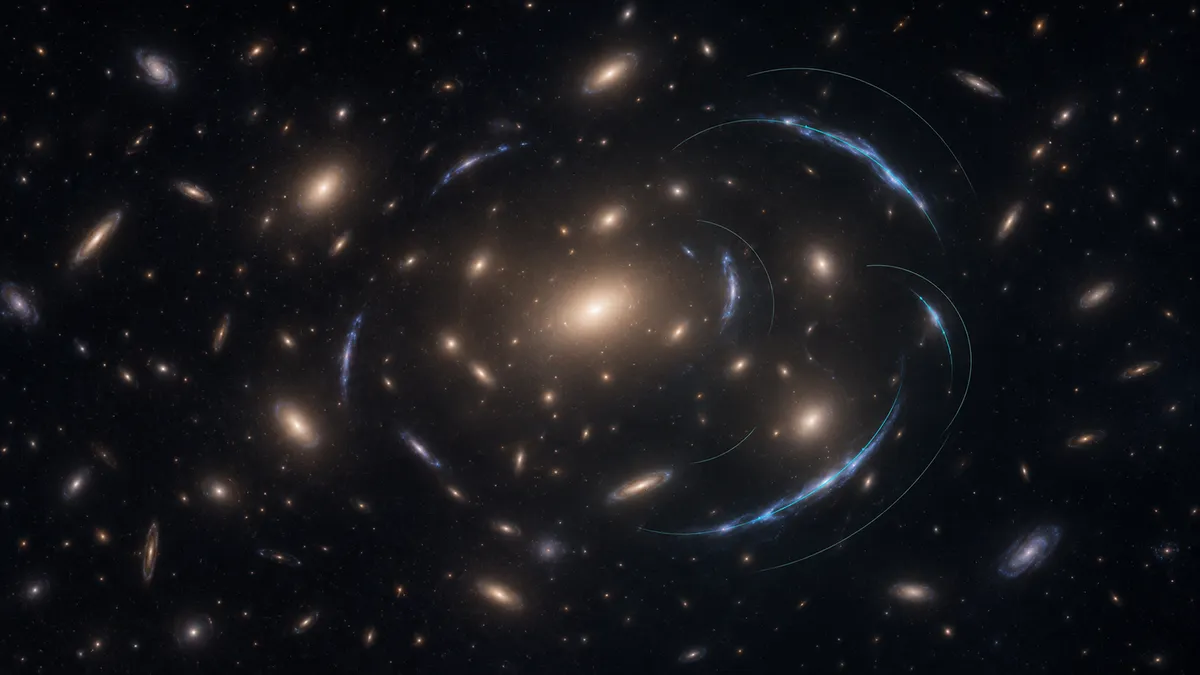
Faint, curved streaks in astronomical images can reveal how a galaxy cluster bends light from more distant galaxies. Distinguishing those gravitational arcs from ordinary elongated objects is difficult. HLA-Net proposes an inspectable, geometry-based screening process, with early results that remain short of a validated lens catalogue.
Looking for bent light
A massive galaxy cluster can bend light from a background galaxy, producing stretched images that appear as arcs. These strong gravitational lensing features help astronomers investigate how mass, including dark matter, is distributed. Finding them is not straightforward: faint arcs can resemble elongated galaxies, overlap other objects or break into disconnected patches in noisy images.
In a preprint submitted to arXiv on 3 November 2026, Don S of Amrita Vishwa Vidyapeetham presents HLA-Net, short for Hybrid Lens Arc Network. The proposed system combines conventional image processing with geometric checks motivated by gravitational lensing. Despite its name, it is not a trained neural network. Its reported implementation uses deterministic image processing and geometric analysis, without manually labelled training examples.
The work describes a way to prioritize candidates for astronomical inspection, rather than establish that every selected feature is a gravitational arc. It is a preprint; the supplied source record does not establish peer review.
Turning a bright streak into a skeleton
HLA-Net starts with astronomical images in FITS format, which stores scientific image data and associated metadata. The pipeline normalizes image intensities, estimates and subtracts background variations, and enhances local contrast. It then applies multi-scale filtering and adaptive thresholding to separate potentially interesting structures from their surroundings.
Next comes skeletonization: reducing an extended object to a thin central trace, described in the paper as one pixel wide. This representation makes it easier to examine the path of an elongated feature without processing its entire bright footprint. Very short skeletons are discarded, and the remaining candidates undergo measurements of shape, orientation and curvature.
The physical guidance enters through a simple expectation. Many cluster-lensing arcs run approximately around the cluster centre, rather than pointing directly toward it. HLA-Net therefore evaluates how nearly a candidate lies perpendicular to the direction connecting it to that centre. It also examines curvature stability and radial consistency—whether the candidate maintains a relatively consistent distance from the centre.
These are screening criteria, not a complete reconstruction of the gravitational lens. Combined scores rank objects according to agreement with the chosen geometric expectations. The scores should not be interpreted as independently validated probabilities that the objects are genuine lenses.
What the experiment reports
The reported evaluation uses publicly available Hubble Space Telescope observations of the galaxy cluster Abell 1689. The field contains lensing features alongside galaxies, stars and imaging artifacts, offering a crowded setting for testing candidate selection.
The abstract reports 169 initial candidates and a reduction to 83 geometrically consistent candidates. It separately reports successful circle fitting for 113 candidate structures. These numbers describe processing outcomes, not confirmed lens discoveries. They also should not be treated as a fully documented sequence of nested filtering steps: the paper does not clearly reconcile all three counts in its results discussion.
The ranking examples illustrate why multiple checks matter. An object with particularly strong tangential alignment does not necessarily lead the final list, because radial consistency and other shape measurements also contribute. Candidate 120 receives the highest reported final confidence score. That designation reflects the pipeline’s ranking, not independent astrophysical confirmation.
Crucially, the evaluation emphasizes candidate reduction, geometric consistency and qualitative results rather than comparison against a labelled reference set. Reducing the list alone cannot show how many rejected objects were false alarms or how many genuine arcs were lost. The paper therefore does not establish precision, completeness or superiority over competing detectors through a matched quantitative benchmark.
Promise, assumptions and the next test
The approach’s practical attraction is inspectability: astronomers can examine intermediate skeletons and measurements instead of receiving only a final classification. Avoiding network training also removes that particular computational requirement. The paper offers an approximately linear scaling argument for much of the processing, but does not provide measured runtime comparisons demonstrating survey-scale speed.
Several limitations are explicit. Tangential verification assumes an approximate cluster centre is already known. Very faint arcs can fragment during segmentation, weakening their skeleton continuity and scores. Irregular foreground galaxies can still satisfy several geometric checks and survive as false positives.
Evaluation on larger, multi-band datasets and multiple clusters is proposed future work, not a completed result. For now, HLA-Net is best understood as a transparent candidate-screening approach demonstrated on one cluster, with broader reliability and the balance between missed arcs and false alarms still to be established.
- gravitational lensing
- gravitational arcs
- HLA-Net
- astronomical image analysis
- skeletonization
- physics-guided methods
- Abell 1689
- preprint
Related reading
Automatically matched by shared topic keywords. These links do not imply that the sources agree or establish a consensus.