TRANSMISSION // 2611.05435v1
Testing Tomorrow’s Lunar Asteroid Telescopes in Earth’s Harshest Places
Source published
A preprint proposes using observatories in the Atacama, Inner Mongolia, Antarctica and the Sahara to test technologies for future lunar asteroid surveys. The AMAS concept links dust protection, thermal control and autonomous operation to a longer-term Earth–Moon planetary-defence network, but does not demonstrate a working system or verified detection gains.
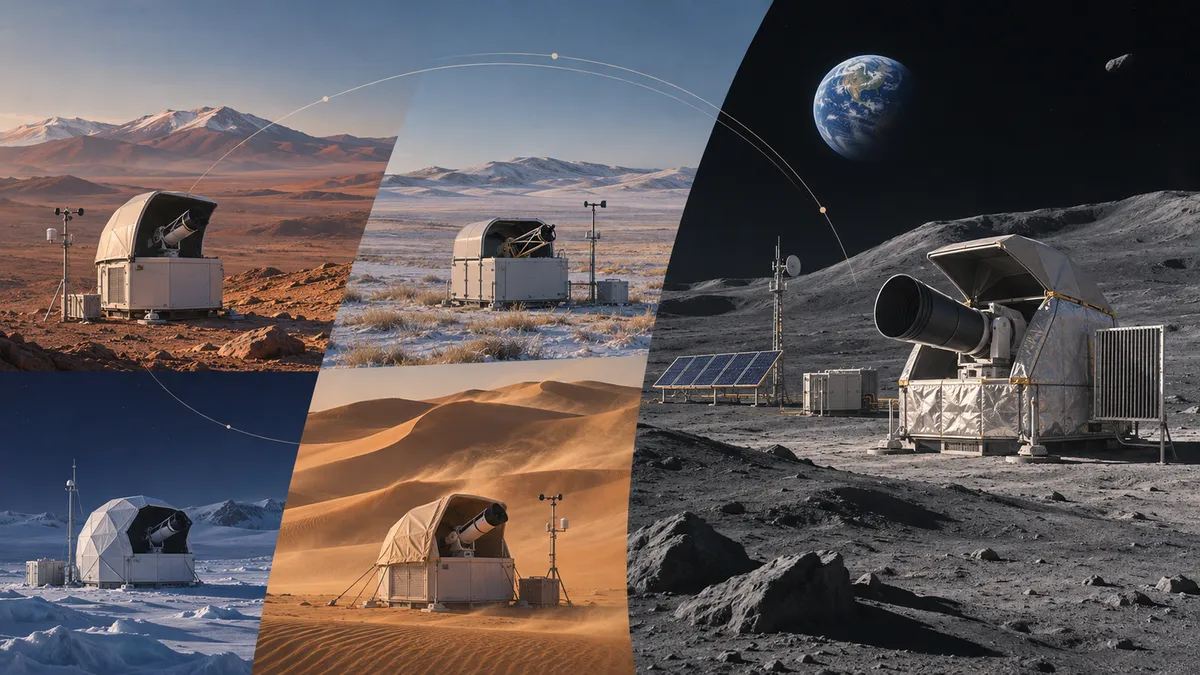
Finding a dangerous asteroid is only part of the challenge; finding it early enough to act is the goal. M. Hadjara and colleagues propose an Earth-first route toward lunar asteroid observatories, using extreme terrestrial environments to test whether their hardware and software could withstand remote, demanding operation.
The problem is not just telescope size
Asteroid surveys must find faint, moving targets across large areas of sky, then observe them repeatedly to establish their paths. Weather, daylight and atmospheric scattering interrupt that work. Objects appearing close to the Sun in the sky are especially difficult to detect from the ground, potentially leaving little time between discovery and a close encounter.
In their preprint, M. Hadjara and colleagues describe a persistent gap between the relatively complete census of kilometre-scale near-Earth asteroids and the much less complete inventory of smaller bodies. They cite Tunguska and Chelyabinsk as reminders that damaging events do not require a giant asteroid. Their central question is how to extend detection and follow-up into difficult observing conditions, rather than simply build a larger general-purpose telescope.
The paper presents an engineering concept and development roadmap. It does not report a completed lunar observatory, an operational AMAS network or measured improvements in asteroid warning times.
Why consider the Moon?
The authors argue that a lunar telescope could complement terrestrial surveys through its different observing position and the absence of an atmosphere. Without atmospheric scattering, observations at small angular separations from the Sun could become more practical. That would not eliminate the engineering problem of sunlight: the proposed instruments still require protective baffles to limit stray light and permit safe operation.
The paper discusses possible additional warning ranging from hours during some final approaches to much longer intervals in other observing scenarios. Those possibilities are not interchangeable performance guarantees. The authors explicitly note that detectability depends on factors including asteroid reflectivity, viewing geometry, telescope aperture and background brightness. No demonstrated survey performance establishes a general warning-time improvement.
The Moon also replaces familiar obstacles with unfamiliar ones. Dust, vacuum, radiation, repeated temperature changes and limited maintenance access all shape the proposed design. An instrument that observes well on Earth would not automatically be ready for lunar deployment.
Four environments, complementary stresses
The proposed AMAS framework takes its name from Atacama, Mongolia, Antarctica and Sahara. Its purpose is to test different aspects of a future autonomous observatory across complementary terrestrial environments.
The Atacama offers dry air, good astronomical conditions and existing observatory infrastructure, making it suitable for evaluating optics and robotic observing. Inner Mongolia contributes cold winters, dust and seasonal variability, relevant to mechanisms, enclosures and contamination control. Antarctica combines extreme cold, long polar nights and difficult logistics, placing particular pressure on autonomous operation and energy management. The Sahara adds heat, abrasive dust and strong temperature gradients for testing thermal systems and protective materials.
These are proposed test environments, not evidence that lunar qualification has been achieved. The framework addresses selected operational stresses; the paper also identifies lunar requirements, such as vacuum compatibility and radiation resistance, that remain separate engineering concerns.
A telescope that must manage itself
The baseline optical concept is a compact, wide-field survey instrument, with an aperture of roughly half a metre to one metre. Its priority would be rapid searches and accurate position measurements of moving objects rather than detailed physical characterization. Infrared sensing is also considered because dark asteroids can be difficult to detect through reflected visible light.
Much of the proposal concerns keeping that instrument usable. Protective hoods, abrasion-resistant surfaces and contamination sensors would address dust. Insulation, radiators and heaters would help preserve optical alignment and detector performance through temperature changes.
Software would need to schedule observations, track moving targets, process images, identify candidates and generate reports or alerts. It would also manage power, respond to faults and recover into safe operating states. The authors envisage artificial intelligence assisting these tasks, but provide no evaluated model or demonstrated end-to-end autonomous pipeline.
Shared infrastructure, not a replacement for Earth
The paper favours adapting proven space-instrument technologies rather than relocating an existing telescope such as Hubble to the lunar surface. It also proposes a common observatory platform supplying power, communications, thermal regulation and environmental protection to different scientific payloads. Suggested cost and deployment benefits remain expectations, not quantified results.
The ultimate vision joins terrestrial surveys, AMAS testbeds, lunar instruments and shared data processing. Earth-based facilities would remain foundational, providing broad surveys, follow-up and long-term tracking. The authors emphasize that no single observatory can cover the entire near-Earth asteroid population.
AMAS therefore offers a proposed route for testing the engineering behind lunar astronomy, not proof that the route has already worked. Its significance lies in connecting a planetary-defence ambition to concrete problems that must be solved before deployment: protecting optics, maintaining alignment, conserving energy and operating reliably without nearby help.
- near-Earth asteroids
- planetary defence
- lunar observatories
- AMAS
- terrestrial analogues
- autonomous telescopes
- thermal control
- dust mitigation
Related reading
Automatically matched by shared topic keywords. These links do not imply that the sources agree or establish a consensus.