TRANSMISSION // 2611.05434v1
Could the Moon Become a Giant Optical Observatory?
Source published
A preprint reviews six decades of lunar astronomy ideas and proposes a staged route toward hypertelescopes: widely separated mirrors that combine their light to reveal fine celestial detail. The scientific ambitions are substantial, but dust, power, thermal control, precision alignment and sustained lunar infrastructure remain unresolved barriers.
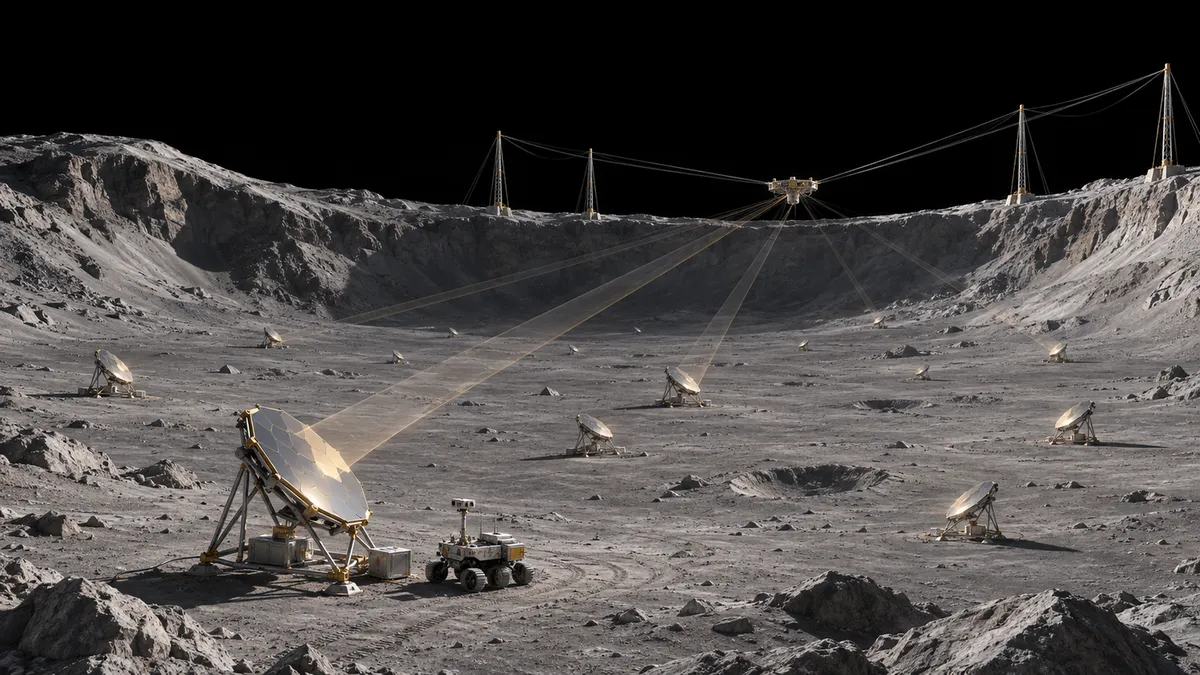
The Moon could be more than a destination for telescopes to observe. It might also become a foundation for telescopes too widely spread to build as single structures. M. Hadjara and colleagues examine that possibility in a historical review and proposed development roadmap, distinguishing existing demonstrations from an ambitious future of lunar optical arrays.
A familiar ambition, reconsidered
Astronomers have imagined observatories on the Moon since the early Space Age. In a preprint submitted to arXiv on November 3, 2026, M. Hadjara and colleagues revisit those ideas and outline a route toward lunar hypertelescopes. These would combine light from many separated mirrors rather than depend on one enormous, continuous reflecting surface.
The paper is a review and conceptual roadmap, not a report of a newly operating lunar interferometer. Its central argument is that advances in robotics, optics and lunar exploration infrastructure warrant revisiting proposals that earlier generations could not implement.
What the Moon offers
Without a substantial atmosphere, the Moon avoids the atmospheric turbulence that blurs astronomical images on Earth, along with atmospheric absorption. Its terrain could also support instruments spread across hundreds of metres or kilometres without requiring every component to fly independently in space.
Other advantages depend on location and wavelength. The far side shields radio instruments from terrestrial radio emissions. Permanently shadowed polar regions offer cold environments potentially useful for infrared astronomy. These are different opportunities, not interchangeable benefits available to every lunar telescope.
The historical record also encourages caution. The authors describe numerous Apollo-era proposals that remained studies, alongside the far-ultraviolet camera and spectrograph operated during Apollo 16. They attribute the limited development of lunar observatories to technological immaturity, high costs, changing political priorities and the success of orbital alternatives.
Demonstrations are not yet giant observatories
The review points to China's Chang’e-3 Lunar-based Ultraviolet Telescope, deployed in 2013, as an example of astronomical observations from the lunar surface. It also discusses terrestrial hypertelescope demonstrators that have tested principles of combining light from sparse arrays.
Proposed lunar interferometers would take further steps. MoonLITE envisages two telescopes separated by about 100 metres. The more ambitious Artemis-enabled Stellar Imager explores a larger ultraviolet and optical array. The paper presents these as proposals and studies, not completed lunar facilities.
Artemis, the International Lunar Research Station and commercial delivery services could provide supporting transport and infrastructure. Their relevance to astronomy remains conditional: access, power, communications and maintenance must actually become available to observatories.
How a hypertelescope would work
An interferometer combines light collected at separated locations while carefully controlling the distances that light travels. Its ability to distinguish fine angular detail depends strongly on the separation between its outermost collectors, called the baseline, as well as the observing wavelength.
A hypertelescope adds a technique called pupil densification. In accessible terms, it rearranges the collected beams to concentrate light into a directly usable image while retaining the resolution associated with the wide array. That is different from simply constructing a filled mirror as wide as the baseline.
The proposed science includes mapping stellar surfaces, examining material around black holes and studying nearby exoplanets. Imaging Earth-like planets and investigating possible biosignatures are long-term aspirations, not capabilities demonstrated by this paper.
A staged route, not a launch schedule
The authors propose four development phases. Small robotic payloads would first measure local conditions, including dust deposition and thermal stability, while testing deployment and communications. Observatories with roughly one- to ten-metre apertures would then build experience in sustained science, pointing, aging and robotic maintenance.
Next would come interferometric arrays with separations of tens to hundreds of metres, testing coherent light combination and extremely precise optical-path control. The final stage envisages kilometre-scale hypertelescopes with hundreds or thousands of collecting elements. Each stage depends on capabilities established earlier; the roadmap is not a committed mission timetable.
A related hybrid concept would use a natural crater, rim-mounted supports and a cable-suspended instrument platform. More elaborate variants introduce stabilized platforms or distributed small spacecraft. These remain architectural proposals rather than validated optical systems.
The hard part is sustained precision
The lunar environment removes atmospheric turbulence but introduces serious engineering burdens. Abrasive, electrostatically charged dust can contaminate mirrors and mechanisms. Long nights complicate power supply. Large temperature changes can deform structures and disrupt alignment. Transporting fragile equipment remains risky, and routine repairs cannot be assumed.
The review discusses robotic assembly, construction using local material and nuclear power as possible enablers. Experiments with lunar-soil simulants and developments in terrestrial reactors do not establish that those technologies are ready to support a lunar optical array.
The most defensible reading is therefore a research agenda: demonstrate the environment, operations and precision control before scaling up. The authors ultimately envisage a network sharing infrastructure across optical, infrared and radio facilities, complementing rather than replacing Earth-based and free-space observatories. Whether that vision becomes practical depends on sustained investment and engineering evidence still to come.
- lunar astronomy
- hypertelescopes
- optical interferometry
- lunar observatories
- robotic deployment
- pupil densification
- astronomy infrastructure
Related reading
Automatically matched by shared topic keywords. These links do not imply that the sources agree or establish a consensus.