TRANSMISSION // 2611.05417v1
AI’s economic impact may depend on teamwork, not just smarter machines
Source published
A theoretical preprint argues that AI’s ability to coordinate could reshape firms more sharply than improvements in individual task performance. Its model shows how complementary human teams can remain competitive, why employment losses can be gradual or sudden, and how reorganizing firms can change wages.
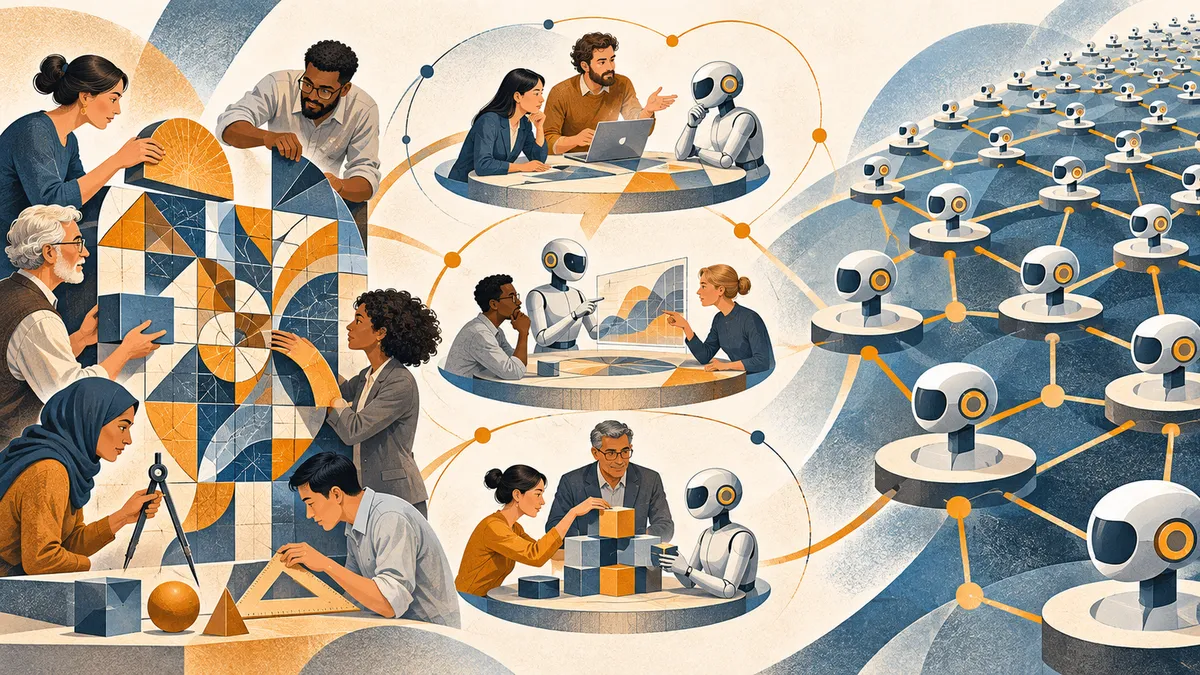
An AI system that outperforms an average worker does not necessarily outperform a well-organized company. In Organizing Intelligence, researchers Alex Imas, Andrew Koh and Shane Legg argue that understanding AI’s economic consequences requires looking beyond individual capabilities to how people and machines work together.
The October 31, 2026 preprint develops a theoretical model of firms, wages and employment—not a forecast of when AI will transform the economy. Its central distinction is between competence, which raises output at a given organizational size, and coordination, which determines how productivity changes as an organization grows.
Better coding or writing can make a team more productive. Better coordination can allow a larger team to remain productive despite communication burdens, limited attention and conflicting incentives. The researchers argue that these two kinds of progress can lead to very different economic outcomes.
Why human teams can still compete
The model gives workers several capabilities rather than a single intelligence score. People with different strengths can form teams that overcome one another’s weaknesses, creating what the authors call mosaic intelligence.
Their illustrative economy includes coders who write poorly and writers who code poorly. Each specialist scores 1.8 on the example’s combined competence measure when working alone. An equally balanced team reaches five. These are constructed model values, not measured worker performance: the calculation uses a formula that penalizes weakness in either essential skill.
This helps explain why beating an average individual need not be enough for AI to displace an organization. Human teams can assemble a stronger combination of capabilities than their members possess separately. Coordinators can add further value despite having weak direct task skills, because they help specialists work effectively at greater scale.
But employment protection does not necessarily protect pay. In one numerical scenario, AI matching average standalone human competence and coordination leaves all 14 humans employed while reducing their wages. Reproducible AI expands supply and lowers output prices, reducing the premium that scarce human expertise commands.
When better coordination changes firm size
The model assumes that human capabilities are in fixed supply, while copies of one AI type can be rented without limit at a fixed per-copy compute cost. Replicating AI therefore does not create the same scarcity premium as hiring a limited pool of skilled people.
Improving AI’s task competence raises productivity but, with workforce composition held fixed under the paper’s separable specification, does not change preferred firm size. Firms can nevertheless shrink or grow if they change the mix of humans and machines, thereby changing average coordination.
Coordination improvements have a more direct connection to scale. Below a critical threshold, adding agents eventually reduces output per agent. Above it, the technology permits output per agent to keep increasing as an AI organization expands. The authors call this property supercooperation.
Their analytical result concerns increasingly large markets: below the threshold, production expands through replication of bounded-size firms; above it, equilibrium production becomes concentrated in firm types whose capacity approaches the whole market. This is not a prediction that one company will inevitably dominate the entire economy. Demand limits matter, and the researchers identify regulation, competing AI providers, capacity constraints and rigid supply contracts as potential obstacles to such concentration.
Two routes to displacement
The researchers distinguish replacement inside firms from competition between firms.
When human and AI strengths reward mixing, improving machines can progressively reduce the human share of a joint workforce. Under the paper’s stated mathematical and feasibility conditions, employment adjusts continuously.
When production instead favors separate human and AI firms, displacement can be abrupt. Once AI-only production becomes cheaper than human-only production at workers’ minimum acceptable wage, human employers can disappear. One illustrative calculation moves from 12 employed specialists to none across such a threshold. That is a scenario generated by chosen parameters, not an estimate of likely job losses.
Wages also depend on reorganization. The authors separate the direct effect of better AI within an unchanged firm from changes caused by its size and workforce composition. Expansion can temporarily raise the value of human coordination even when the direct technological effect reduces it. Reorganization can therefore reverse the direction of a wage effect.
What the model cannot establish
The paper does not estimate when AI will cross its coordination threshold. It represents organizational frictions through a production formula rather than modeling detailed management structures. Its equilibrium uses an unusual replacement test, allowing alternative industry arrangements and transfers that make consumers and workers no worse off. Firm activity weights can also be fractional, an approximation that matters especially for large firms.
Some numerical illustrations have checks only at selected points, not guarantees along entire paths. The authors explicitly distinguish these calculations from their analytical results.
Their measurement proposal follows directly: assess how output scales across AI copies, track human payroll alongside AI expenditure, and study workers moving between employers. Individual benchmarks alone, they argue, cannot reveal how capabilities combine inside economically competitive organizations.
- artificial intelligence
- firm organization
- coordination
- mosaic intelligence
- employment
- wages
- market concentration
- economic theory