TRANSMISSION // 2611.05309v1
A fast AI estimate of gravitational-wave detectability
Source published
ΦasmaNet predicts signal-to-noise ratios for simulated black-hole binaries, potentially speeding up population studies, though it has been tested in a specific detector setup.
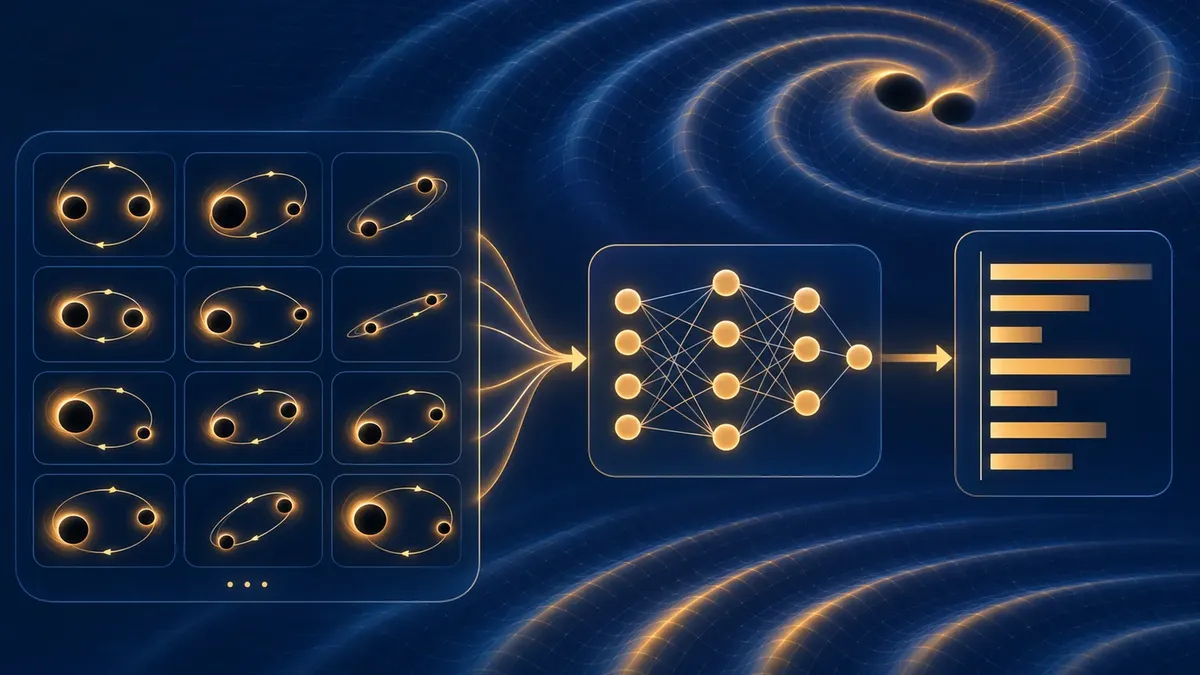
Gravitational-wave population studies can require millions of calculations to estimate which simulated black-hole mergers a detector might observe. A new neural network, ΦasmaNet, is designed to make those estimates faster. Its authors report high accuracy for the simulations and detector configuration they tested; the evidence available here is the paper’s abstract, so the reported results cannot be independently assessed from this source alone.
Why estimate signal-to-noise ratios?
When astronomers study populations of black-hole mergers, they need to account for selection effects: a detector is more likely to observe some signals than others. Estimating how detectable each simulated signal would be involves calculating its signal-to-noise ratio (SNR). Repeating that calculation across millions of simulated systems can be computationally expensive.
The authors introduce ΦasmaNet, a neural network intended to approximate those SNR calculations quickly. The aim is not to detect gravitational waves directly, but to predict SNR for simulated sources and potentially help researchers evaluate large catalogues.
What the researchers did
According to the abstract, the team trained the model to predict the phase-averaged optimal SNR for precessing black-hole binaries that include higher-order waveform modes. The inputs are 11 parameters describing the binary. The signals were modeled using IMRPhenomXPHM, and the calculation assumed one detector operating at a fixed Advanced LIGO design sensitivity.
ΦasmaNet has approximately 732,000 parameters. Its design processes learned input tokens through ordered stages, then passes information back through a gated feedback mechanism. The authors describe this staged spectral refinement as an architectural prior: a design choice intended to structure how the network learns from tabular inputs.
They compared it with a multilayer perceptron, a one-dimensional residual network, and a Transformer encoder, using matched training conditions and datasets ranging from 100,000 to one million examples. The abstract also reports tests across independent dataset realizations and a calibration step using rank-preserving monotonic PCHIP. The abstract does not provide further details about that calibration procedure.
What they report
At one million training examples, the authors report a test-set score of 98.73% for “100 minus MAPE,” a measure based on mean absolute percentage error. After calibration, that figure rises to 99.29%. In the detection-relevant subset with SNR above 8, they report 99.39% and an R² of 0.9998. The abstract says ΦasmaNet outperformed the three named baseline models under the tested training conditions and maintained stable accuracy across independent dataset realizations.
The reported speed is also substantial: about 120,000 SNR evaluations per second on a single GPU. The authors say a catalogue of one million injections took about 8.3 seconds end to end, compared with conventional waveform-and-inner-product calculations on a 16-core CPU. These are the authors’ reported figures for their setup, not a universal speed ratio across hardware, software, or workloads.
Because SNR scales inversely with luminosity distance in this setup, the authors say predictions can be rescaled exactly for repeated catalogue-wide detectability calculations. The abstract also says tests on public tabular datasets indicate competitiveness beyond gravitational-wave applications, but it gives no detailed results for those tests.
What remains uncertain
The scope is specific: one detector, a fixed design sensitivity, and simulated binary black-hole signals described by a particular waveform model. The abstract does not establish how well the network would work with real detector data, different sensitivities, a network of observatories, other waveform models, or sources outside the training distribution. Extensions to detector networks and time-varying sensitivities are described as possibilities, not demonstrated results.
The performance figures are claims reported in the authors’ abstract. The evidence available here does not include full details on data generation, parameter coverage, error distributions, hardware, or evaluation procedures, so readers cannot independently assess how representative the tests are. As a general caution for predictive models, a high aggregate score alone does not establish equally reliable predictions across every possible input; the abstract does not show whether errors vary across this model’s parameter space.
The source is an arXiv preprint record, and the material provided for this article is limited to its abstract. That limits what can be checked here; it does not by itself establish the work’s review or publication status. ΦasmaNet is presented as a computational shortcut for a defined simulation task, while broader applicability would require evidence beyond the abstract’s reported tests.
- gravitational waves
- signal-to-noise ratio
- neural networks
- black hole binaries
- selection effects
- ΦasmaNet
Related reading
Automatically matched by shared topic keywords. These links do not imply that the sources agree or establish a consensus.
Could LIGO triggers hint at sub-solar objects?
Source published
Shared keywords: gravitational waves
Can LISA spot black hole mergers before they happen?
Source published
Shared keywords: gravitational waves
When a Third Body May Shift Gravitational-Wave Timing
Source published
Shared keywords: black hole binaries, gravitational waves
Phentax adapts black hole waveform calculations for LISA’s crowded signals
Source published
Shared keywords: black hole binaries, gravitational waves
Even powerful birth kicks struggle to reverse black hole binary orbits
Source published
Shared keywords: black hole binaries, gravitational waves