TRANSMISSION // 2611.05171v1
AgentAM puts metal-printing models behind a conversational interface
Source published
A research preprint presents an AI assistant that queries simulation-trained models to explore metal-printing settings. Its benchmark separates reliable tool use from physical accuracy, while margin-aware optimization trades higher predicted spatter for more room from model-defined defect boundaries.
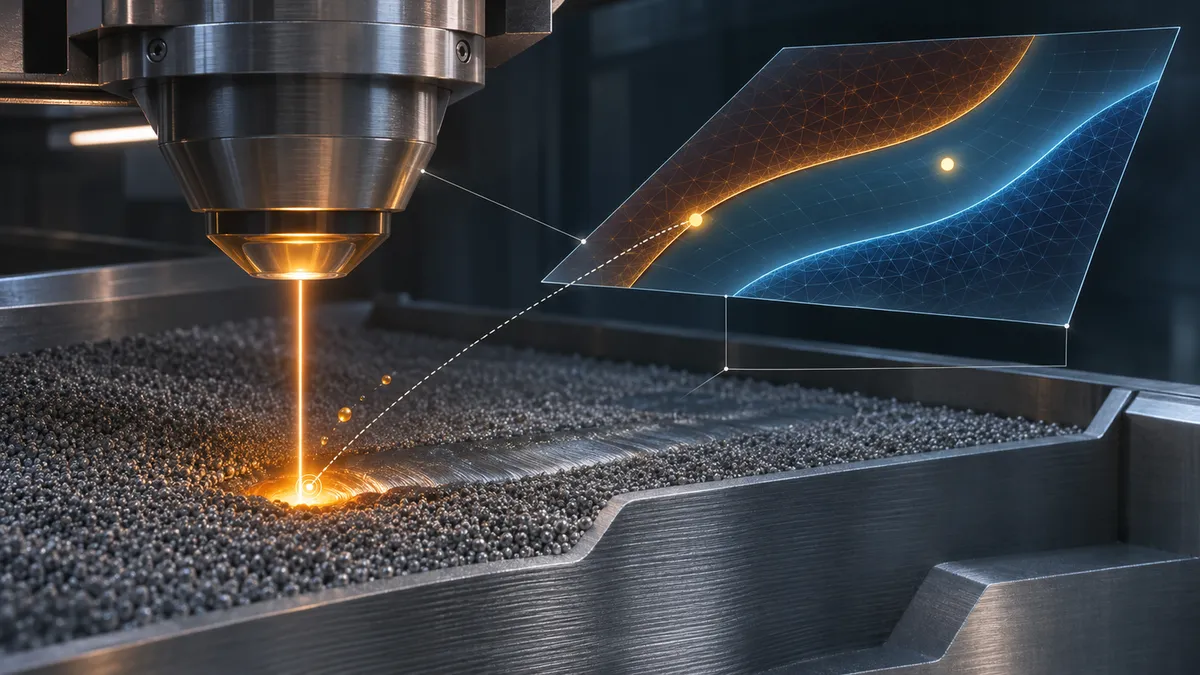
Choosing the lowest-spatter setting for a metal printer can put the process close to failing to fuse a layer. AgentAM lets engineers ask predictive tools for alternatives in plain language—but its recommendations still need validation on physical builds.
Laser powder bed fusion builds metal parts by melting successive layers of powder. Choosing laser power and scanning speed involves competing demands: settings that limit ejected droplets, or spatter, must also produce a melt pool capable of bonding the material. A numerical optimum can sit uncomfortably close to a predicted defect boundary.
In the AgentAM preprint, Olabode T. Ajenifujah and Amir Barati Farimani present a conversational interface for exploring that trade-off. Their system connects a large language model to predictive tools for SS316L stainless steel. The language model interprets requests and selects tools; it does not supply the underlying process predictions.
Conversation above a numerical model
AgentAM uses the Model Context Protocol to expose polynomial surrogate models: relatively inexpensive mathematical approximations trained on computational fluid dynamics simulations. Its data comprise 279 simulated single tracks, covering laser powers of 160–430 watts and scanning speeds of 100–1,500 millimeters per second.
The tools predict spatter volume and melt pool geometry, scan parameter ranges, and search for settings that satisfy constraints. Surrogate calculations run locally, while the tested language model, Claude Opus 4.5, runs through a cloud provider. The server clamps out-of-range inputs to its supported limits, flags that adjustment, and rejects unsupported materials.
Predicted geometry determines whether a setting receives a keyhole, lack-of-fusion, balling or “Good” label. These are geometry-derived regimes, not observations of defects in printed parts. For example, the lack-of-fusion rule identifies a melt pool shallower than the modeled powder layer.
Under cross-validation, labels calculated from predicted geometry agreed with labels calculated from simulated geometry in 93.4% of tracks. That measures how faithfully the surrogate reproduces a simulation-based classification—not physical defect-detection accuracy. The chosen thresholds also matter: the keyhole threshold substantially changes the size of the predicted stable window and requires calibration against physical builds.
Leaving room around the optimum
Minimizing spatter alone often pushed recommendations toward the lack-of-fusion boundary. Across 17 queries for which both plain and margin-aware solutions existed, 12 plain optima had predicted depths within 10 micrometers of that threshold.
The margin-aware optimizer instead requires clearance from each regime threshold and from the edges of the trained input range. In one search, the recommendation moved from approximately 160 watts and 349 millimeters per second to 184 watts and 411 millimeters per second. Predicted spatter increased by 39.8%, while the depth margin grew from 6.7 to 15.3 micrometers.
The authors tested these recommendations using simulated perturbations. With assumed independent 2% relative process variation in power and speed, the median estimated probability of remaining classified Good rose from 0.94 for plain optima to 1.00 for margin-aware optima. Adding jointly sampled cross-validated geometry residuals yielded medians of 0.72 and 0.91.
Those probabilities describe behavior under modeled disturbances, not calibrated manufacturing reliability. Process variation was assumed rather than measured on a machine. Among the 12 queries whose optimum moved, the median predicted spatter increase was 39.8%; five other optima already met the margins.
Testing the interface separately
To evaluate the agent rather than the surrogate, the researchers used direct tool calls as reference answers. Their main benchmark contained 145 prompts, each repeated five times, covering parameter extraction, unit conversion, scans, optimization and requests outside the model’s scope.
The agent passed the intended inputs in 98.5% of parsing runs. Every scored spatter value and defect class it reported matched the tool output within the evaluation tolerance. All 65 recommendations from feasible optimization runs met the stated constraints when re-evaluated by the server, with a median spatter gap of 1.0% from a brute-force grid optimum.
Performance was less consistent when interpreting ambiguity or explaining infeasibility. The agent also invented trained ranges when a tool returned clamped values without the complete range. After the tools were changed to include that information, none of 50 repeated out-of-range runs stated an incorrect range.
Removing the tools exposed a different failure mode: under the deployed prompt, 80.4% of runs contained fabricated tool-call text. An answer guard tested offline blocked every answer containing fabricated tool markup, without blocking any of 29 legitimate tool-free answers tested. Its coverage was weaker under neutral prompts, where unsupported answers often lacked those markers.
AgentAM therefore demonstrates useful access to numerical tools, not autonomous control of a validated production process. Its current evidence concerns one alloy, fixed process conditions and simulated single tracks. Physical validation, multi-layer effects and broader process inputs remain outside the demonstrated system.
- AgentAM
- laser powder bed fusion
- AI agents
- Model Context Protocol
- surrogate models
- spatter
- margin-aware optimization
- SS316L