TRANSMISSION // 2611.05167v1
Separating movement-related dynamics from mixed brain recordings
Source published
BREM-NET combines spikes and local field potentials while learning separate representations for movement prediction and remaining neural variability. Tests on one macaque’s reaching recordings suggest benefits for decoding, including under simulated missing-data conditions.
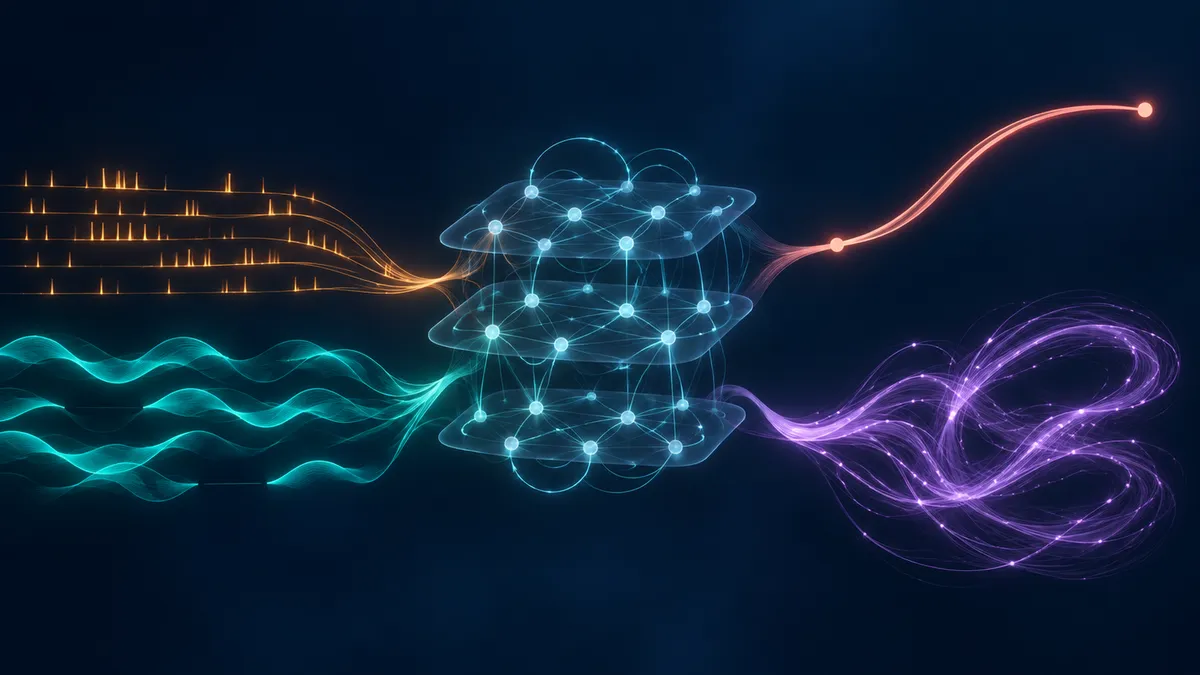
Different brain signals offer complementary views of neural activity, but not every pattern helps predict a measured movement. A new preprint describes a model that combines those views while separating movement-predictive dynamics from the neural variation they leave unexplained.
Recording more kinds of brain activity does not automatically reveal which patterns matter for behavior. Individual neurons produce brief electrical spikes, while local field potentials, or LFPs, capture electrical activity over a larger spatial scale. These signals offer complementary information, but combining them can mix movement-related patterns with other neural variation.
In an arXiv preprint, Parastoo Azizeddin, Eray Erturk and Maryam M. Shanechi introduce BREM-NET, a nonlinear dynamical model designed to make that distinction. Their experiments combine spikes and LFPs to predict movement while separately modeling neural dynamics that the movement-predictive representation leaves unexplained.
Learning movement first, then the remainder
BREM-NET represents changing neural activity through latent states: compact internal variables inferred from the recordings. Its central design choice is to divide those states into two groups and train them in three stages.
First, a recurrent neural network learns states that predict the recorded behavior from past neural observations. In the reaching experiments, the behavioral target is two-dimensional cursor velocity. Second, with that network held fixed, separate decoders learn how those movement-predictive states relate to spikes and LFPs. Third, another recurrent network learns additional states that improve predictions of the neural activity left unexplained by the first group.
The resulting division is functional, not a claim that the remaining activity is biologically unimportant. Here, “residual” means variation not accounted for by the first representation. The residual states were less useful for decoding the measured behavior, rather than completely devoid of behavioral information.
The model also respects differences between signal types. It models spike counts with a Poisson distribution and LFPs and continuous behavior with Gaussian distributions. Behavior supplies supervision during training, but is not an input when the trained model makes predictions from neural recordings.
Evidence from a reaching task
The biological evaluation used a public dataset from one macaque performing sequential reaches to targets in a virtual environment. Recordings came from primary motor cortex across four sessions. The analysis selected the top 20 channels of each neural modality according to behavior-prediction performance, then examined different channel combinations.
Results used five-fold cross-validation. The reported sample count of 20 therefore reflects four sessions multiplied by five folds, not 20 animals.
Adding LFP channels to spikes improved behavior decoding, and adding spikes to LFPs also helped. Gains were largest when the initial modality supplied relatively little information, such as when fewer channels were available. Combining modalities also improved neural prediction compared with single-modality models.
The authors report that BREM-NET outperformed the tested multimodal baselines on behavior decoding, neural prediction and alignment between its behaviorally relevant states and velocity trajectories. Experiments removing individual components supported contributions from multimodal fusion, behavioral supervision and staged training. Removing the final residual-learning stage preserved behavior decoding but substantially worsened neural prediction.
Missing signals expose an important distinction
Each neural modality has its own encoder. If a modality is unavailable at a particular timestep, its encoder contributes nothing to that update; the model instead uses its evolving state and any available observations.
To test unequal sampling rates, the researchers reduced LFP sampling by a factor of five while leaving spikes and behavior unchanged. Mean behavior-decoding correlation was 0.7571, compared with 0.7645 at matching resolutions. Spike prediction also remained close to its original level. However, LFP prediction correlation fell from 0.8078 to 0.6272. Maintaining movement decoding did not mean every prediction remained equally accurate.
In a separate experiment, randomly removing 80% of LFP samples reduced behavior-decoding correlation from 0.7645 to 0.7516. Removing spikes had a larger effect: correlation reached 0.7245 at 40% dropout and 0.6292 at 80% dropout. These were controlled missing-data experiments applied to an originally fully observed dataset.
A tool with a defined scope
The findings suggest a way to combine neural signals without forcing all their variation into one undifferentiated representation. That could be useful for studying brain–behavior relationships and developing brain–computer interfaces.
The evidence remains bounded by this preprint’s simulations and one macaque’s motor-cortex reaching recordings. The authors identify other brain regions, behaviors and modalities, including EEG and physiological signals, as future directions. BREM-NET demonstrates improved prediction in the tested setting, not a universally established separation of the brain’s behavioral and nonbehavioral activity.
- BREM-NET
- multimodal neural recordings
- neural dynamics
- local field potentials
- spiking activity
- behavior decoding
- brain–computer interfaces