TRANSMISSION // 2611.05151v1
WebCatalyst trains HTML generators to improve what happens after the first click
Source published
A preprint introduces browser-based reinforcement learning that checks sustained interaction, penalizes visual degradation and traces successful actions back to generated code. The authors report gains in mini-game and conventional webpage benchmarks, while showing how functionality-focused feedback alone can damage visual quality.
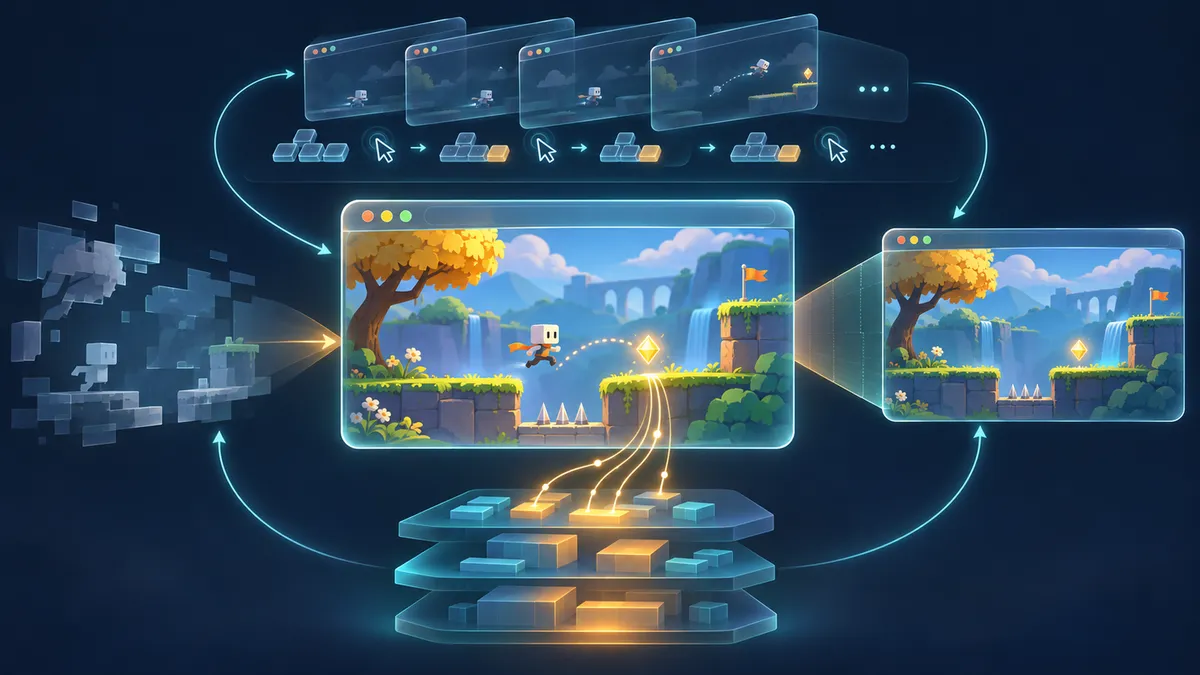
A generated browser game can look convincing until someone starts playing. WebCatalyst tackles that gap by training a code model on interactive browser feedback—and checking that better behavior does not come at the expense of design.
A webpage that renders successfully is not necessarily a webpage that works well. Buttons may fail, game scenes may break after launch, and apparently polished interfaces may become confusing during use. In the preprint Catalyzing Interactive HTML Generation Capabilities via High-Fidelity Reinforcement Learning, Xujia Wang and colleagues investigate how training feedback can better capture those failures.
Their framework, WebCatalyst, combines browser interaction, reference-based visual checks and execution tracing. The central idea is that improving generated HTML requires more than judging a screenshot or assigning one undifferentiated score to an entire program.
Testing beyond the opening screen
The researchers use mini-games as a demanding training setting. Unlike a simple webpage interaction, gameplay can require held keys, simultaneous inputs, moving targets and repeated state changes. These demands expose problems that shallow click-and-type tests may miss.
WebCatalyst’s GUI Assessor runs generated HTML in Chromium through Playwright. An execution agent chooses actions such as clicking, hovering, pressing keys, combining keys or waiting. In the main training setup, it has a budget of eight interaction turns per page.
A step-level judge examines before-and-after screenshots alongside execution records. A higher-level judge then aggregates the interaction evidence into an overall assessment. Its criteria include visual stability, feedback clarity, interaction reliability, requirement alignment and task progress. Severe usability defects can cap the final score, preventing an otherwise favorable average from concealing a broken core experience.
The distinction between simulator mistakes and application failures matters. A click that misses its intended target is not equivalent to a correctly delivered click that exposes a broken control.
Keeping functionality gains from erasing design
The authors identify a failure mode in training with GUI feedback alone: the generator can improve interaction scores while simplifying visual structure or dropping features that the judge does not adequately penalize.
Their ablation experiment illustrates the trade-off. Adding only the GUI Assessor raises the base model’s mini-game functionality score from 56.1 to 60.5, but aesthetics falls from 81.5 to 71.3. The combined score declines despite the functional improvement.
WebCatalyst’s Visual Anchor addresses this by comparing a generated page with a reference artifact for the same request. The main setup uses GPT-5.5 to produce those references before training. For each artifact, the framework selects the highest-scoring screenshot from its interaction trajectory.
A visual judge applies a one-sided penalty when the generated screenshot is clearly worse in presentation, including layout, hierarchy and design completeness. Equal or better visual quality receives no penalty. The mechanism is intended to discourage visual degradation, not require the generator to copy a reference exactly.
Connecting successful actions to code
The third component, Action-Trace Credit, changes how training feedback reaches individual generated tokens.
Ordinary page-level reinforcement learning provides limited information about which code produced a useful behavior. WebCatalyst captures JavaScript call stacks during supported browser actions, retains evidence from actions judged successful and maps the corresponding function spans back to generated tokens.
Tokens associated with successful execution receive stronger positive updates when the page performs relatively well, and weaker negative updates when it performs relatively poorly. Credit decreases toward outer callers in the captured stack, while normalization preserves the average token-level advantage.
The authors deliberately avoid directly attributing failed actions: missing logic may leave no relevant execution trace, making blame unreliable.
Reported gains—and their boundaries
The main experiment trains Qwen3.6-35B-A3B using game-focused requests derived from Reddit posts. The reported checkpoint follows 40 updates, corresponding to 640 processed request instances.
On 156 Cookie-Bench Mini Games requests, the total score rises from 68.8 to 75.3. Aesthetics increases from 81.5 to 87.5, and functionality from 56.1 to 63.2. On WebGen-Bench, which contains 101 requests and 647 test cases, accuracy rises from 48.8 to 56.9. That accuracy awards partial credit for partly satisfied requirements; it is not simply the percentage of fully working websites.
WebCatalyst also achieves a better average rank across the reported evaluation dimensions than Claude Opus 4.7. This is not a clean sweep: Claude’s webpage accuracy is slightly higher, and its mini-game functionality score is higher too.
The results support transfer from game-focused training to conventional webpages in these evaluations. They do not establish universal superiority or production reliability. The authors note that reinforcement learning depends on capabilities already present in the base model, and they do not specifically optimize planning, iterative debugging or tool-use pipelines. Judge quality and evaluation cost also remain practical constraints. The contribution is a concrete demonstration that what training feedback measures—and where it assigns credit—can substantially change the balance between interactive behavior and visual quality.
- WebCatalyst
- HTML generation
- reinforcement learning
- browser interaction
- reward hacking
- visual evaluation
- credit assignment
- code generation