TRANSMISSION // 2611.04809v1
Combining explicit rules and graph learning to recover missing synthesis conditions
Source published
The RAHC framework combines experimental context with traceable rules to rank missing materials-synthesis conditions. In an unreviewed preprint, researchers report improved benchmark rankings across five synthesis datasets, while a training-only answer vocabulary remains an important constraint.
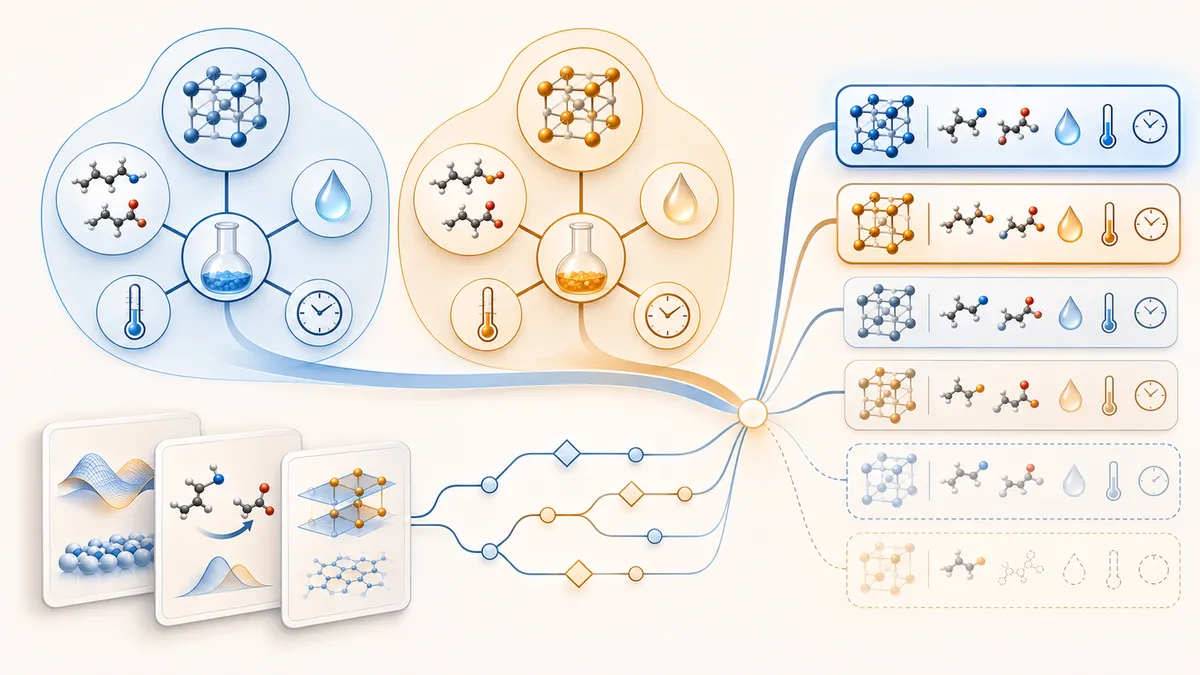
An incomplete synthesis record can leave researchers without a solvent, temperature or reaction time. A new preprint describes a system that uses both patterns in experimental records and explicit, source-backed rules to rank possible missing values without mixing conditions from separate experiments.
A material’s identity does not uniquely determine how it was made. Different synthesis routes can use different inputs and conditions, so recovering a missing detail requires considering the rest of the experiment. In an unreviewed preprint posted to arXiv on November 3, 2026, Jiawei Sun, Sijia Xu, Zihan Chen and Zhengyi Yang introduce RAHC, a framework designed to make that contextual reasoning more explicit.
The system combines a hyper-relational knowledge graph with rules drawn from training records and retrieved literature. Its task is to rank candidate values for missing synthesis conditions, either individually or as combinations. The reported results concern recovery of recorded information; ranking performance should not be interpreted as a laboratory synthesis success rate.
Keeping each experiment together
RAHC represents a material and one particular synthesis run as a primary relationship. Additional relation–value pairs, called qualifiers, attach the experiment’s inputs and conditions to that relationship. Supporting graph structures retain chemical roles, quantities, procedural steps and provenance.
This run-centered organization matters because two experiments targeting the same material may follow different routes. A temperature recorded for one run should not become context for predicting the solvent of another. When evaluating a missing condition, the researchers mask every recorded value of that condition, including multiple solvents where applicable, and remove answer-revealing alternative paths or derived fields.
The model then processes two kinds of information separately: the observed graph structure and explicit rules supporting a proposed answer. Rules are retrieved only when their required conditions match the available context, their scope permits the query and their conclusion agrees with the candidate being scored.
Rules provide evidence, not automatic answers
Training-derived rules capture recurring dependencies using up to three generalizable antecedent conditions. Literature-derived rules are assembled through retrieval and language-model extraction, followed by another search for independent support, scope boundaries and counterexamples. The paper specifies that a single experimental observation does not automatically become a general rule.
Hard rules exclude candidates that violate explicit checks, such as target-slot types or elemental consistency. Soft rules influence the ranking of candidates that remain. A candidate without matching rule evidence is not automatically rejected: the structural model can still score it.
The researchers compare two aggregation strategies. RAHC-G weights matched rules by their calibrated global reliability. RAHC-Q additionally learns which rules are relevant to the current query. A learned gate combines rule evidence with the structural representation. Neither strategy wins consistently across all tasks.
For several missing conditions, RAHC adds rules supporting compatible combinations to the individual condition scores. All component predictions use the same jointly masked context, rather than filling slots sequentially and letting earlier predictions determine later ones.
What the benchmarks showed
The evaluation covers five materials-synthesis datasets, including metal-organic framework records, inorganic precursor selection and zeolite organic structure-directing agent selection. Models are retrained and rule catalogs rebuilt for each dataset, so these cross-material comparisons are not demonstrations of unchanged-model transfer.
The main metric is mean reciprocal rank, or MRR: a higher score means recorded answers tend to appear nearer the top of candidate lists. On MOF-SynHKG under the Semi-inductive protocol, RAHC-Q achieved solvent MRR of 0.379 versus 0.330 for MAYPL, a reported relative improvement of 14.8%. Temperature MRR reached 0.732 versus 0.633, a 15.6% relative improvement. RAHC-G produced the strongest reaction-time result at 0.681.
Joint prediction also improved over the same scorer without its joint-rule term. For temperature plus time, RAHC-Q increased complete-pair MRR from 0.4012 to 0.4331. In a separate entity-disjoint knowledge-graph benchmark, RAHC-G improved MRR from its shared NodePieceGNN encoder’s 0.08659 to 0.08965, a smaller absolute gain.
The answer vocabulary sets a boundary
Both main synthesis evaluation protocols rank only values found in training records. Semi-inductive evaluation includes queries whose answers are representable in that vocabulary. Open-Answer Inductive evaluation also includes answers outside it, counting those as failures; it does not let the model generate new answer values.
The contribution of literature also needs proportionate interpretation. In a solvent-completion validation ablation, combining training and literature rules raised MRR from 0.3726 with training rules alone to 0.3752. The authors describe that additional gain as small.
Overall, the preprint supports explicit, candidate-specific rules as a useful addition to structural ranking. Its evidence establishes improved record-completion benchmarks, not that every recovered condition is uniquely correct or experimentally validated.
- materials synthesis
- knowledge graph completion
- hyper-relational knowledge graphs
- rule-augmented learning
- experimental records
- synthesis conditions
- RAHC