TRANSMISSION // 2611.04494v1
AR Glasses That Remember Encounters—and Keep the Images Behind Their Answers
Source published
A preprint describes AR glasses that selectively save color images, link descriptions to their sources, and revisit those images when later questions need more detail. A short replay demonstrates selective capture, but not broad recall accuracy or proven energy savings.
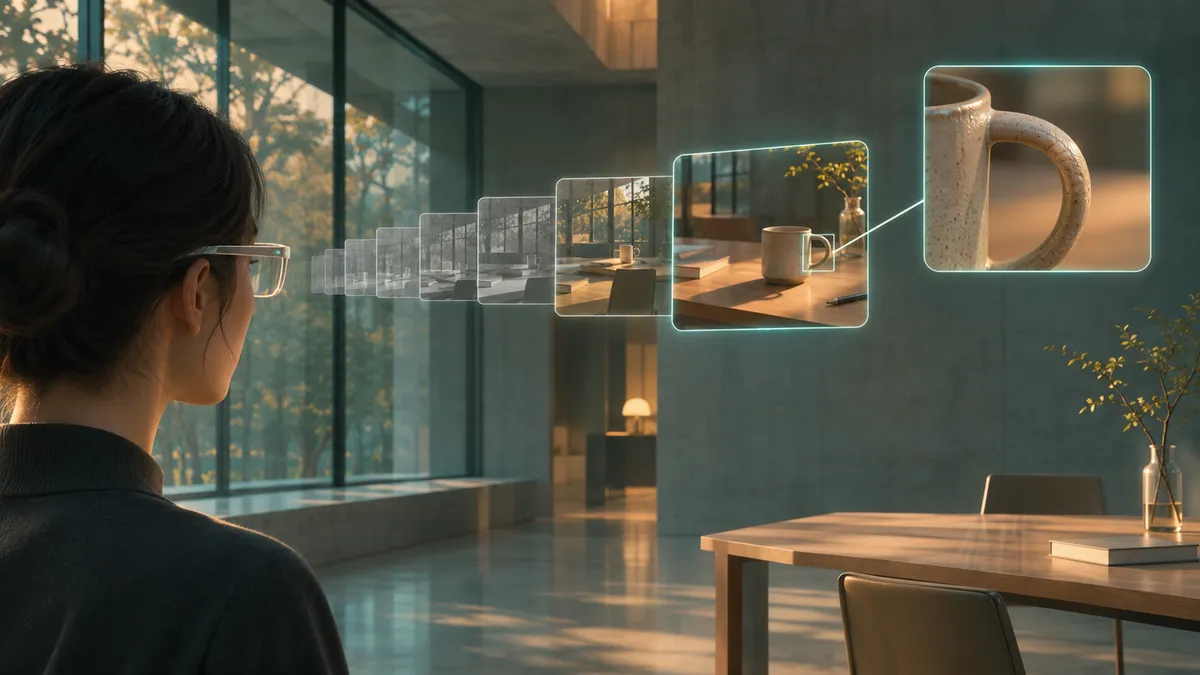
Remembering where you saw a mug is different from knowing where it is now. An experimental AR memory system builds that distinction into its design, preserving the images and encounter times behind an assistant’s answers.
A wearable assistant cannot recover a detail it never recorded. It can also lose useful information by reducing an image to a description that leaves something out. In a November 3 preprint, independent researchers Tianxing Zhu and Dan Huang describe an augmented-reality memory system designed around these two problems: choosing what to capture and preserving evidence for questions that arrive later.
Their prototype uses RayNeo X3 Pro optical see-through glasses, which display information while leaving the physical scene visible. The paper describes an acquisition-to-recall pipeline, but its numerical evaluation is a 131.35-second replay of recorded first-person video. That distinction matters: the results characterize selection behavior and imaging conditions, rather than establish reliable everyday memory assistance.
Choosing which encounters to save
The system uses a monochrome camera to monitor the scene and selects some observations for detailed color capture. Early checks assess brightness and sharpness. Comparisons of image brightness patterns then decide whether more expensive appearance analysis should run.
That analysis considers both the whole view and four overlapping regions. The regional comparisons are intended to notice smaller changes that a whole-scene comparison might overlook. A candidate must also remain sufficiently consistent across multiple observations and a minimum duration before qualifying for capture.
This creates a tradeoff. Waiting helps reject fleeting or unstable views, but it can also miss a brief encounter. Furthermore, the monochrome and color cameras do not see exactly the same area. Head movement, different viewing angles and capture delays can move an interesting detail outside the saved image or blur it.
Keeping descriptions attached to evidence
Each stored observation links its source image to an acquisition time, scene description, object information and spatial relations. The architecture separates three things: whether a view was accepted for capture, whether interpretation succeeded, and whether the retained evidence supports a particular answer.
These are not interchangeable. An image can survive a failed interpretation. A successful description can still omit a detail needed later. And an observation that supports a historical statement does not necessarily support a present-tense claim.
For a suitable historical location question, the system can answer directly from its local index, returning the recorded place, time and source. Questions requiring additional detail can trigger inspection of saved images. More general questions use a bounded catalog-selection stage followed by a separately bounded image-inspection stage.
The paper illustrates the benefit with a pouring encounter. An offline description records the activity but omits which side of the image shows the mug handle. That detail remains visible in the source crop. This is an illustration of what source access can preserve, not a comprehensive test of question-answering accuracy.
Repairing gaps without rewriting history
A captured view can become familiar to the selection system before its interpretation succeeds. Without feedback, the glasses might then reject another useful look at the same scene.
The authors describe bounded reassessment to address this problem. A suitable saved image can be interpreted again after a processing failure; a clearer recurring view can justify another capture when the original evidence is inadequate. Retry budgets and stopping conditions limit repeated work.
The design also links retention decisions to evidence dependencies. Deleting an image may remove the only support for a claim, so dependent indexes or summaries must be updated or marked unsupported. However, the reported replay does not quantify how much reassessment or dependency-aware retention improves recall.
What the replay actually showed
The acquisition policy selected six color observations from 648 monochrome observations, equivalent to 2.74 selections per minute. Raising the capture ceiling did not increase that count. A periodic reference retained the same number of observations, but matching capture counts alone does not establish which method better preserves useful memories.
Selection was sparse; computation was not. Feature extraction ran on 633 observations, or 97.7%. The inexpensive brightness-comparison stage bypassed just 15 checks. The authors attribute the low bypass rate to conditions consistent with walking, where head motion and shifting backgrounds change pixels even without a meaningful scene change. These results do not demonstrate measured battery savings.
Timing also limits the evidence. In the paired reference streams, monochrome-to-color offsets ranged from 11.13 to 67.33 milliseconds. The separately described still-capture path includes a one-second color-preview warm-up plus camera-switching overhead. The replay’s short offsets should therefore not be mistaken for demonstrated still-capture latency.
A memory aid with explicit boundaries
The prototype performs image-quality checks and appearance embedding locally, but uses Xiaomi MiMo-V2.6-Flash through a cloud service for descriptions, source selection and image-backed answers. Saved images and memory records remain in app-private storage; eligible indexed historical lookups need no model call.
The central contribution is a distinction, not a promise of perfect recall: saved pixels, searchable descriptions and supported claims are different resources. The short replay demonstrates selective color acquisition while exposing frequent local inference as a remaining cost. It does not establish long-term reliability, broad answer accuracy or user benefit. Most importantly, seeing a mug on a desk earlier is evidence of that encounter—not proof that the mug is still there.
- augmented reality
- AR glasses
- spatial memory
- egocentric vision
- selective image capture
- source-linked recall
- evidence provenance