TRANSMISSION // 2611.04481v1
An Optical AI Experiment That Revises Its Own Tools
Source published
A preprint presents an agent-based optical research framework that uses measurements to revise experimental software, protocols and models. In one augmented-reality color-matching setup, the authors report substantial improvements from spectral feedback, alongside smaller and less consistent gains from a revised response model.
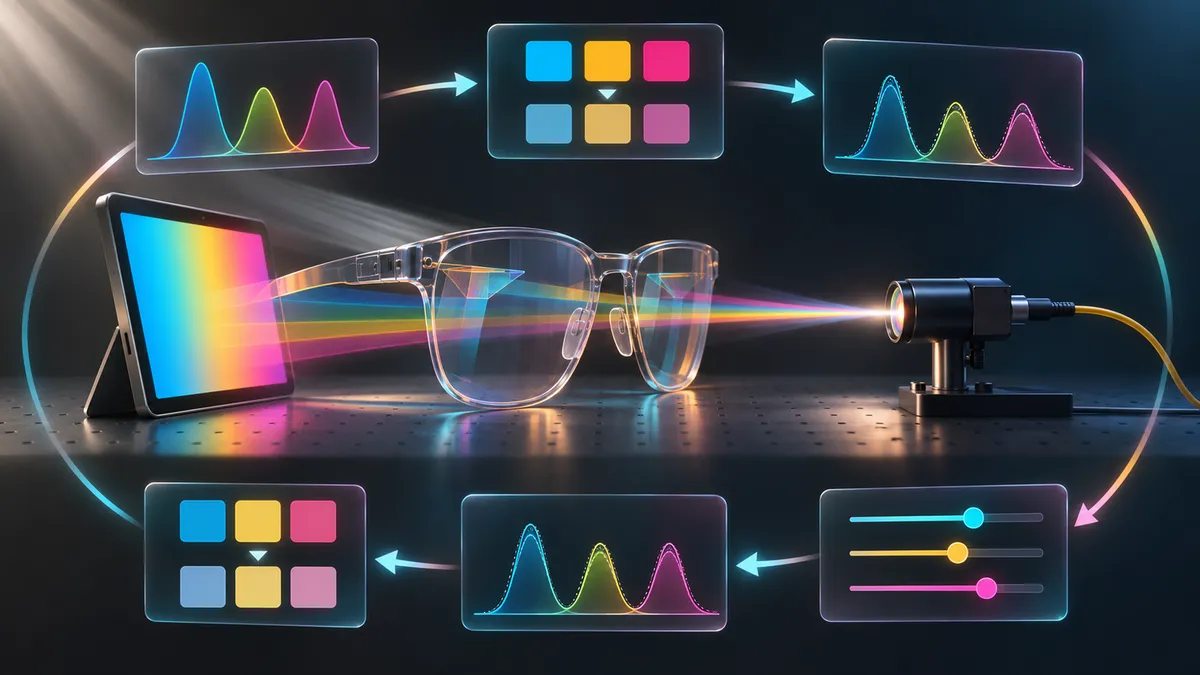
An automated experiment can choose a new setting—but what happens when its software cannot perform the next useful test? A new preprint explores a research loop in which agents revise the tools used to investigate a persistent scientific goal, demonstrated through color matching in see-through augmented-reality glasses.
Keeping the goal, changing the tools
In a preprint published on November 3, 2026, Tianxing Zhu, Huacheng Lu, Ming Liu and Malte Hillebrand propose “goal-driven self-recursive” optical research. Their idea is that measurements should inform not only the next experiment, but also changes to the software, protocols and models that make experiments possible.
The authors call this self-recursive because evidence changes the means used to gather further evidence. The scientific objective remains fixed while the experimental environment evolves. Their framework encompasses hardware changes, but the reported demonstration centers on expanded software control, spectral feedback and model refinement—not autonomous construction of new optical equipment.
A color problem with physical limits
The case study concerns optical see-through displays. Light emitted by the glasses combines with background light transmitted through them. Matching a desired color therefore requires accounting for both contributions at a particular viewing position.
The apparatus uses an iPad to generate backgrounds and RayNeo X3 glasses to add display light. A TOP 300 optical probe, coupled to a CAS140D spectroradiometer, measures the combined spectrum. Both measurement devices are from Instrument Systems.
The researchers convert spectra into CIELAB color coordinates using a specified reference white. They report mismatch as ΔE*76, a distance in that color space: smaller values mean closer colorimetric matches. That number alone does not establish how a person would judge the result under other viewing conditions.
There is also a basic constraint: adding display light cannot produce every conceivable target against every background. Better software can expose more settings, but it cannot eliminate the physical limits of the optical arrangement.
Making a requested color stay put
A practical obstacle was ensuring that a model-generated color remained displayed throughout a spectrometer acquisition. The revised glasses application accepts arbitrary RGB “HOLD” commands through a USB/ADB interface, retains the requested color and returns identifying information and drawing acknowledgements. The host stores this state information with the spectrum.
The authors report validation of all 64 named stimulus commands and 12 passed live device-control tests. Three framebuffer checks, each sampling 384 pixels, found no RGB mismatches. These checks support command execution; they are not, by themselves, evidence of color accuracy.
At fixed eye selection, patch geometry and brightness, the revised interface exposes the full digital RGB range rather than catalog-based playback. This makes settings selected by the model executable and available for measurement.
What the measurements showed
For one target, the authors report an initial mismatch of 19.756 ΔE*76. Two feedback-guided updates reduced it first to 5.315 and then to 1.211—a reported reduction of 93.9%. In a separate five-target comparison, all five improved, and the median mismatch fell from 9.377 to 1.882.
These results concern feedback adjustment of display settings. The paper separately examines whether revising a reusable response model improves later experiments.
The characterization corpus contains 2,170 stimulus conditions plus 356 control measurements. Three model families were compared using predictions for whole target-color groups excluded from fitting. Their prediction errors were 1.842, 1.363 and 1.444 ΔE*76 RMSE. The selected model retained an affine XYZ relationship but fitted its parameters to minimize CIELAB residuals; adding bounded quadratic terms did not deliver the lowest prediction error.
After refitting, the selected model was tested against its predecessor on three targets under three backgrounds. It improved seven of nine physical matches and worsened two. The median paired decrease was 0.197 ΔE*76. That is a more modest, mixed result than the headline feedback example and should not be conflated with it.
A framework, not a general guarantee
The paper’s mathematical account separates three factors: the best match physically attainable, the penalty from inaccessible commands and the model’s approximation error. Under assumptions including globally optimal selection of the predicted setting and a uniform model-error bound, it derives an upper bound combining those contributions.
The sampled prediction scores do not establish that uniform bound across every executable command. Likewise, opening the full RGB command range removes the modeled command-access gap only for the stated configuration; it does not make every target attainable.
The evidence demonstrates the concept in one optical arrangement. It does not establish transfer across devices or viewing geometries, and the paper presents time-dependent stimulus investigations as a possible extension rather than a completed result. Its strongest demonstrated lesson is narrower: dependable experimental control can enable useful feedback, while revised models still require fresh physical tests.
- autonomous experimentation
- scientific agents
- optical see-through displays
- color matching
- spectral feedback
- experimental software
- CIELAB