TRANSMISSION // 2611.04371v1
When a Robot Experiment Becomes Scientific Evidence
Source published
A review preprint argues that autonomous laboratories should be judged not only by how quickly they operate, but by whether their records and follow-up tests support scientific claims. Its framework separates physical execution, experiment selection and evidence assessment, while acknowledging limits in the review’s literature selection and workflow coding.
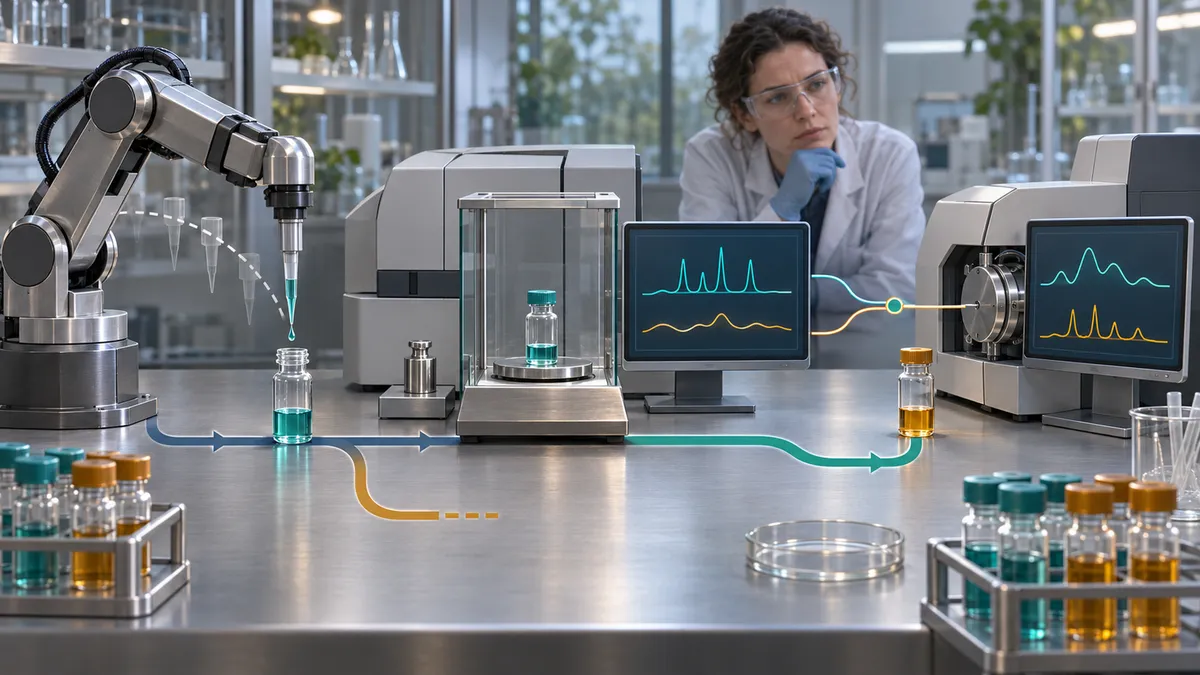
A robot can complete a laboratory procedure without establishing that the intended experiment actually happened. In a November 3, 2026 preprint, Wenhao Xu and colleagues examine what must connect automated actions to interpretable measurements and independently tested findings.
Beyond completing the task
A successful robot movement is not necessarily a successful experiment, and a successful experiment is not automatically a confirmed discovery. That distinction anchors Embodied AI for Scientific Discovery: From Physical Action to Scientific Evidence, a review preprint by Wenhao Xu and colleagues posted on November 3, 2026.
The paper connects two research traditions: robot learning, which develops physical competence, and AI for science, which helps choose experiments and interpret results. The authors argue that evaluating these capabilities separately can obscure whether an automated workflow produces trustworthy scientific evidence. Their contribution is an analytical framework and evaluation proposal, not a newly demonstrated laboratory system.
Three questions behind every experiment
The review organizes workflows around three forms of “closure,” meaning different connections that must be checked.
Operational closure asks whether the physical experiment matched the intended procedure. Did the apparatus deliver the required material, maintain the specified conditions and preserve specimen identity?
Epistemic closure asks whether observations informed a scientific belief or the choice of the next experiment. A system can execute flawlessly yet investigate conditions that do little to answer its question.
Evidential closure asks whether the experimental record and follow-up support a claim. Calibration, specimen history and fresh confirmation matter here, rather than task completion alone.
The authors propose reading these connections through four linked functions: Record, Diagnose, Calibrate and Confirm. These are not simply consecutive automation stages. Diagnosis can prompt recalibration or a new preparation, while confirmation can narrow or overturn an earlier interpretation.
Commands are not measurements
A central distinction is between commanded, realized and observed conditions. Telling a pipette to dispense a volume does not establish how much liquid reached the vessel. An instrument reading also depends on the specimen, apparatus state and measurement process.
The review uses viscous-liquid handling to illustrate this gap. It describes published work in which optimizing aspiration and dispensing rates, with gravimetric feedback, achieved transfers within 5% percentage transfer error for viscosities up to 1,275 centipoise on the tested automated pipettes. The authors emphasize that this result depends on the equipment and transfer volume; it is not a universal tolerance.
Failure records matter for the same reason. A qualified assay that finds no product can be a valid negative result. A failed transfer may mean the intended response was never generated. An unclear detector signal may leave the outcome inconclusive. Treating all three as low performance teaches an optimizer a mixture of scientific response and execution reliability. Discarding failures can instead leave a selectively favorable dataset.
What existing workflows establish
The paper’s evidence map covers 28 selected workflows: 26 physical systems and two software-boundary components. It distinguishes decisions about specimen access, preparation, experiment selection, measurement, interpretation and confirmation. These categories describe reported responsibilities, not a ranking of scientific validity.
Examples show why boundaries matter. RoboChem combines reaction optimization with inline nuclear magnetic resonance measurements, while researchers still define the search space, prepare stocks and isolate products. Adaptive microscopes and field instruments decide where or when to measure, but accuracy at selected locations cannot establish what happened in unobserved regions.
The review also discusses reassessment of A-Lab’s inorganic-material synthesis results. According to its account of the published correction, conclusions remained correct for 36 of 40 reported successes, while four compounds became inconclusive after reanalysis. Novelty wording narrowed to materials new to the prediction platform. The example illustrates how characterization and correction can change a claim without erasing the achievement of automated execution.
Count evidence, resources and human work separately
The authors recommend separate accounting for actions, attempted experiments, valid observations, campaigns and confirmed claims. A high completion rate cannot substitute for a high rate of valid measurements. Repeated readings of one preparation do not measure variation between independent preparations.
Their proposed comparisons cross reference and adaptive experiment selectors with baseline and improved executors. Holding the endpoint and resources constant would help distinguish gains from better experiment choice from gains in physical reliability. Budgets should include calibration, recovery, confirmation, consumables, instrument time and human intervention.
Confirmation also needs fresh evidence not reused from candidate selection. Different assays can still share preparation errors, so using another measurement technique does not automatically establish independence.
A framework with explicit limits
This is a structured narrative review, not a systematic review or exhaustive census. The authors acknowledge that original search strings, database hit counts and screening exclusions were not reproducibly recorded. Agreement between independent coders was not assessed, and an unreported capability is not evidence that a system lacks it.
The checklist and research propositions are proposals, not an established standard or experimentally proven route to better discovery. Their central recommendation is nevertheless concrete: assess automated science through the traceable connection between intended actions, realized conditions, measurements and claims—not speed or autonomy labels alone.
- embodied AI
- AI for science
- self-driving laboratories
- scientific evidence
- robotic experimentation
- experimental validity
- reproducibility
- preprint