TRANSMISSION // 2611.04181v1
Could internal rhythms give AI a different way to process time?
Source published
An arXiv preprint argues that internally maintained rhythms and signal delays could help AI route information and organize memory. Its spiking-network simulations show that changing transmission delays disrupts learned sequences, but whether self-generated timing outperforms existing AI architectures remains untested.
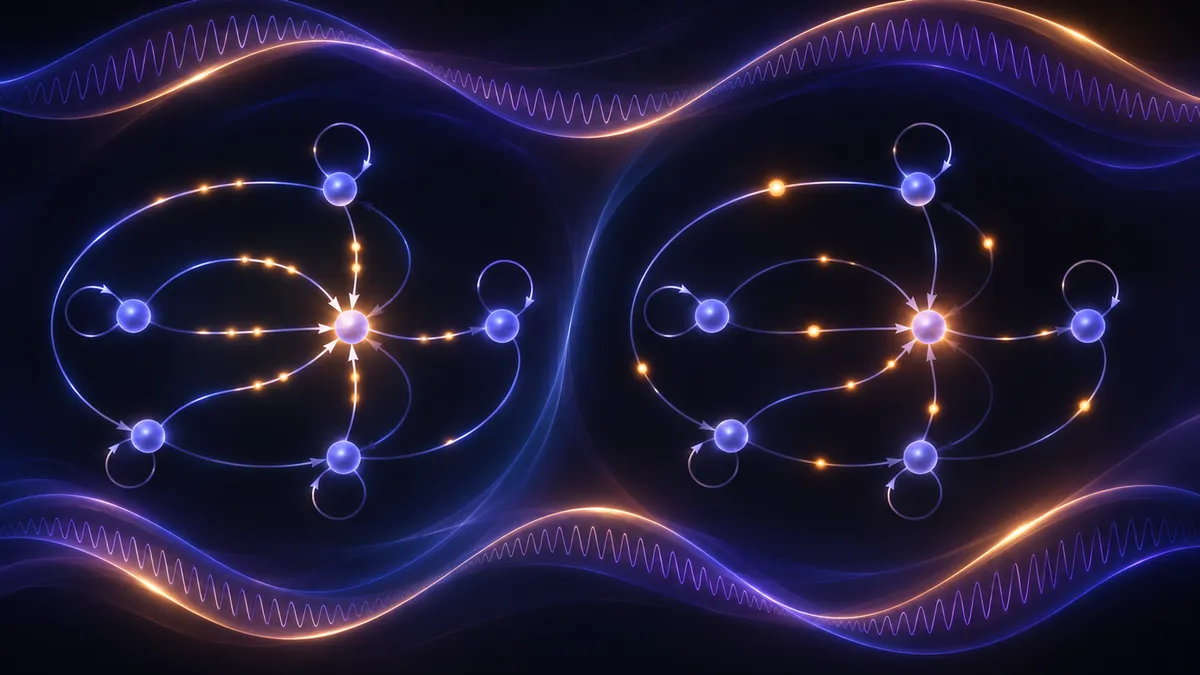
Knowing which event came next is not the same as tracking how much time passed. Meysam Hashemi, Alireza Valizadeh and Viktor Jirsa explore that distinction in a preprint asking whether sequence-processing AI could benefit from temporal structure maintained within the system itself.
A sequence model can distinguish the first input from the fifth without independently tracking the time between them. In an arXiv preprint posted on November 3, 2026, Meysam Hashemi, Alireza Valizadeh and Viktor Jirsa ask whether this distinction points to useful alternatives for AI design. Their paper combines neuroscience evidence, computational proposals and spiking-network simulations—not a demonstration that brain-inspired clocks outperform mainstream AI.
The authors call their proposed resource endogenous temporal structure: internally generated rhythms and maintained timing relationships, including transmission delays, that shape computation rather than merely describe input order.
Order is not elapsed time
The paper uses a timing-invariance test to explain the distinction. Without timestamps, a reactive sequence model processes the same ordered inputs identically whether they arrive milliseconds or hours apart. An internally evolving system can instead encounter each input at a different phase of its own activity.
This is not a claim that all artificial networks lack autonomous dynamics. The authors discuss continuous-time models, oscillatory state-space models and recurrent networks that learn rhythms. Such alternatives must be included in fair comparisons.
Brains provide motivation, but not proof of superiority. Some studies link stimulus detection or attention to ongoing neural phase; others fail to reproduce particular effects or question how behavioral rhythms were identified. Even a genuine phase effect could impose a cost by making a target easier to miss at an unfavorable moment.
What changing delays revealed
The paper’s main simulation examines polychronous neuronal groups: reproducible firing cascades in which neurons activate at different times, but transmission delays allow their signals to converge on downstream targets. Neurons can participate in multiple differently timed groups.
The researchers trained two networks of 1,000 spiking neurons each, with 800 excitatory and 200 inhibitory cells, using a learning rule sensitive to spike timing. One network had excitatory delays distributed from 1 to 20 milliseconds. The other placed neurons on a spatial sheet and assigned delays according to connection distance.
After training, the authors fixed connection weights and connectivity, then changed the excitatory delays. Shuffling preserved the overall delay distribution but reassigned delays among connections. A minimum-delay control set every excitatory delay to one millisecond. Although described as instantaneous transmission, this was not literally zero delay: the numerical update scheme did not support it.
Crucially, the analysis separated capacity, meaning the number of distinct groups detected under each condition, from retrieval, meaning reactivation of the original groups at their original timing. Retrieval required at least half a group’s members to fire within two milliseconds of their baseline times.
Shuffling preserved some detected capacity while impairing retrieval much more strongly. At the longer causal-chain threshold, retrieval disappeared in both networks although some capacity remained. Capacity declined more sharply in the spatial network. Setting delays to the minimum eliminated detected capacity at both tested chain-length thresholds, while a small fraction of shorter baseline sequences still met the retrieval criterion.
These results support a narrow conclusion: specific delay assignments can carry information beyond fixed weights and connectivity. Group counts depend on detection rules and chain-length thresholds, and candidate groups were sampled rather than exhaustively enumerated. The experiment does not establish an advantage over transformers or other resource-matched AI systems.
Four functions to investigate
Beyond delays, the authors identify three possible roles for internal rhythms. First, phase-dependent routing could make connections more or less effective as populations move through receptive windows. Whether observed brain coherence causes communication or reflects it remains uncertain.
Second, nested slow and fast rhythms could organize ordered memory. The paper illustrates an abstract code in which phase specifies position and amplitude specifies identity. Direct sampling permits linear decoding under ideal alignment, but amplitude noise limits distinguishable identities, and timing jitter becomes more problematic as slots narrow. The implementation treats phase and amplitude independently, so it does not explicitly implement biological theta–gamma gating.
Third, rhythms might coordinate offline transfer between fast and slow memory systems. The authors call this the weakest proposed function: existing replay methods already prioritize useful experiences, so rhythmic timing must add value beyond choosing replay content.
The decisive comparison is still missing
The proposed tests would give reactive baselines timestamps and match parameters, memory, training resources and inference costs. Benefits should appear on specified temporal tasks, not equally on atemporal controls, and should diminish when the relevant timing mechanism is disrupted.
For oscillatory functions, another control is essential: compare self-generated rhythms with an equivalent externally supplied oscillation. Equal performance would support temporal structure without establishing a special benefit from generating it internally. No new empirical data were collected, and the broader hypothesis remains a research program rather than a demonstrated remedy for AI agents’ wall-clock timing failures.
- sequence-processing AI
- endogenous temporal structure
- neural oscillations
- transmission delays
- polychronous neuronal groups
- memory retrieval
- phase-dependent routing
- cross-frequency multiplexing