TRANSMISSION // 2611.04015v2
How interactions may create Weyl superfluidity from ordinary bands
Source published
A theoretical proposal uses attractive interactions in a three-dimensional optical lattice to produce topological superfluid phases, even though the atoms’ noninteracting bands are topologically trivial. Mean-field calculations predict Weyl nodes in several configurations and fully gapped alternatives. This is not an experimental observation, and effects beyond the approximation remain uncertain.
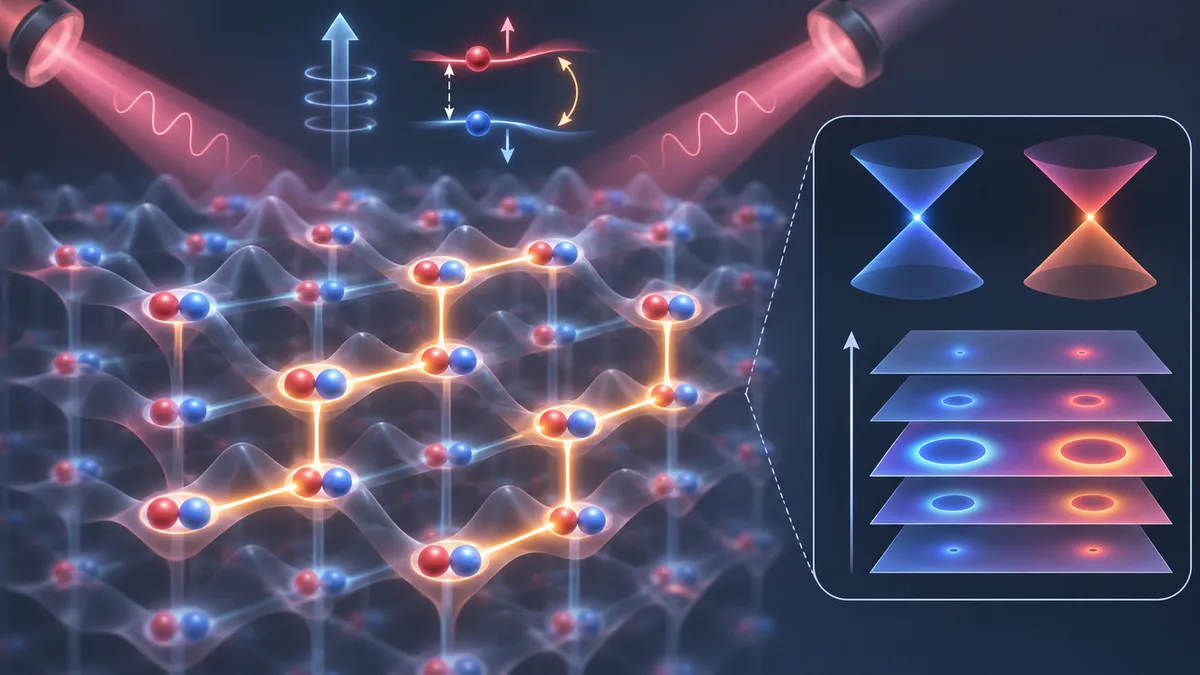
Can interactions do more than bind atoms into pairs—can they help create a superfluid’s topology? Yong-Huan Wang and Xin-Chi Zhou propose a route using ultracold potassium atoms in a carefully designed optical lattice. Their calculations suggest that tuning interactions and particle filling could switch among distinct topological phases.
The puzzle: topology without topological starting bands
Weyl points are isolated crossings in a three-dimensional energy spectrum. In a Weyl superfluid, the relevant spectrum is that of Bogoliubov quasiparticles: excitations described in terms of particles and holes in a paired state. Such phases are interesting partly because their topology can produce unusual boundary states. One proposed route to topological superfluidity combines single-particle spin-orbit coupling, a Zeeman field, and attractive pairing. But the Zeeman splitting needed in that scheme can also make pairing harder.
This paper asks whether interactions can help resolve that tension—and produce Weyl superfluidity even when the noninteracting bands are topologically trivial.
A resonance that depends on who occupies a site
The authors model fermionic atoms in a three-dimensional optical Raman lattice. A large Zeeman splitting makes ordinary spin-flip hopping energetically unfavorable. Meanwhile, an attractive on-site Hubbard interaction lowers the energy of two atoms occupying the same site. When the interaction nearly compensates the Zeeman energy mismatch, particular two-particle processes can become resonant.
In plain terms, local occupancy changes which hops are energetically allowed. The resulting occupation-dependent spin-orbit coupling links neighboring pairs of spin-down atoms with on-site pairs, or doublons. The authors describe a route to mobile pairs with mixed s-wave and p-wave components. Spin-conserving tunneling between lattice layers extends the setup into three dimensions.
The interaction is not simply acting on a pre-existing topological band. In this proposed mechanism, it helps generate effective spin-orbit coupling and pairing processes that enable topology in the superfluid’s quasiparticle spectrum.
What the calculations find
The researchers use a self-consistent mean-field treatment of the microscopic model. They examine the quasiparticle spectrum and the topology of two-dimensional momentum slices through the three-dimensional system. Each gapped slice can be characterized by a Chern number, a mathematical label for its band topology.
The calculated phase diagram includes Weyl superfluids with two, four, or eight Weyl nodes, as well as fully gapped weak topological superfluids. In the Weyl phases, the gap closes at isolated momenta as momentum along the z direction—perpendicular to the layers—varies through the interlayer dispersion. The Chern number of the slices changes across those points. In the fully gapped phases, the slices retain a nonzero Chern number throughout. The calculations indicate that changing interaction strength and particle filling can move the system between phases and alter the number of nodes.
The authors also outline a possible implementation with ultracold potassium-40 atoms, including laser-lattice and magnetic-field controls. This is an experimental proposal, not evidence that the predicted phases have been produced or observed.
What remains uncertain
The central limitation is the mean-field approximation. It makes calculations of pairing and quasiparticle bands tractable, but does not capture every many-body fluctuation. The authors note that fluctuations and residual quasiparticle interactions could shift Weyl-node positions and phase boundaries. They argue that weak residual short-range interactions should not remove the topological charges of isolated, linearly dispersing nodes. That conclusion is theoretical, not an experimental test.
Practical realization also remains to be demonstrated. The proposal requires coordinating strong attraction, a large Zeeman splitting, Raman-assisted hopping, and tunneling between layers. The paper estimates parameters for potassium-40, but estimates do not establish that the desired phase can be prepared, maintained, or identified in an experiment.
This account is based on the paper text and abstract supplied for this article. The work is an arXiv preprint; the supplied material does not establish its peer-review status. Its results should therefore be read as a theoretical proposal, not a settled experimental finding. The study presents a mechanism and testable predictions, while leaving open how robust the phases are beyond mean-field theory and whether they can be realized in the laboratory.
- Weyl superfluid
- ultracold atoms
- optical Raman lattice
- interaction-driven topology
- spin-orbit coupling
- mean-field theory
Reviewed cross-references
These connections were reviewed by a model, not independently fact-checked by a human. Similarity does not imply agreement; consult the original papers and the evidence below.
A Raman route to anyon-like behavior in a one-dimensional lattice
Shared method: Both papers use Raman coupling in an optical lattice to engineer occupation-dependent terms: Wang and Zhou describe interaction-assisted spin-flip hopping that produces density-dependent spin-orbit coupling for fermion pairs, while Cabedo and colleagues describe density-dependent tunneling phases for Raman-dressed bosons. This is a shared design approach, not a shared model or result; the systems differ in statistics, dimensionality and engineered terms, and the Weyl phases are mean-field predictions.
Model review: · openai-codex/gpt-6-luna
Evidence and provenance
Selected excerpts, not complete papers. PDF extraction can omit figures or damage equations, tables and reading order; sources may be preprints.
2611.04015v2 — Original paper
Excerpt reference:
static/papers/2611.04015v2.md:56-106
Basis: Paper text
Source SHA-256:464c34707f26f42796a12e528919c774897ceb9807a41d035309cebfa61414c52611.04015v2 — Original paper
Excerpt reference:
static/papers/2611.04015v2.md:12-55
Basis: Paper text
Source SHA-256:464c34707f26f42796a12e528919c774897ceb9807a41d035309cebfa61414c52611.09855v2 — Original paper
Excerpt reference:
static/papers/2611.09855v2.md:64-121
Basis: Paper text
Source SHA-256:1d25bdee04a2aef88ea570e9493fec2191065860ee8ee6b50337fd1fbfc39c142611.09855v2 — Original paper
Excerpt reference:
static/papers/2611.09855v2.md:12-63
Basis: Paper text
Source SHA-256:1d25bdee04a2aef88ea570e9493fec2191065860ee8ee6b50337fd1fbfc39c14
Related reading
Automatically matched by shared topic keywords. These links do not imply that the sources agree or establish a consensus.
Could axions reshape magnetic turbulence? A theoretical study links field-line geometry to energy spectra
Source published
Shared keywords: mean field theory
Nuclear symmetry breaking rearranges where correlations live
Source published
Shared keywords: mean field theory
When two atoms scatter light as a pair
Source published
Shared keywords: ultracold atoms
When two atoms interact more strongly than they radiate
Source published
Shared keywords: ultracold atoms
A Raman route to anyon-like behavior in a one-dimensional lattice
Source published
Shared keywords: ultracold atoms