TRANSMISSION // 2611.03690v1
Accurate plasma forecasts do not guarantee reliable tokamak control
Source published
A simulation study finds that learned models’ forecasting accuracy does not fully describe how controllers trained inside them perform. Broader training coverage improved prediction consistently in one configuration, but episode completion, duration and tracking errors revealed different strengths and weaknesses.
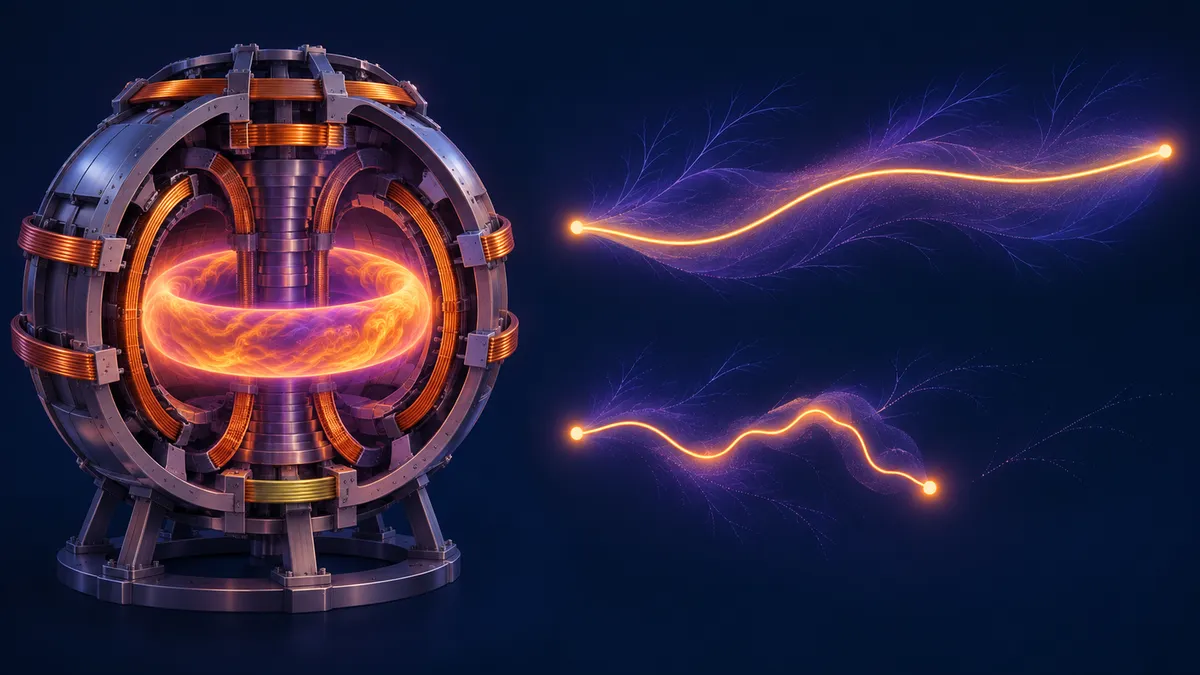
A model can predict recorded plasma trajectories accurately yet provide an unreliable training environment for a controller. In a preprint, Guoyang Shi and colleagues examine this gap using tokamak simulations, finding that prediction scores and successful episode counts each leave important parts of control performance hidden.
Magnetic control in a tokamak regulates plasma current, position and shape through interacting plasma and electrical-circuit dynamics. A learned simulator offers an environment in which reinforcement-learning controllers can practice. But accurately replaying recorded behavior is not the same as representing the behavior that a newly optimized controller will produce.
In the preprint From Forecasting to Feedback: Evaluating Learned Dynamics for Tokamak Control, submitted on 27 October 2026, Guoyang Shi and colleagues investigate that distinction. Their controlled comparison transfers controllers from learned models into a physics-based reference simulator—not into a working tokamak.
Four ways to collect training data
The reference environment was FGE, a solver that combines plasma equilibrium, circuit dynamics and current evolution. The researchers used a configuration calibrated to EXL-50U discharge 13844. The paper reports agreement with principal experimental trends, while cautioning that remaining mismatches prevent treating FGE as an exact digital twin.
The team collected four datasets using the same frozen reinforcement-learning controller and the same collection-noise process. D1 provided a narrow baseline. D2 varied physics parameters, D3 varied requested plasma-current trajectories, and D4 combined both forms of coverage.
Each dataset supplied matched budgets of 500, 1,000, 3,000 and 5,000 simulated rollouts, producing 16 Transformer-based dynamics models. These models predicted the next state from recent states and applied coil voltages. Evaluation fed predictions back into subsequent steps, testing how errors developed over a trajectory rather than only one step ahead.
Controllers were then trained with proximal policy optimization inside the four 5,000-rollout models. Each model produced one controller trained without added action perturbations and another trained with them. Those perturbations were separate from the noise used during data collection.
More data did not help every model equally
D4 was the only configuration whose average prediction error across four held-out conditions decreased at every tested data budget. Its normalized cross-condition error fell from 0.528 to 0.381, a reduction of about 28%.
D1 showed why a narrow validation result can mislead. Its error on the matching, in-distribution condition improved from 0.345 to 0.135, while its average error outside that distribution rose from 0.960 to 1.060.
These comparisons do not isolate coverage as the sole cause. D2 and D4 received physics parameters as model inputs, whereas D1 and D3 did not. Equal rollout counts also did not mean equal effective information: a broader rollout could contain more diverse transitions.
Completion concealed differences in endurance
The frozen controllers were evaluated without adaptation in FGE. Six conditions combined three current endpoints—400, 500 and 600 kiloamperes—with nominal or perturbed physics. Each episode lasted up to 400 steps, equivalent to 0.4 seconds.
Without action-noise training, D2, D3 and D4 each completed five of six conditions, or 83.3%. Yet they reached, on average, 99.0%, 94.7% and 90.5% of the evaluation horizon, respectively. Their worst conditions lasted 94.2%, 68.2% and 43.2% of the horizon. Identical completion rates therefore concealed markedly different failure timing.
D4 had the lowest average forecasting error, but D2 had the highest mean horizon reached. Among completed episodes, D2 also had numerically lower average current and boundary tracking errors than D4. Tracking statistics excluded failed episodes, so they describe successful subsets rather than overall reliability.
Action-noise training performed worse in these trials
Across 24 matched configuration–condition pairs, nominal-training controllers completed 19 evaluations; action-noise-trained controllers completed five. Mean episode length, capped at 400 steps, fell from 372.8 to 207.5 steps. On the five conditions completed by both regimes, current and boundary errors were also numerically larger after action-noise training.
This is evidence about the tested setting, not a general verdict on noise-based training. Each configuration used one trained policy per regime and one evaluation realization per condition. The six conditions were distinct tests, not repeated trials, and termination times did not identify the underlying failure mechanism.
The study supports evaluating learned control environments with several complementary measures: prediction error, completion, condition-level duration and tracking quality. Within this reference-solver comparison, none alone captured the full picture.
- tokamak magnetic control
- learned dynamics
- reinforcement learning
- Transformer models
- plasma simulation
- data coverage
- closed-loop evaluation