TRANSMISSION // 2611.03100v4
When AI agents fix a system but misdiagnose the fault
Source published
A synthetic-world benchmark separates AI agents’ experiments, predictions, diagnoses and interventions—and shows why successful repairs alone may hide weak causal reasoning.
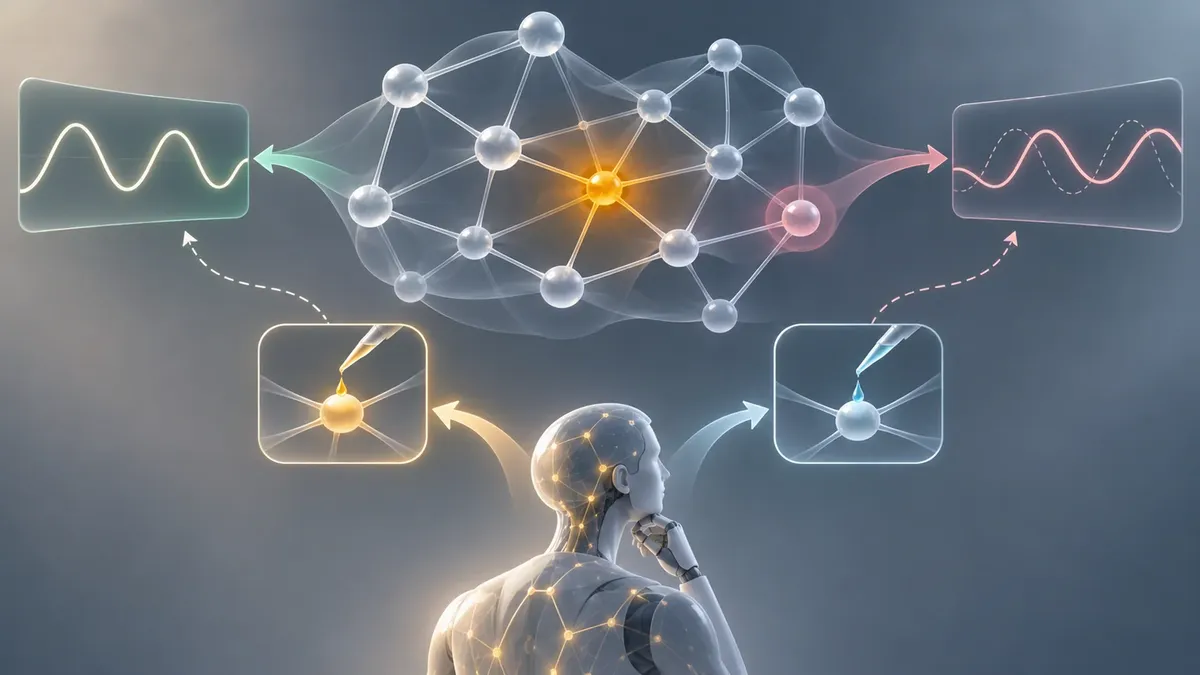
An AI agent can restore a malfunctioning system without identifying what went wrong. LUCA, a benchmark built around synthetic regulatory networks, lets researchers examine the experiments and evidence behind an agent’s decisions—not just whether its final intervention worked.
An agent that fixes a malfunctioning system may still have no sound account of what caused the problem. That distinction matters for scientific AI: if an evaluation checks only whether the final intervention works, it can miss faulty diagnoses and weak use of evidence.
In LUCA: A Synthetic World for Experimental Reasoning, Anna Gogleva and colleagues introduce a benchmark designed to make those hidden steps measurable. They test whether AI agents can choose experiments, predict outcomes, identify hidden faults and attempt repairs—each as a separate capability.
A controllable world for testing experiments
LUCA models synthetic organisms as networks of interacting genes and external signals that produce observable outputs, called phenotypes. A hidden malfunction can push one or more outputs outside their healthy range. Agents do not see the network’s internal structure: they must probe it through interventions and observe the results.
The environment is inspired by gene-regulation research, but the authors stress that it is not a realistic model of cellular biology. Its vocabulary and networks are constructed, and the evaluator knows the full underlying system. This gives researchers access to ground truth, including what different experiments would reveal, while preventing an agent from simply looking up the invented system.
Agents work under a limited experimental budget. In healthy scenarios, they explore and then predict the result of unseen, two-gene interventions. In disease scenarios, they must also commit to a diagnosis before testing a rescue intervention. That order matters: it prevents an agent from trying repairs first and using a successful one to infer its diagnosis afterward.
The study evaluated seven large language models and three non-LLM baselines. The authors report 1,200 agent–organism sessions across three difficulty tiers and healthy or disease settings, with 20 random organisms per condition. They also ran a separate scaling study, increasing network size for four language models and the baselines.
A repair can succeed for the wrong reason
The central finding is a gap between repairing a system and correctly diagnosing it. Across the tested models, rescue scores were higher than diagnosis scores. A compensatory intervention can restore an output even if it does not target the original fault—much as easing a symptom does not necessarily identify its cause.
Diagnosis varied more across models than prediction did: on medium-difficulty disease tasks, diagnosis scores spanned a sevenfold range, compared with a 1.4-fold range for prediction. The authors also report that some models reached high rescue scores while diagnosing correctly in no more than 55% of cases. These results show why a single overall score can blur distinct abilities.
The researchers also examined how agents explored. Some tested nearly all available genes; others sampled fewer. More exploration did not reliably mean better performance. In one especially revealing case, the authors looked at sessions involving signal malfunctions that could resemble gene malfunctions. An experiment could distinguish the explanations, and agents performed that test in 36 of 56 relevant language-model sessions. Yet only one of those sessions received any diagnosis credit. In other words, gathering a useful observation did not guarantee that the agent used it correctly.
What the results do—and do not—show
LUCA’s main strength is experimental control: because the simulated mechanisms are known, researchers can separate failures in experiment choice, prediction, diagnosis and intervention. The benchmark also illustrates how a successful action can coexist with an incorrect explanation.
But the results do not establish that AI agents behave the same way in living cells, laboratories or other scientific settings. LUCA uses fixed-point dynamics, does not capture oscillatory or multistable behaviour, and tests single sessions rather than investigations that unfold over multiple sessions. Some systems may also be underdetermined: different hidden networks can fit the same observations but imply different outcomes for untested interventions. That means a wrong prediction or diagnosis may sometimes reflect ambiguity in the evidence, not only a reasoning failure.
There is an additional version-specific caveat. The paper’s November 2026 author note says later fixes address implementation issues affecting some results and comparisons, and that evaluations with the updated repository may produce different numbers. The authors plan to report updated evaluations in a future revision. Readers should therefore treat the reported measurements as results from the original LUCA environment, not assume they are unchanged in later versions.
The paper is a preprint, and its findings are specific to a constructed benchmark; they should be read as evidence about performance in that setting, not as a verdict on scientific AI as a whole. Still, LUCA makes a useful evaluation principle concrete: to assess an experimental agent, ask not only whether it achieved a successful outcome, but also what it tested, what evidence it encountered and whether its conclusion followed from that evidence.
- artificial intelligence
- scientific reasoning
- experimental design
- causal inference
- AI evaluation
- synthetic systems
Reviewed cross-references
These connections were reviewed by a model, not independently fact-checked by a human. Similarity does not imply agreement; consult the original papers and the evidence below.
AI Can Fix a Simulated System Without Finding What Broke It
Supporting evidence: Both papers report that agents can rescue synthetic regulatory systems without correctly diagnosing the hidden fault. The focused study reports perfect rescue but 55% diagnosis for Opus and 35% for Sonnet on medium-difficulty organisms, and describes discriminating evidence appearing in many sessions. These are closely related studies by the same authors using LUCA, not independent replication; the LUCA paper’s author note says later fixes affect some results and comparisons, so updated evaluations may differ. The findings concern synthetic systems and do not establish the pattern in real biology.
Model review: · openai-codex/gpt-6-luna
Evidence and provenance
Selected excerpts, not complete papers. PDF extraction can omit figures or damage equations, tables and reading order; sources may be preprints.
2611.03100v4 — Original paper
Excerpt reference:
static/papers/2611.03100v4.md:13-75
Basis: Paper text
Source SHA-256:69c6dc426dfa24957bd544fc24d867835461b22f1cc8def7280ebecb792d6fef2611.03100v4 — Original paper
Excerpt reference:
static/papers/2611.03100v4.md:76-177
Basis: Paper text
Source SHA-256:69c6dc426dfa24957bd544fc24d867835461b22f1cc8def7280ebecb792d6fef2611.04473v1 — Original paper
Excerpt reference:
static/papers/2611.04473v1.md:138-251
Basis: Paper text
Source SHA-256:455deff2a1af17221c0aa0d0f8002266ca0bfe53b58f58bb6dca35093daa54972611.04473v1 — Original paper
Excerpt reference:
static/papers/2611.04473v1.md:499-614
Basis: Paper text
Source SHA-256:455deff2a1af17221c0aa0d0f8002266ca0bfe53b58f58bb6dca35093daa5497
Related reading
Automatically matched by shared topic keywords. These links do not imply that the sources agree or establish a consensus.
AI Can Fix a Simulated System Without Finding What Broke It
Source published
Shared keywords: ai evaluation, artificial intelligence, causal inference, experimental design, scientific reasoning
When treatments spill over, an experiment may answer the wrong question
Source published
Shared keywords: causal inference, experimental design
Using geometry to decide where to collect intervention data
Source published
Shared keywords: causal inference, experimental design
Can a computer model knowledge we cannot quite explain?
Source published
Shared keywords: artificial intelligence, scientific reasoning
Can AI Make Scientific Reasoning Easier to Check?
Source published
Shared keywords: artificial intelligence