TRANSMISSION // 2611.02828v2
Choosing galaxies could shape the science of a future giant telescope
Source published
A preprint explores how the proposed Wide-field Spectroscopic Telescope could choose its targets to study cosmic expansion, early-universe physics and neutrino masses. Its forecasts suggest that simpler galaxy selections could compete with conventional approaches, while the best high-redshift strategy depends on the scientific goal.
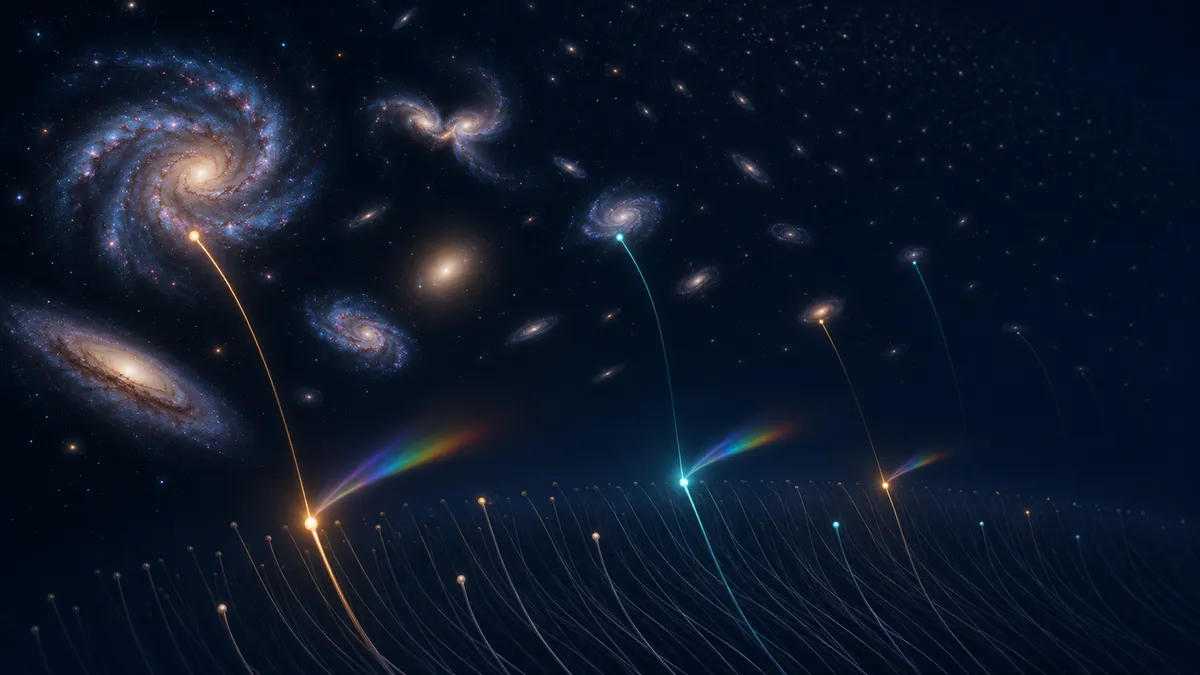
A larger telescope can collect light from fainter galaxies, but that does not automatically make every faint galaxy worth observing. A new forecasting study asks how a future spectroscopic survey should balance target selection, observing time and the cosmological questions it hopes to answer.
Designing the sample before observing
The proposed Wide-field Spectroscopic Telescope, or WST, could operate in Chile in the 2040s if selected. Its design combines a roughly 12-metre telescope with 30,000 low-resolution spectroscopic fibres, allowing it to collect light from many objects simultaneously. Spectra provide redshifts, which help astronomers map the three-dimensional distribution of galaxies and quasars.
In a preprint, Constantin Payerne and colleagues investigate which objects such a facility should target. The paper was first posted to arXiv on November 2, 2026, and revised on November 6. Its landing page describes it as intended for submission to MNRAS, not an accepted journal publication.
The central question is practical: should future surveys extend familiar galaxy-selection recipes to fainter objects, or choose samples differently to exploit the new instrument?
Connecting images, spectra and scientific return
The researchers construct a framework linking target selection to expected cosmological precision and telescope time. They use existing imaging, including deep observations of the COSMOS field from CLAUDS and the Hyper Suprime-Cam survey, to approximate the multiband datasets expected in the WST era.
They estimate how many targets different selections would produce, their redshift distributions, and how often observations would yield usable spectra. A simplified fibre-assignment model estimates how repeated visits could reach targets that cannot all be observed simultaneously.
Finally, Fisher-matrix calculations forecast parameter uncertainties under specified assumptions. These are predictions of possible measurement precision, not observations of dark energy or neutrino masses.
The baseline footprint covers 18,000 square degrees. The calculations examine cosmic distances, the growth of structure, possible departures from Gaussian primordial fluctuations, and the combined mass of neutrinos.
A simpler selection for lower redshifts
Conventional surveys use combinations of brightness and colour to select populations such as bright galaxies, luminous red galaxies and emission-line galaxies. The team extends these approaches to the fainter limits anticipated for WST.
It also develops an alternative called MagMax. This sample uses a single near-infrared H-band brightness limit after separating stars from galaxies. It is not entirely colour-free: the star-removal procedure uses three-dimensional colour information, but there are no additional colour cuts designed to isolate particular galaxy populations.
The baseline MagMax selection contains approximately 30,000 targets per square degree. In the COSMOS data, its star–galaxy separation achieves approximately 99% galaxy purity. That describes contamination, not the fraction of all galaxies recovered or the probability of measuring a redshift.
At a comparable total target density, MagMax produces broadly competitive forecasts for cosmic-distance and structure-growth measurements. Neither strategy wins everywhere: MagMax performs better for some lower-redshift growth measurements, while emission-line galaxies perform better at higher redshifts within the comparison.
More galaxies do not always mean more information
Galaxy clustering contains baryon acoustic oscillations, a characteristic scale inherited from sound waves in the early Universe. Measuring that scale at different redshifts helps constrain cosmic expansion and dark energy.
For some lower-redshift measurements, the forecasts approach the cosmic-variance limit: uncertainty arising because a survey samples only a finite cosmic volume. Once this limit dominates, adding more galaxies to that volume yields diminishing returns. This does not mean denser samples have no other scientific value; information from smaller, more nonlinear scales is not fully explored here.
Different goals favour different distant targets
At higher redshifts, the study considers Lyman-break galaxies. Absorption by hydrogen makes these galaxies faint in particular imaging bands, allowing colour-based “dropout” selections spanning roughly redshifts 2.5 to 5.5.
The preferred observing depth depends on the question. Forecast constraints on local primordial non-Gaussianity, a measure of departures from Gaussian initial fluctuations, improve relatively little after the survey reaches sufficient depth. The explored combinations give uncertainties around 1.1–1.3 on its amplitude parameter.
Neutrino-mass forecasts behave differently. Across designs corresponding to roughly two to seven years of high-redshift surveying, the predicted uncertainty improves from about 20 to 10 millielectronvolts. These estimates incorporate Planck-based cosmological priors; they are not standalone mass measurements.
What still needs validation
The authors emphasise substantial uncertainties. COSMOS is a small field, and its imaging is somewhat deeper than the anticipated ten-year Rubin survey data. It cannot reproduce all the spatial variations of a wide survey.
Redshift-recovery efficiencies and galaxy-clustering models are partly extrapolated from existing observations or simulations. Fibre assignment is approximate, and much of the forecasting uses linear-scale information. The primordial-fluctuation forecasts also omit important large-scale imaging systematics. Observing-time estimates assume all relevant fibres serve cosmology, although WST would share them among science programmes.
The result is therefore a framework for comparing survey choices, not a guaranteed performance specification. Its main lesson is that target selection should follow the scientific objective, rather than simply expanding an existing catalogue.
- Wide-field Spectroscopic Telescope
- galaxy surveys
- cosmology
- target selection
- dark energy
- neutrino mass
- Lyman-break galaxies
- MagMax
Related reading
Automatically matched by shared topic keywords. These links do not imply that the sources agree or establish a consensus.
How distance-unit choices can skew conclusions from galaxy maps
Source published
Shared keywords: dark energy
Galaxy Motions Help Untangle Models of Dynamical Dark Energy
Source published
Shared keywords: dark energy
Stability Limits a Class of Interacting Dark-Sector Models
Source published
Shared keywords: dark energy
Finding more cosmological information in DESI’s nearby galaxies
Source published
Shared keywords: dark energy
Could cosmic voids reveal uneven dark energy?
Source published
Shared keywords: dark energy