TRANSMISSION // 2611.02528v3
How moving nitrogen spins reshape diamond’s quantum echo
Source published
A simulation suggests that treating surrounding nitrogen spins as frozen overestimates NV-center coherence at higher magnetic fields. Modeling their correlated pairwise flips brings predictions closer to measurements without requiring unidentified defects to explain most of the high-field excess. The calculation still falls short at low field.
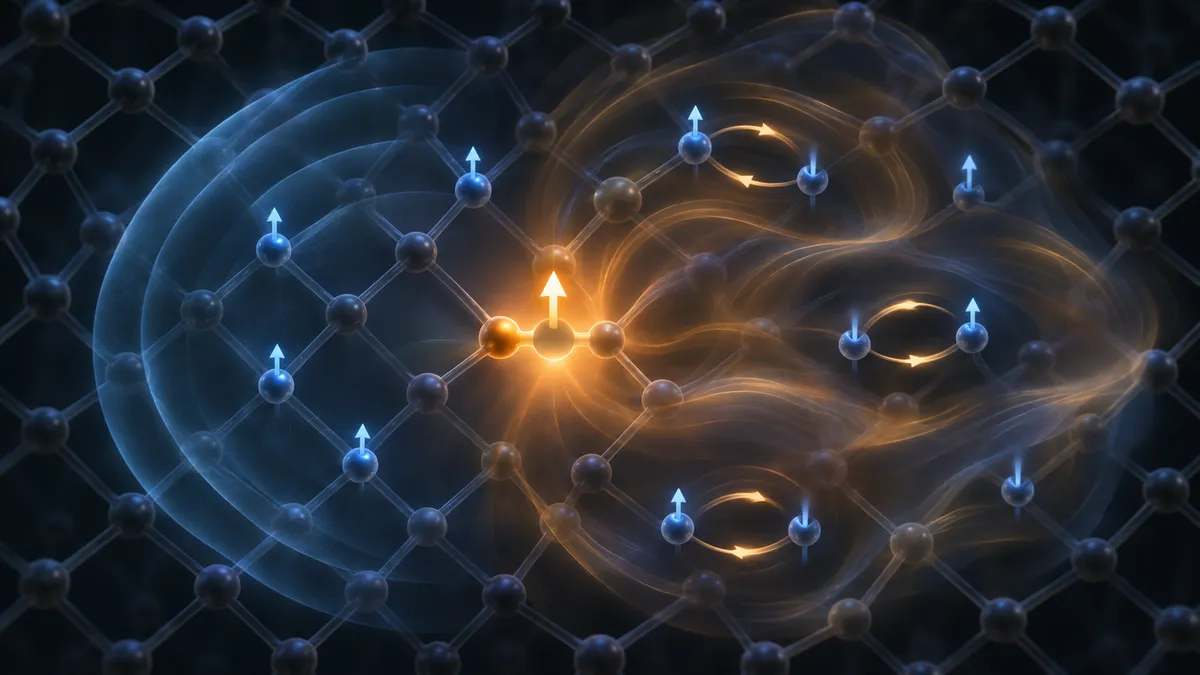
Nitrogen-vacancy centers in diamond are useful quantum sensors, but surrounding spins can scramble their signals. A new simulation asks whether a common calculation overestimates how long those signals remain coherent by treating nearby nitrogen spins as stationary. Its answer is largely yes at higher magnetic fields, but not across the full range.
Why the surrounding spins matter
A nitrogen-vacancy (NV) center is a defect in diamond whose spin can be prepared, manipulated and read optically. Its coherence—the persistence of its quantum phase—sets how long it can gather information before its signal is scrambled. One source of that scrambling is a bath of substitutional nitrogen defects, called P1 centers. Their electron spins interact with the NV center and with one another.
Experiments on nitrogen-rich diamond have found that the Hahn-echo coherence time, T₂, multiplied by nitrogen concentration is about 160 microseconds per part per million, with little change across magnetic fields from roughly 2 to 30 millitesla. Yet some calculations using the cluster-correlation expansion, or CCE, predicted longer coherence at higher fields. One proposed explanation was that real diamonds contain extra, unidentified magnetic defects. Chikara Shinei’s study tests another possibility: perhaps the calculation makes the nitrogen bath too static.
Simulating a bath that can move
CCE calculates spin dynamics within small groups, or clusters, of bath spins. It must also account for spins outside each cluster. If those outer spins are treated as fully mixed, their average magnetic field is zero. If each is assigned a random spin state and held fixed, the resulting local field—the Overhauser field—can detune pairs of P1 centers and hinder their state exchanges, called flip-flops.
The study introduces a third option: let the outer P1 centers flip-flop in pairs while the cluster evolves in their changing field. A kinetic Monte Carlo simulation generates these events at rates calculated from dipolar interactions, rather than fitted to match measured coherence. Because partners exchange states together, each pair conserves its total spin projection along the magnetic-field axis. The model recovers the frozen-field and zero-mean-field approaches as limiting cases when simulated motion is stopped or made extremely fast.
The calculation represents each P1 center as an electron spin coupled to a nitrogen-14 nucleus. It uses CCE to second order, including single centers and pairs, and averages over simulated bath configurations and field histories. Reported uncertainties reflect variation across configurations. This is a computational study, not a new measurement of diamond samples.
The frozen-field excess shrinks
At 30 millitesla, the frozen-field calculation gives T₂ multiplied by nitrogen concentration of 264 ± 16 microseconds·ppm, compared with the experimental benchmark of 160 ± 12. Including pair flip-flops reduces the prediction to 188 ± 12. At 10 millitesla, the dynamic model gives 167 ± 11, close to the benchmark. In this model, much of the high-field excess arises because the static calculation holds the Overhauser field fixed—not because unidentified defects must be added to explain that discrepancy.
The field is not rapidly erased, either. The simulated Overhauser field retains 68–83% of its autocorrelation after 200 microseconds. It remembers much of its earlier value over a timescale relevant to the echo, while changing enough to affect the spin dynamics. Treating it as either perfectly frozen or instantly averaged away misses this intermediate behavior.
The paired nature of the motion matters. A simpler approximation lets each P1 center jump independently, rather than changing states in pairs. At 30 millitesla it predicts 147 ± 9 microseconds·ppm—about 20–30% shorter than the paired model at high fields. The authors attribute the difference to partial cancellation: when two partners exchange states together, their effects on a distant cluster can partly offset one another.
What remains unresolved
The model does not match the benchmark everywhere. At 2.5 millitesla, it predicts 112 ± 8 microseconds·ppm, and even the frozen-field limit remains below the measured value. The calculation also predicts that coherence rises by a factor of 1.69 ± 0.07 from 2.5 to 30 millitesla, while the cited experiment found little field dependence. The low-field shortfall persists when the authors vary assumed flip-flop rates. They point instead to uncertainties in representing strongly hybridized electron–nuclear states and overlapping transition channels. More complex flips involving three or more centers are also outside the model.
Other caveats matter when interpreting the high-field agreement. The simulations include a P1 bath, whereas real ensemble samples may also contain NV centers and other nitrogen-related defects. The authors do not rule out such defects; they argue that the excess in a frozen-field calculation cannot, by itself, establish their concentration. The study uses 23 random bath configurations after excluding one unusually close NV–P1 pair. Its newly developed code is available from the author on request, not publicly released.
The source is an arXiv preprint. The supplied material does not establish its peer-review status, so readers should consult the source for publication updates and treat the findings as a research report rather than assume they have been independently validated. The main contribution is methodological: explicitly simulating spins outside a cluster can change predicted coherence. Further tests—including field-resolved measurements with independently established P1 concentrations—will be important, especially for the unexplained low-field behavior.
- nitrogen-vacancy centers
- diamond
- spin coherence
- cluster-correlation expansion
- spin bath
- quantum sensing
Reviewed cross-references
These connections were reviewed by a model, not independently fact-checked by a human. Similarity does not imply agreement; consult the original papers and the evidence below.
When diamond’s vacancies combine, a qubit may keep its coherence longer
Shared method: Both studies use a cluster-correlation expansion with a dynamical mean field in which bath spins outside each cluster flip-flop in pairs. The vacancy-aggregation study benchmarks its method against a P1 bath, reporting 179 ± 22 μs·ppm versus 160 ± 12 μs·ppm experimentally at 1 ppm; the origin study reports 188 ± 12 μs·ppm at 30 mT. These are related method and benchmark results, not a direct like-for-like comparison because the reported setups and calculations differ.
Model review: · openai-codex/gpt-6-luna
Evidence and provenance
Selected excerpts, not complete papers. PDF extraction can omit figures or damage equations, tables and reading order; sources may be preprints.
2611.02528v3 — Original paper
Excerpt reference:
static/papers/2611.02528v3.md:13-64
Basis: Paper text
Source SHA-256:c33376fede80a63368337bec68d6152cbce6eade79bd51215b0a82372b4cebe72609.24295v4 — Original paper
Excerpt reference:
static/papers/2609.24295v4.md:145-184
Basis: Paper text
Source SHA-256:f393682ceff7e5ca3935f3218d19b3b4c28c5b01808be705eb7e965c066755c0
A quieter diamond spin bath—if the magnetic field is low
Shared method: Both studies use CCE with a dynamical mean field for pairwise bath flip-flops. The target applies that approach to optically polarized NV⁻ baths and combines it with separate treatments of probe–bath exchange and T₁ relaxation; its predicted dephasing and echo gains therefore concern a different bath and observables than the origin study’s P1-bath Hahn-echo analysis.
Model review: · openai-codex/gpt-6-luna
Evidence and provenance
Selected excerpts, not complete papers. PDF extraction can omit figures or damage equations, tables and reading order; sources may be preprints.
2611.02528v3 — Original paper
Excerpt reference:
static/papers/2611.02528v3.md:13-64
Basis: Paper text
Source SHA-256:c33376fede80a63368337bec68d6152cbce6eade79bd51215b0a82372b4cebe72610.29279v2 — Original paper
Excerpt reference:
static/papers/2610.29279v2.md:60-106
Basis: Paper text
Source SHA-256:fa10853d610298798cebb3eba56576ef9b7a3f35077d627136c45d40cbceae41
Related reading
Automatically matched by shared topic keywords. These links do not imply that the sources agree or establish a consensus.
A quieter diamond spin bath—if the magnetic field is low
Source published
Shared keywords: quantum sensing, spin bath, spin coherence
When diamond’s vacancies combine, a qubit may keep its coherence longer
Source published
Shared keywords: quantum sensing, spin coherence
Two imaging methods reveal microwave patterns in a superconducting lattice
Source published
Shared keywords: nitrogen vacancy centers
When a quantum sensing limit depends on the model
Source published
Shared keywords: quantum sensing
Two microwave tones sharpen a quantum sensor in boron nitride
Source published
Shared keywords: quantum sensing