TRANSMISSION // 2611.02472v2
Teaching GUI Agents to Assemble—and Repair—3D Machines
Source published
A new benchmark separates three challenges for AI in 3D mechanical assembly: deciding what to connect, issuing the right GUI action, and repairing mistakes while moving as few parts as possible. Its MAGAR system improved a task-balanced score on held-out assembly families, but some attempted corrections introduced errors. The results come from recorded virtual assembly states, not live, long-running assembly, and the work is a preprint.
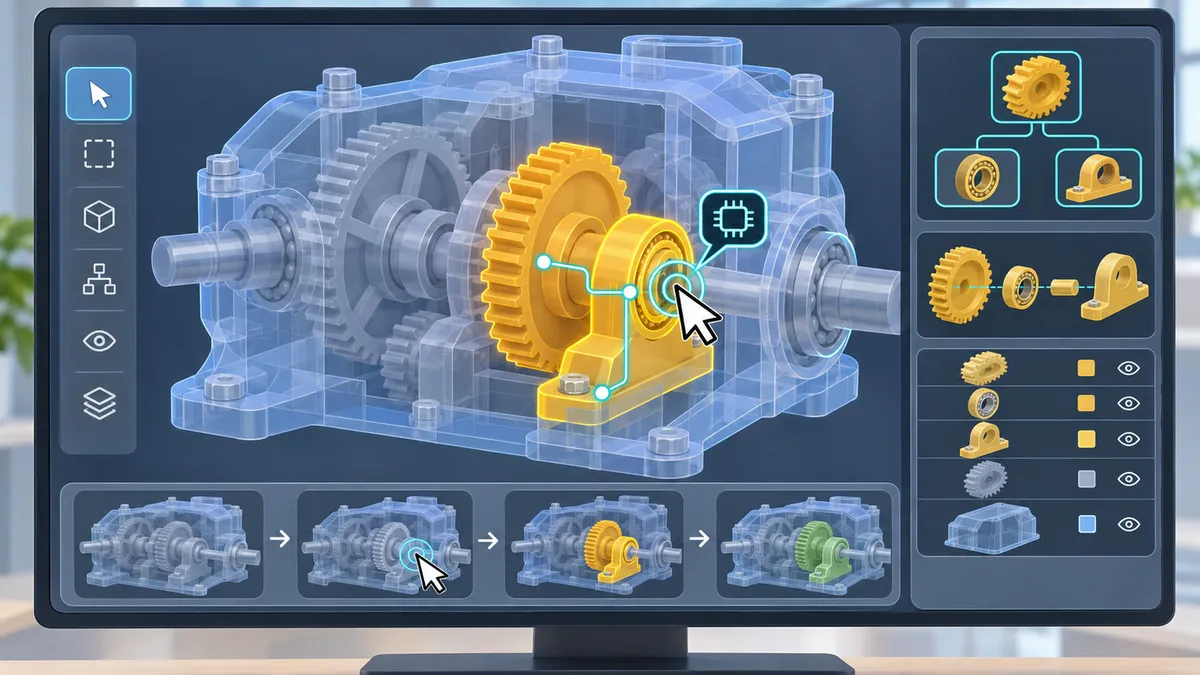
A click can land in the right place and still make the wrong thing happen. In 3D mechanical assembly, an AI agent must understand which components belong together, translate that plan into interface actions, and—if something goes wrong—avoid disturbing parts that are already correct. A study introduces a benchmark and correction system designed to test these challenges separately.
The difference between a valid click and a correct assembly
A graphical user interface (GUI) agent can perform an action that the software accepts while still producing the wrong assembly. It may choose the wrong component, misunderstand how parts relate, or move more pieces than a repair requires. That gap matters: successful interface control is not the same as sound mechanical reasoning.
In a preprint, Jingxuan Wei and colleagues present MAGAR-Bench, a benchmark for evaluating AI on virtual 3D mechanical assembly, and MAGAR, a system that selectively revises an existing model’s predictions. Their central idea is to treat assembly as three related but distinct problems: choosing an assembly operation and its parts; carrying out one native GUI action with the right parameters; and identifying the smallest set of parts that need to move to recover from an error.
What the benchmark measures
MAGAR-Bench contains 4,000 multimodal samples drawn from 26 assembly families. The samples combine visual information with details such as the assembly state, candidate parts, GUI context and interaction history. The authors divide the data by family: 20 families, with 3,000 samples, are used for training; six held-out families, with 1,000 samples, are used for testing. This tests performance on families not seen in training, though it does not by itself show how a system would perform across all kinds of CAD software or mechanical work.
The three tasks probe different abilities. Assembly Decision asks what operation to perform, which parts are involved and what the next subgoal should be. Atomic Action asks for a single interface operation—such as a click, drag, keystroke or text entry—and its parameters. Minimal Rework asks which parts must move to repair an incorrect assembly.
For that last task, “minimal” has a specific, limited meaning: the benchmark counts distinct moved parts among validated recovery candidates for a given state, not the number of GUI actions. The paper explicitly does not claim that this candidate set contains the globally best repair among every possible action sequence. Nor does matching a recovery route or action identifier prove that the repair would execute successfully; the benchmark does not run those recovery plans to verify them.
A cautious correction layer
MAGAR starts with a frozen, supervised fine-tuned vision-language model. Rather than always replacing its output, MAGAR generates possible revisions and uses task-specific selectors to decide whether a candidate should replace the original prediction. For assembly decisions and repair scope, it can revise structured fields while preserving others. For interface actions, it selects a complete action together with its parameters, instead of choosing those pieces independently.
That distinction reflects the different ways predictions can go wrong: changing one assembly field may leave other correct fields intact, while an action type and its parameters need to fit together. But a selective gate cannot guarantee that a proposed correction is right. Its purpose is to retain the original prediction unless a candidate meets the system’s learned intervention criteria.
Gains, with errors still in the ledger
On the held-out recorded states, MAGAR’s task-balanced Overall score was 41.39, compared with 37.50 for the supervised fine-tuned model it builds on—a gain of 3.89 points. The authors report gains across all three task families. This aggregate averages metrics within each family and then gives each family equal weight; it is not a measure of real-world assembly success or a simple percentage of tasks completed correctly.
The intervention accounting makes the tradeoff clearer. Among 209 cases where MAGAR changed the original prediction, 70 changed an incorrect prediction to a correct one, while 22 changed a correct prediction to an incorrect one. In 117 cases, strict case-level correctness did not change, though partial-credit metrics could still differ. These counts describe interventions, not the Overall score, and show why a correction system needs to be evaluated for both fixes and newly introduced errors.
What remains uncertain
The study evaluates recorded Unity states rather than long-horizon, live interaction in which an agent must act, observe consequences and adapt over time. The authors identify online assembly, globally consistent recovery planning and broader CAD environments as future directions. The benchmark’s repair target is also bounded by its validated candidate set, and its recovery identifiers are not execution-validated. So the findings support the value of task-specific correction in this test setting; they do not establish that MAGAR can reliably assemble or repair physical machinery.
Finally, this is an arXiv preprint, not evidence of peer-reviewed publication. Its reported results should be read as the authors’ evaluation under their stated data splits and metrics, pending further scrutiny and testing in other settings.
- artificial intelligence
- multimodal agents
- GUI
- 3D mechanical assembly
- benchmark
- error correction
- preprint
Reviewed cross-references
These connections were reviewed by a model, not independently fact-checked by a human. Similarity does not imply agreement; consult the original papers and the evidence below.
Why a plausible repair can still fail: teaching AI to respect assembly dependencies
Supporting evidence: Both papers support the bounded point that assembly recovery must account for structural relationships, not just locally plausible choices: MAGAR separates prediction of the moved-part set from other assembly tasks, while FORGE reports that repair programs must handle blocking dependencies to restore the target state. The evidence is complementary, not a direct comparison: MAGAR evaluates predictions on recorded GUI states and scores rework within validated candidates; FORGE evaluates executable programs in symbolic interlocking assemblies. Both are preprints.
Model review: · openai-codex/gpt-6-luna
Evidence and provenance
Selected excerpts, not complete papers. PDF extraction can omit figures or damage equations, tables and reading order; sources may be preprints.
2611.02472v2 — Original paper
Excerpt reference:
static/papers/2611.02472v2.md:68-158
Basis: Paper text
Source SHA-256:75966a88a84d508c3bd7422ad78f8d5a9ea8e81681bd2d2d55efb238fd8b1e562611.02536v2 — Original paper
Excerpt reference:
static/papers/2611.02536v2.md:70-138
Basis: Paper text
Source SHA-256:e49f581b46d99f762a33dbbf9d9e63d6fac225032574b5fb1b13ca5af51716ff
Related reading
Automatically matched by shared topic keywords. These links do not imply that the sources agree or establish a consensus.
Why a plausible repair can still fail: teaching AI to respect assembly dependencies
Source published
Shared keywords: artificial intelligence
An AI coordinator improves answers by directing attempts, not solving problems
Source published
Shared keywords: artificial intelligence
AI agents can group the right documents under the wrong parent
Source published
Shared keywords: artificial intelligence
Messier gathers agent benchmark results—and shows how scoring shapes the picture
Source published
Shared keywords: artificial intelligence
Can AI judges tell a strong research report from a polished one?
Source published
Shared keywords: artificial intelligence