TRANSMISSION // 2611.01491v2
A Transformer Tries to Read the Geometry Hidden in Wireless Echoes
Source published
A model called SCFT estimates the delays and directions of individual radio paths, then uses them in positioning and radio-SLAM tests. In ray-tracing experiments it outperformed a ResNet baseline on several measures, but not all; transfer to other environments remains untested.
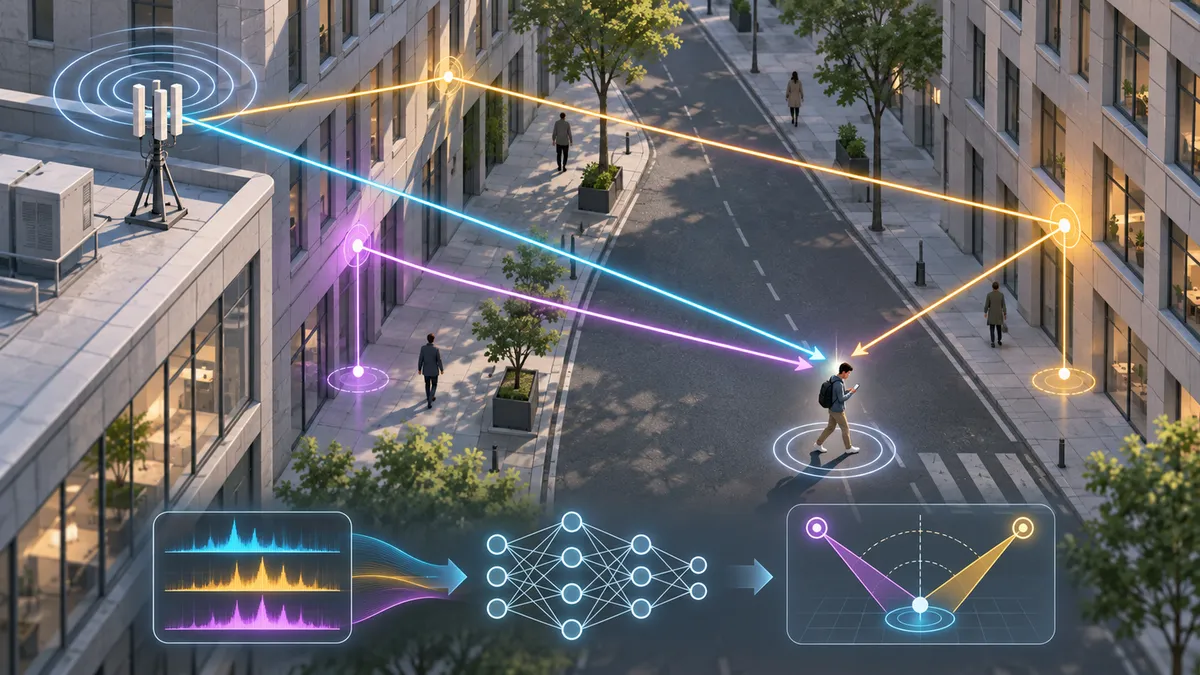
Wireless signals can reach a receiver directly or after bouncing off surfaces. Those routes carry clues about location and surroundings. A study introduces a neural network designed to recover that geometric information from noisy mmWave channel measurements, then tests whether its estimates help with positioning and radio SLAM.
A wireless receiver does not always hear one clean signal arriving along one route. Radio waves can travel directly from transmitter to receiver, or arrive after reflecting off buildings and other surfaces. These multiple paths can complicate communication, but they also contain clues about the environment. Their delays and directions can help estimate a receiver’s position or build a map from radio observations.
A paper by Yaya Etiabi, Wessam Ajib and Halima Elbiaze asks whether a neural network can recover those path-by-path clues well enough to support positioning and radio mapping. The authors call their model the Spectral-Convolutional Factorized Transformer, or SCFT. The work is available as an arXiv preprint; the materials available for this article do not establish whether it has been peer-reviewed.
From channel estimates to paths
Many machine-learning approaches to wireless channels are designed to improve communication tasks. This study instead focuses on estimating multipath components, or MPCs: individual signal routes described by features including delay, angle of arrival (the direction a path reaches the receiver), and angle of departure (the direction it leaves the transmitter). The model also classifies paths as line-of-sight or non-line-of-sight.
SCFT takes noisy complex channel estimates and descriptions of the transmitter–receiver beam pairs used to observe them. Its design processes patterns across frequency with local convolution, while attention combines information across beam pairs. A query-based Transformer decoder then predicts a set of candidate paths. Because the paths are an unordered set—there is no meaningful first, second or third path—the training procedure matches predicted paths with reference paths without relying on their order.
The researchers evaluated the model using realistic ray-tracing data for an outdoor urban scenario from DeepMIMO v4. Training, validation, calibration and test sets used distinct receiver locations. They compared SCFT with other learning-based models, including a ResNet and a flat Transformer, as well as classical signal-processing methods. They also tested estimated paths in a separate positioning and mapping trajectory, with repeated noisy realizations.
What the comparisons show
On the path-estimation measure called GOSPA, SCFT scored 2.001, compared with 2.303 for ResNet, the strongest competing baseline on that measure. The authors report this as a 13.1% reduction in error. SCFT also had the highest reported detection F1 score among the evaluated methods: 0.942, compared with 0.932 for ResNet. These results describe performance on the study’s test data, not a general guarantee for other settings.
The advantage was not uniform across every path parameter. The paper reports that SCFT’s non-line-of-sight delay error remained relatively high and comparable to ResNet’s. Some classical methods achieved lower angle-of-arrival error on matched paths, even though their overall path-set scores and detection results were worse. A better combined score does not mean the model wins on every individual quantity.
For independent snapshot positioning, the reported position RMSE was 2.55 metres for SCFT and 3.13 metres for ResNet. In the radio-SLAM test, which estimates a trajectory and vertical-facade virtual anchors using a causal factor-graph system, position RMSE was 1.78 metres for SCFT and 5.09 metres for ResNet. The authors report these as reductions of 18.5% and 65.0%, respectively. But the map GOSPA result favored ResNet: 3.997 metres versus 4.94 metres for SCFT. Position accuracy and map accuracy are different measures, and SCFT did not lead on both.
Virtual anchors are geometric representations used by the SLAM system to model paths associated with facades; they should not be read as a direct map of physical reflecting surfaces. The authors also compared with an oracle supplied with ground-truth path information. Its reported position RMSE was lower than SCFT’s in both tasks. This comparison illustrates that imperfect path estimates remain a limitation; it does not mean an oracle-like system is available in practice.
A promising test, not a field verdict
The study offers evidence that explicitly estimating multipath geometry can support downstream positioning and SLAM in the tested setup. SCFT is designed to use the distinct structure of frequency measurements and beam-pair observations rather than treating everything as one undifferentiated sequence. But the results come from ray-tracing data for one urban scenario, with a particular antenna configuration and beam codebook. The authors explicitly say generalization beyond those conditions remains untested.
The downstream results also depend on choices in the evaluation pipeline: which detected path is used for snapshot positioning, how clock bias is handled, and how the SLAM system associates paths with virtual anchors. They should be read as results for this experimental setup, not as proof that SCFT alone will deliver the same gains in deployed networks.
Because the paper is a preprint and peer-review status is not established here, its findings are best treated as an initial demonstration rather than a settled result. Testing in additional environments—and ultimately with real-world measurements—will be important for determining how reliably the approach transfers beyond the simulated urban case.
- wireless positioning
- mmWave
- multipath
- Transformer
- radio SLAM
- ray tracing
Reviewed cross-references
These connections were reviewed by a model, not independently fact-checked by a human. Similarity does not imply agreement; consult the original papers and the evidence below.
Can Wi-Fi predict when its channel needs measuring again?
Shared method: Both studies use ray-tracing-generated wireless channels in their evaluations: SCFT is tested on urban ray-tracing data for multipath estimation and downstream positioning/SLAM, while the sounding study uses Sionna ray tracing to assess mobile-channel prediction and link-level outcomes. This is a shared evaluation approach, not evidence that their methods or results are directly comparable; the tasks and settings differ.
Model review: · openai-codex/gpt-6-luna
Evidence and provenance
Selected excerpts, not complete papers. PDF extraction can omit figures or damage equations, tables and reading order; sources may be preprints.
2611.01491v2 — Original paper
Excerpt reference:
static/papers/2611.01491v2.md:945-1059
Basis: Paper text
Source SHA-256:a1fc53b09ba8c97951e3f46a2c73140d7b36e62362663702967fa409bbc9dd332611.05970v1 — Original paper
Excerpt reference:
static/papers/2611.05970v1.md:16-60
Basis: Paper text
Source SHA-256:ca6171a74d95a779bba60312a63d0cfe034b7414b57fcd260b8f0758c44cce2b
Related reading
Automatically matched by shared topic keywords. These links do not imply that the sources agree or establish a consensus.