TRANSMISSION // 2611.01168v2
Making Low-Rank Tensor Algorithms Lighter
Source published
A proposed way to reduce the memory demands of low-rank tensor methods while preserving their original updates, with reported gains on GPU tests.
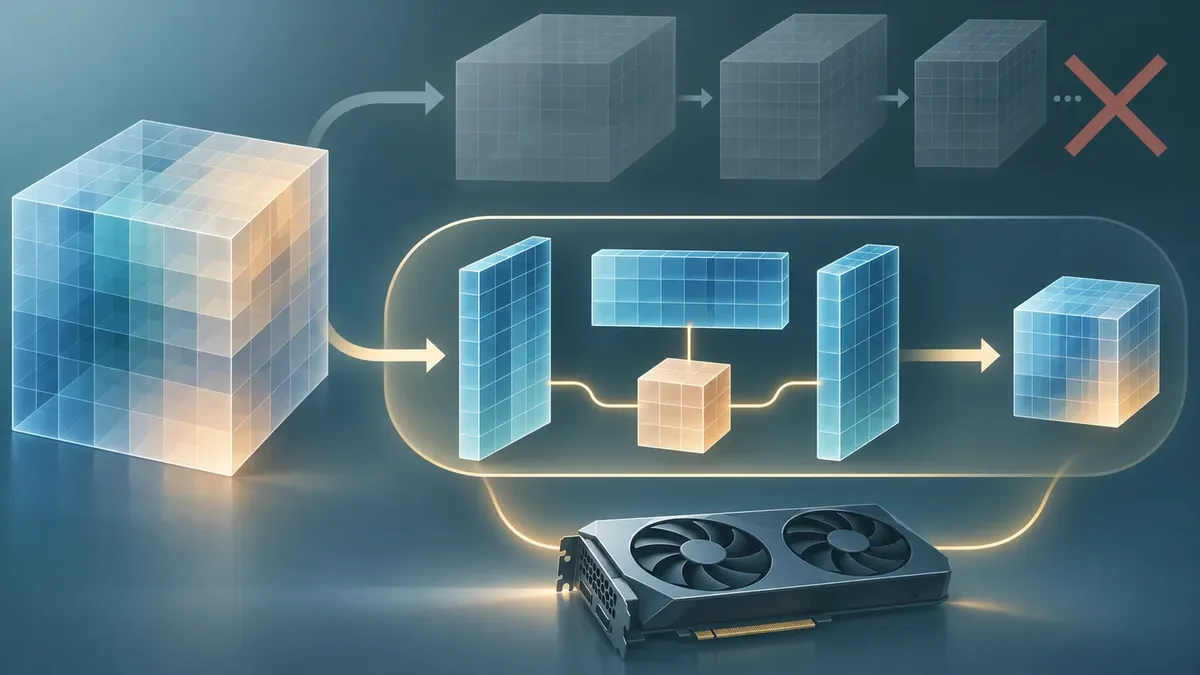
Large tensor calculations can run out of memory even when each algorithmic update needs only a small part of the data structures involved. A study proposes ways to avoid forming some of those structures, while keeping the algorithms’ iterates unchanged.
The memory problem behind tensor methods
Tensors are arrays that extend familiar tables into several dimensions. They can represent data such as video, where the dimensions might include height, width, and time, or a hyperspectral image, which records many wavelengths at each location. When such data have a low Tucker rank, they can be approximated using smaller factor arrays and a compact core tensor.
Algorithms that find these approximations may still create large intermediate objects during each iteration. The paper’s abstract names examples including matrix unfoldings, Kronecker operators, full singular value decompositions (SVDs), and full-sized iterates. These can consume substantial memory, even if the update uses only part of them. The researchers ask whether these costs can be reduced without changing the algorithm’s sequence of estimates—and how the lighter versions compare with efficient implementations.
Rewriting without changing the trajectory
The authors describe a criterion for exactness: the lightweight method’s stored state must correspond to the state of the reference method in a way that preserves each update. They report that three existing techniques meet this criterion across five estimators: computing only the singular triplets an update requires; carrying out tensor contractions without explicitly forming Kronecker products; and representing states in sparse-plus-factored form.
The intended distinction matters. These are presented not as approximations that trade accuracy for lower memory, but as alternative ways to carry out the same iterations. According to the abstract, the iterates—and the reference estimators’ guarantees—remain unchanged.
What the authors report
In tests on an A100 GPU, lightweight HOOI used the least memory among 15 HOOI-type methods at every tested size. For tensors of size 800 × 800 × 800, the authors report that it used 95 times less memory beyond the input than the lightest exact implementation. They also say it was the fastest method to reach the HOOI estimate on the largest tensors.
Compared with efficient public code, their implementation was faster and lighter for three of the five estimators—not all five. On a surveillance video and a satellite hyperspectral cube, the authors report that it was the only tested implementation to fit within devices with 1 GiB and 4 GiB of memory, respectively.
The abstract also stresses that lower memory use and faster execution have separate requirements. The proposed changes do not guarantee both benefits in every setting; the authors say they identify conditions under which the gains fail.
What remains uncertain
This account is based on the paper’s abstract, not a full-text assessment. The abstract does not provide enough detail to examine the experimental setup, datasets, baselines, implementation choices, or the precise conditions behind the reported gains. The figures should therefore be read as results reported by the authors, not as independently verified performance claims. The source is an arXiv preprint; the supplied material does not establish whether it has undergone peer review.
- tensor decomposition
- low-rank tensors
- Tucker rank
- GPU memory
- HOOI
- scientific computing
Reviewed cross-references
These connections were reviewed by a model, not independently fact-checked by a human. Similarity does not imply agreement; consult the original papers and the evidence below.
Shrinking video memories without retraining the model
Shared method: Both papers use Tucker-style tensor representations: the origin paper evaluates lightweight implementations of low-Tucker-rank estimators, while MSI uses HOSVD/Tucker factors to compress video-memory features. The shared representation does not imply the same algorithm or guarantees: the origin emphasizes unchanged estimator iterates, whereas MSI reports compression and segmentation results in its video settings.
Model review: · openai-codex/gpt-6-luna
Evidence and provenance
Selected excerpts, not complete papers. PDF extraction can omit figures or damage equations, tables and reading order; sources may be preprints.
2611.01168v2 — Original paper
Excerpt reference:
static/papers/2611.01168v2.md:71-147
Basis: Paper text
Source SHA-256:641f2fa0884d031b260a7695f9b93a302a67f7548bb63a6bf164baee7fa3184c2611.28087v1 — Original paper
Excerpt reference:
static/papers/2611.28087v1.md:549-713
Basis: Paper text
Source SHA-256:5cd68fb52cb779a15dba37449aa7c6d5871ff738832e42baf73a3146f8ba5818
Related reading
Automatically matched by shared topic keywords. These links do not imply that the sources agree or establish a consensus.
A low-rank route to Coulomb interactions on quantum computers
Source published
Shared keywords: tensor decomposition
Why scientific computing needs human-guided AI proofs
Source published
Shared keywords: scientific computing
A DOE blueprint for quantum supercomputing
Source published
Shared keywords: scientific computing
QuASAR tests whether AI agents can turn scientific ideas into quantum prototypes
Source published
Shared keywords: scientific computing
Teaching Monte Carlo estimates to correct themselves
Source published
Shared keywords: scientific computing