TRANSMISSION // 2610.41082v2
Could dark matter help hold unusual compact objects together?
Source published
A numerical study tests whether compact objects containing ordinary matter and a hypothetical dark-matter fluid can remain stable when both fluids oscillate. Its models include dark-matter-admixed planets, white dwarfs and neutron stars, plus extended dark halos. The results depend strongly on assumed dark-particle properties; they describe possible configurations, not confirmed objects or predictions of how often they form.
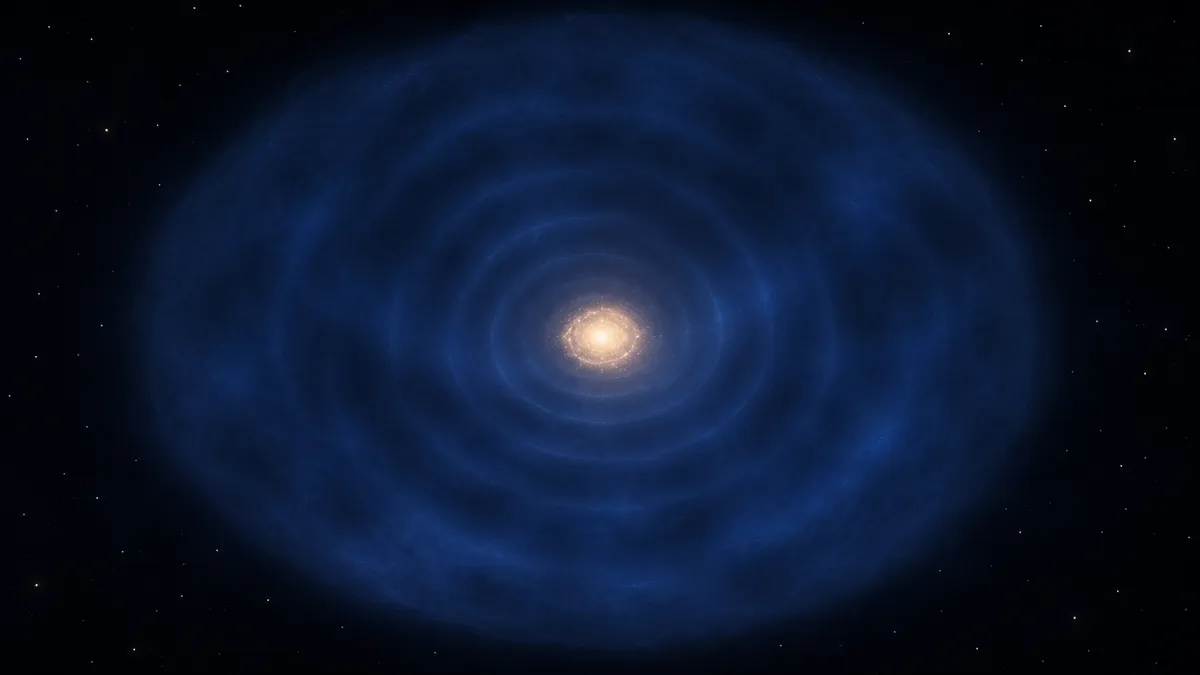
What happens to planets, white dwarfs and neutron stars if dark matter gathers inside them—or surrounds them in a halo? José C. Jiménez, Oscar Pastor and Laura Tolos model ordinary and dark matter as separate fluids interacting through gravity, then test whether the combined objects can withstand radial pulsations. Their calculations find stable examples of several different kinds, but the results depend on hypothetical dark-matter properties and do not establish that such objects exist in nature.
Dark matter’s nature remains unknown, but gravity gives scientists a way to ask how it might behave inside or around familiar astronomical objects. José C. Jiménez, Oscar Pastor and Laura Tolos explore this question for compact objects ranging from planet-like bodies to neutron stars. Their focus is not just whether two kinds of matter can settle into an equilibrium, but whether that arrangement remains stable when the object is disturbed and begins to pulse inward and outward.
That extra test matters. A calculated object can balance gravity and pressure in a static model yet still be unstable: a small disturbance could grow rather than produce harmless oscillations. In a two-fluid object, ordinary matter and dark matter have independent motions, so stability depends on their coupled response—not on examining either fluid alone.
Two fluids, one gravitational field
The researchers model ordinary matter and dark matter as separate, non-rotating fluids that interact only through the shared gravitational field. For ordinary matter, they use an equation of state—a relation between pressure and density—based on a model intended to cover a broad range of densities. It uses established low-density prescriptions for the outermost matter, chiral effective field theory near nuclear densities, and perturbative quantum chromodynamics at high density.
The dark component is modeled as a cold, self-interacting gas of fermions. The calculations consider particle masses of 2, 5, 10 and 100 giga-electronvolts, and two choices for the strength of repulsive self-interactions: a weaker and a much stronger case. These are model assumptions, not measurements of dark matter.
For each combination, the authors scan a broad grid of central pressures for the two fluids. They first calculate equilibrium structures using the relativistic equations for spherical stars. They then solve a coupled radial-oscillation problem, allowing both fluids to move independently. The sign of the lowest squared oscillation frequency determines stability: positive indicates stability against these radial disturbances, while negative indicates instability.
This approach also helps avoid a misleading shortcut. A turning-point condition based on equilibrium quantities can mark where a mode reaches zero, but it does not, by itself, identify whether that mode is the fundamental one or a higher radial mode. The authors compare the equilibrium-based curves with the calculated oscillation modes to distinguish the boundary of stability from zero crossings inside already unstable regions.
A varied model family
Within the sampled parameter ranges, the calculations find radially stable examples classified as dark compact planets, dark white dwarfs and dark-matter-admixed neutron stars. They also find “dark-oyster-like” configurations: objects with compact ordinary-matter cores and more extended dark components, meeting specific mass-and-radius criteria used in the study. These names describe model categories, not observed astronomical objects.
Which categories appear—and how much of the sampled set remains stable—depends strongly on the assumed dark-particle mass and self-interaction. Strong repulsion can support broad dark halos around compact ordinary-matter cores. At the high-mass end of some such sequences, the dark fluid supplies most of the mass, and the models approach the behavior of self-interacting fermion stars. In contrast, increasing the assumed fermion mass generally shifts dark-supported configurations toward smaller masses and radii. The dark-planet-like models are especially sensitive to these choices.
The study also calculates the gravitational redshift of light emitted at the ordinary-matter surface. A dark halo outside that surface contributes to the gravitational field along the light’s escape path. For one highlighted model—a 2-GeV dark fermion with strong repulsion—the largest redshift among the sampled stable configurations is about 2.04. This is a result for that model and sampled configuration, not a general prediction for dark-matter-admixed stars.
What the results do—and don’t—show
The authors’ stability test strengthens the claim that these configurations can persist within the mathematical model: the reported examples pass a calculation of coupled radial oscillations, not merely a static equilibrium test. But “stable” here has a specific scope. The study tests radial, adiabatic pulsations; it does not demonstrate stability against every possible disturbance, such as rotation, non-radial oscillations or changes in temperature.
Nor does a stable solution show that an object forms in the Universe. The paper identifies formation scenarios as an open question. Its object labels are based on operational mass-and-radius windows, and the sampled counts or rejection fractions are not estimates of how common such objects are in space. The authors also caution that overlap between a modeled planet-like object’s mass and an observed object’s estimated mass does not identify the observed body as dark-matter-rich; that would require appropriate formation and thermal-evolution calculations.
The ordinary-matter description is also simplified for some classes. The authors separately test a cold electron–ion model for white dwarfs, but do not include composition-dependent reactions in that treatment. More broadly, the outcome depends on the chosen equations of state and on dark-matter properties that have not been established. The paper is available as an arXiv preprint. Its findings are theoretical results from the specified models and calculations, rather than an observational discovery.
- dark matter
- compact objects
- radial stability
- neutron stars
- white dwarfs
- fermionic matter
- theoretical astrophysics
Reviewed cross-references
These connections were reviewed by a model, not independently fact-checked by a human. Similarity does not imply agreement; consult the original papers and the evidence below.
A dark-star model links a mass ceiling to gravitational-wave signatures
Shared method: Both studies use relativistic two-fluid stellar-structure equations: the origin paper models ordinary matter and dark matter coupled by gravity, while Lopes models two dark-fermion species with mediator interactions and a quantum-pressure correction. This is a methodological overlap, not a shared stability or observational result; the supplied excerpts do not establish that their specific implementations are identical.
Model review: · openai-codex/gpt-6-luna
Evidence and provenance
Selected excerpts, not complete papers. PDF extraction can omit figures or damage equations, tables and reading order; sources may be preprints.
2610.41082v2 — Original paper
Excerpt reference:
static/papers/2610.41082v2.md:175-225
Basis: Paper text
Source SHA-256:80bcc5bc6b525cdb92dd49e2de10692fa9644c372ebf3f85e98935d0aba9e79d2611.10662v1 — Original paper
Excerpt reference:
static/papers/2611.10662v1.md:68-114
Basis: Paper text
Source SHA-256:8ddfe7dacca4c286e923c7f16e5e23d4b3853b5c51388096788f8c1d7ef6f5b52611.10662v1 — Original paper
Excerpt reference:
static/papers/2611.10662v1.md:787-917
Basis: Paper text
Source SHA-256:8ddfe7dacca4c286e923c7f16e5e23d4b3853b5c51388096788f8c1d7ef6f5b5
Related reading
Automatically matched by shared topic keywords. These links do not imply that the sources agree or establish a consensus.
What dead stars reveal about matter, gravity and the early Universe
Source published
Shared keywords: compact objects, dark matter, neutron stars, white dwarfs
A spinning white dwarf’s tidal response depends on how the star changes shape
Source published
Shared keywords: theoretical astrophysics, white dwarfs
Neutron star binaries may get their chance after a cluster’s black holes leave
Source published
Shared keywords: neutron stars
Testing Pulsar Evolution Before Simulating a Whole Star Cluster
Source published
Shared keywords: neutron stars
When a gravitational wave meets a binary’s rhythm
Source published
Shared keywords: theoretical astrophysics