TRANSMISSION // 2610.40592v3
When Higher-Dimensional Quantum Codes Can Be Decoupled
Source published
A mathematical study identifies when certain repeating topological quantum codes can be transformed into stacks of toric codes. In higher dimensions, the key extra obstacle is “gluing” between layers of excitations; under stated conditions, further coarse-graining removes it.
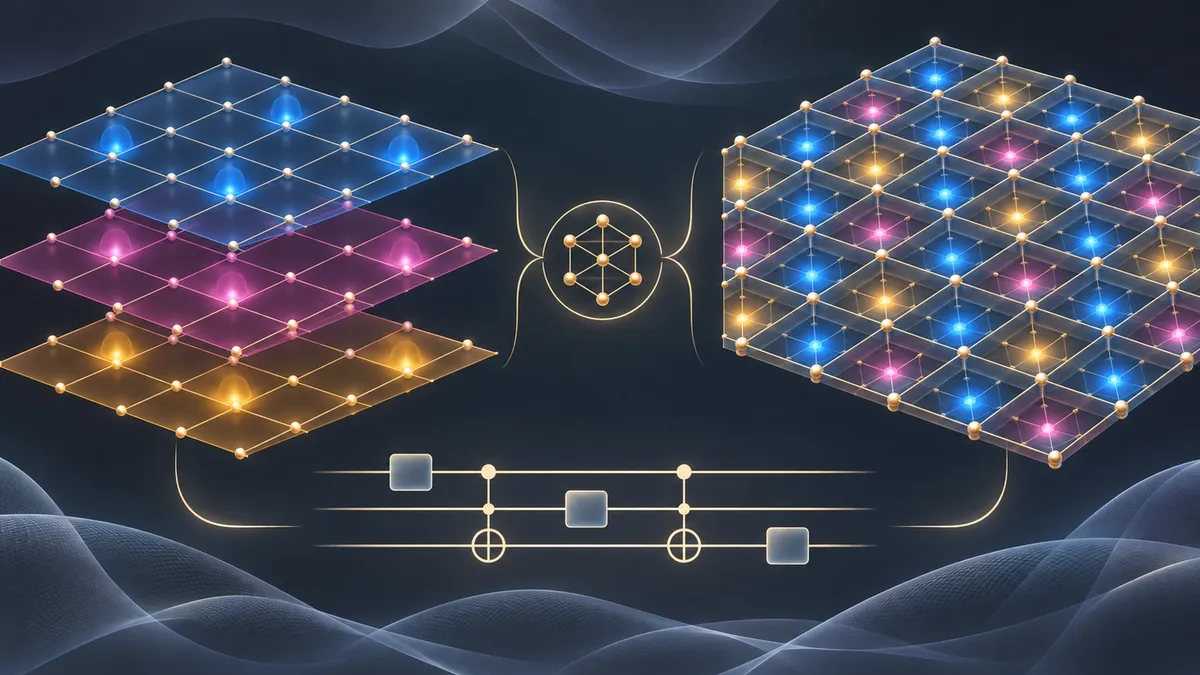
Quantum error-correcting codes store information in ways that help protect it from errors. Some have topological structure, and understanding that structure can help researchers compare and classify codes. In an arXiv preprint, Mingxin He, Yifei Wang, Hao Song and Yingfei Gu ask when regularly repeating topological CSS codes can be transformed into simpler building blocks—and what can obstruct that transformation in higher dimensions.
The question: when can a code be decoupled?
Calderbank–Shor–Steane (CSS) codes are a family of quantum error-correcting codes with two structured types of checks. This work considers topological CSS codes whose rules repeat across a lattice. The authors ask whether such a code can be transformed into a stack of higher-form toric codes using a finite-depth local circuit that preserves the CSS structure. The circuit may add ancillary qudits, and it must respect translations of a repeating sublattice, called a superlattice.
The term “decoupling” describes this mathematical transformation. The paper’s abstract states its conditions and says an algorithm constructs the circuit; it does not describe an experiment or a test on quantum hardware.
Why higher dimensions add an obstacle
In two dimensions, the abstract gives a criterion: decoupling exists once translations act trivially on every anyon type. Anyons are excitation types associated with two-dimensional topological codes.
In higher dimensions, excitations can have different spatial dimensions. The authors organize them into superselection layers. Even when translations act trivially on each layer separately, the layers can remain joined in a way that prevents the code from splitting into independent pieces. They call this connection “gluing.”
The main result is that this gluing is the remaining obstruction: after coarse-graining to a superlattice, decoupling is possible exactly when translations act trivially on every layer and the gluing vanishes. Coarse-graining is part of the mathematical statement; the abstract does not offer a physical interpretation of it beyond its role in specifying the superlattice.
The authors also state a conditional guarantee. If each layer contains finitely many excitation types and there are m nonzero layers, then, once translations act trivially on every layer, further coarse-graining by a factor of p^(m−1) in every direction removes the gluing. Here p is the prime defining the qudit arithmetic of the code. The result is not a claim that all codes can be decoupled without these conditions.
A criterion, a construction, and a finite-system connection
The paper connects the same criterion to codes on a finite torus, a system with periodic boundaries: it determines when the code encodes the maximal number of logical qudits there. The authors also provide an explicit algorithm to construct the decoupling circuit from SUM gates—the qudit version of CNOT—and SWAP gates.
The abstract places this work in the context of higher-dimensional codes, which can offer features useful for fault-tolerant quantum computation, including transversal non-Clifford gates and single-shot decoding. Those are motivations for studying such codes, not findings that the abstract attributes to this particular work. The reported contribution is a structural criterion and a circuit-construction algorithm.
What remains uncertain
This account is based on the abstract rather than the full paper, so it does not detail the proofs or the precise technical definitions behind the criteria. The source is an arXiv preprint. The abstract supports theoretical, conditional claims; it does not report experimental results or establish performance on a quantum device.
- quantum error correction
- topological codes
- CSS codes
- toric codes
- quantum information
- mathematical physics
Related reading
Automatically matched by shared topic keywords. These links do not imply that the sources agree or establish a consensus.
Extra qubits make quantum error checks agree
Source published
Shared keywords: quantum error correction, toric codes
A changing grid could offer a new way to protect quantum information
Source published
Shared keywords: quantum error correction, quantum information
A driven superconducting circuit could correct its own quantum errors
Source published
Shared keywords: quantum error correction
Moving atoms could make globally controlled quantum computers programmable
Source published
Shared keywords: quantum error correction
For silicon quantum memory, the route can matter as much as the circuit
Source published
Shared keywords: quantum error correction