TRANSMISSION // 2610.40299v2
How weak long-range interactions affect a fermion energy gap
Source published
A mathematical result shows that, under specified conditions, weak polynomially decaying interactions preserve a free-fermion system’s bulk energy gap and connect its ground state to an interacting one through a quasi-local transformation.
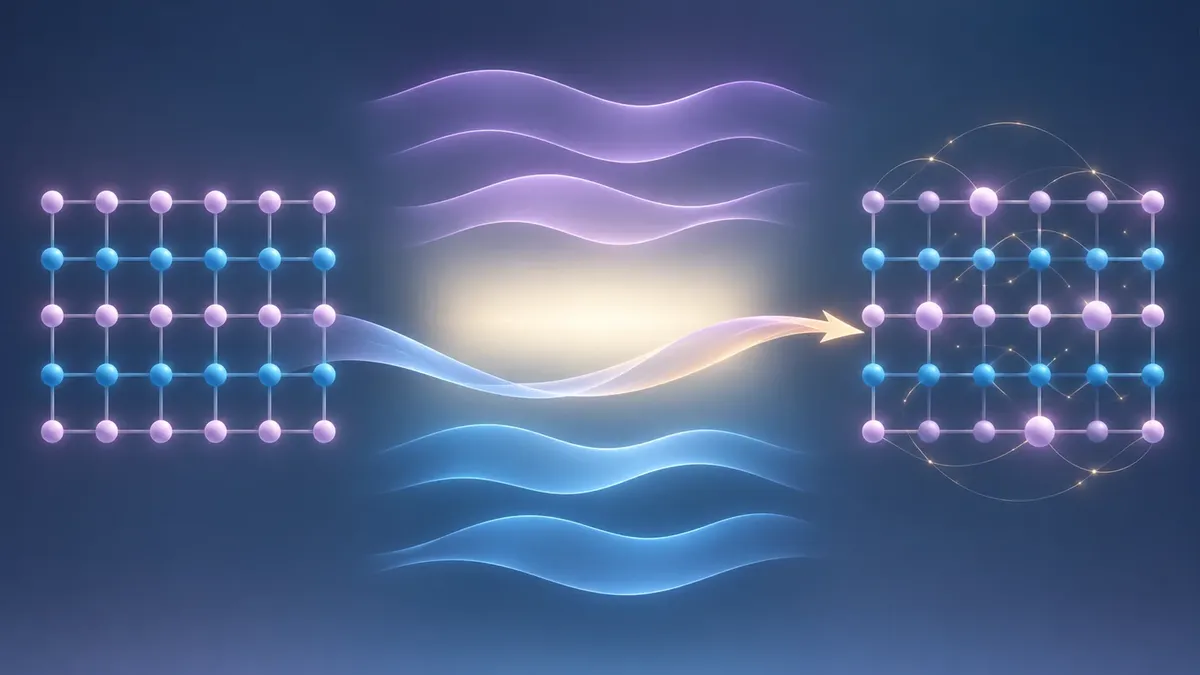
Can a system of fermions stay gapped even when its particles interact over long distances? Stefan Teufel’s mathematical preprint gives a conditional answer: for sufficiently weak interactions, a free system with a bulk gap retains a positive gap, and its ground state can be related to an interacting ground state by a transformation that is mostly local.
A gap in a quantum system is an energy interval with no allowed excitations. In a free-fermion model, such a gap can often be described using the system’s one-particle operator. But real fermions can interact, and those interactions may extend over long distances. The question in Stefan Teufel’s preprint is whether a free system’s bulk gap survives when those interactions are switched on weakly—and whether the corresponding ground states remain related in a controlled way.
The paper proves a mathematical stability result for infinite-volume fermion systems. It starts with a free model whose Majorana coefficient operator has no spectrum in an interval around zero, and adds an even, self-adjoint many-body interaction multiplied by a coupling strength, λ. “Even” here means compatible with fermion-parity symmetry. The interaction need not have finite range: the result includes cases in which the relevant couplings decay polynomially with distance.
For sufficiently small |λ|, the author constructs pure ground states of the interacting system and a quasi-local automorphism that maps the free ground state to an interacting one. An automorphism is a transformation of the system’s observables; quasi-local means it can spread an observable beyond its original region, but its influence becomes controlled as distance increases. The result also gives a lower bound on the gap above each constructed ground state’s representation: at least the original gap, g, minus a term proportional to |λ| and the size of the interaction in a specified norm. Thus the bound guarantees a positive gap only while the perturbation is small enough relative to those quantities.
The distance condition matters. For two-site terms on a uniformly discrete set of points in d-dimensional space, the abstract gives a sufficient example: hopping and pairing coefficients, as well as interaction terms, may decay like (1 + distance)^(-varpi), with varpi greater than 2d. This is a sufficient condition, not a claim that every long-range interaction—or every slower decay—has the same behavior. Pairing terms, which create or remove pairs of fermions, are included in the stated framework.
To establish the result, the paper constructs a spectral flow: a continuous family of transformations connecting the free and interacting systems as the coupling is varied. Its generator, which determines how the transformation changes along that path, obeys locality bounds at the same polynomial decay exponent as the interaction norm. The proof also establishes the gap using an excitation-number comparison. The abstract says that the argument relies on polynomial propagation bounds for evolved interactions proved in a companion paper; it does not provide enough detail to assess those estimates independently.
The result is about what can be proved under explicit mathematical assumptions, not a report of measurements or a demonstration for a particular material. “Quasi-local” does not mean that distant sites have no influence, and the gap bound is not uniform for arbitrarily strong interactions: its correction grows with the coupling and interaction norm. Nor does the stated theorem establish that all possible fermion systems, interaction patterns, or decay rates retain a gap.
The available source for this article is the paper’s abstract, not its full text. That limits how much can be said about technical hypotheses, proof details, examples, or qualifications beyond those summarized there. The work is an arXiv preprint, so its appearance there should not be taken as evidence that it has undergone peer review. The abstract presents a rigorous theorem, but readers should consult the full paper and its publication status for a fuller assessment.
- fermions
- quantum many-body physics
- energy gap
- long-range interactions
- spectral flow
- mathematical physics
Reviewed cross-references
These connections were reviewed by a model, not independently fact-checked by a human. Similarity does not imply agreement; consult the original papers and the evidence below.
When Do Fermionic Equilibrium States Stay Local?
Supporting evidence: Both papers address weakly interacting fermions built on a gapped quadratic system. Teufel proves existence of pure interacting ground states with a quantitative GNS gap bound; Becker, Singh and Teufel report uniqueness of the gapped ground state and low-temperature convergence of thermal expectations to it. These are compatible results, not identical claims: the first constructs ground-state transport using spectral flow, while the second uses a quantum comparison theorem for equilibrium states; their precise assumptions and conclusions differ.
Model review: · openai-codex/gpt-6-luna
Evidence and provenance
Selected excerpts, not complete papers. PDF extraction can omit figures or damage equations, tables and reading order; sources may be preprints.
2610.40299v2 — Original paper
Excerpt reference:
static/papers/2610.40299v2.md:13-49
Basis: Paper text
Source SHA-256:a2f83c0466ec511ebe8d37cba831c502a131d24be324684c879350d2aded2e0c2610.40299v2 — Original paper
Excerpt reference:
static/papers/2610.40299v2.md:95-152
Basis: Paper text
Source SHA-256:a2f83c0466ec511ebe8d37cba831c502a131d24be324684c879350d2aded2e0c2611.27873v1 — Original paper
Excerpt reference:
static/papers/2611.27873v1.md:13-40
Basis: Paper text
Source SHA-256:090f6f2cdefe747d4674fd2d84cc8c80ed5efb368a2cb0302cb02dba7a71d5b72611.27873v1 — Original paper
Excerpt reference:
static/papers/2611.27873v1.md:121-167
Basis: Paper text
Source SHA-256:090f6f2cdefe747d4674fd2d84cc8c80ed5efb368a2cb0302cb02dba7a71d5b7
Related reading
Automatically matched by shared topic keywords. These links do not imply that the sources agree or establish a consensus.
A locality bound for quantum fermions moving in continuous space
Source published
Shared keywords: mathematical physics
A sharp limit on density fluctuations in free-fermion lattices
Source published
Shared keywords: mathematical physics
When long-range interactions switch off the quantum Mpemba effect
Source published
Shared keywords: long range interactions
A shortcut for studying sparse random quantum systems
Source published
Shared keywords: quantum many body physics
Why a hotter Bose gas can produce a narrower impurity spectrum
Source published
Shared keywords: quantum many body physics