TRANSMISSION // 2610.39278v3
WorldFlow predicts motion in both pixels and 3D
Source published
WorldFlow jointly forecasts future video and 3D object trajectories. The authors report improved motion accuracy on benchmarks and robot tests, while noting limits such as dependence on predefined query points.
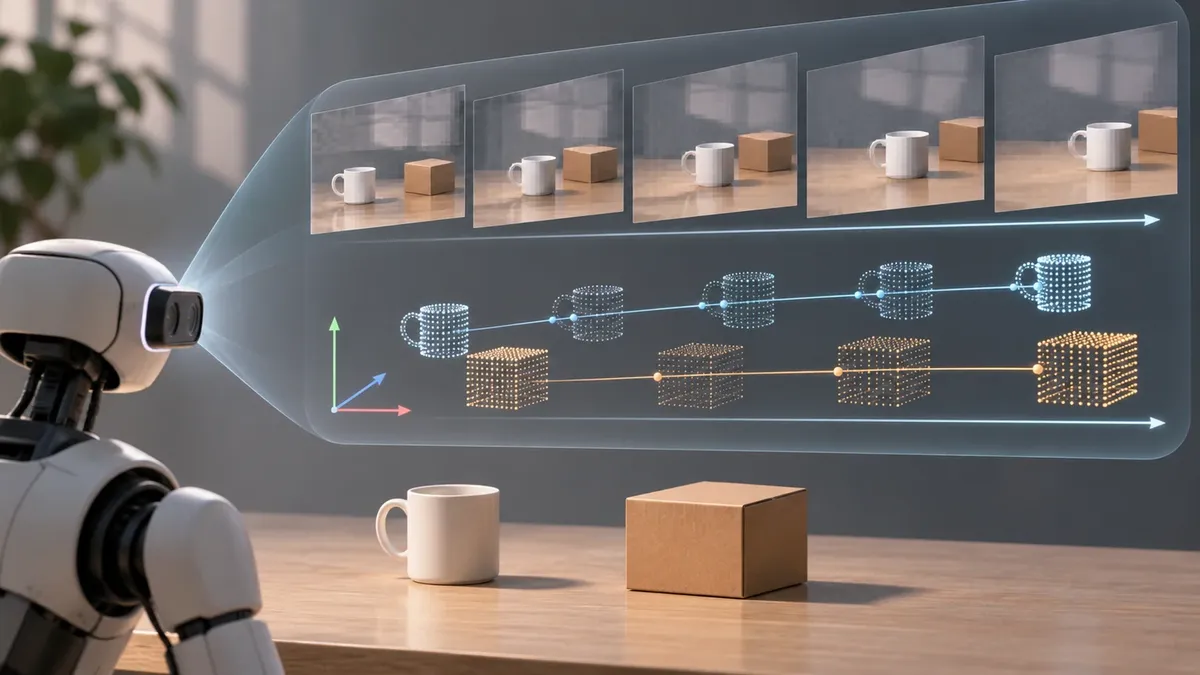
A robot needs more than a plausible picture of what might happen next: it also needs to estimate where objects will move in three-dimensional space. WorldFlow is designed to predict both at once. Its reported results are promising, but they come from selected benchmarks and a limited set of robot experiments—not proof of broad reliability.
A video can show that a cup is moving without saying precisely how its position changes in three-dimensional space. For robots, that distinction matters: a system that predicts an object’s future location may help plan how to pick it up or place it. But predicting 3D motion at scale is difficult, and collecting accurate motion labels is costly.
WorldFlow, a generative model described in a paper by Yuhao Lu and colleagues, aims to combine visual prediction with explicit geometry. Given one RGB image, a language instruction and selected 3D points on objects, it predicts future video frames and the points’ future 3D trajectories. The researchers call the trajectories “flow”: frame-to-frame changes in position, expressed in the camera’s coordinate system.
One model, two kinds of prediction
Many video models predict future scenes as pixels, leaving the underlying geometry implicit. Motion models can instead predict 3D trajectories, but the authors argue that flow-only training provides a narrower learning signal. WorldFlow combines the two: it represents motion as continuous displacement values and aligns those values with the video model’s spatial and temporal tokens. A shared Mixture-of-Transformers backbone generates both modalities together using a rectified-flow objective, a method for gradually turning noise into a prediction.
The team trained the model on about 1.44 million object-level samples drawn from simulated and real-world sources. The data include robot manipulation, human-object interactions and household activities. Some trajectories came from existing annotations; others were extracted automatically from videos using tracking and 3D geometry tools. The researchers applied source-specific checks and standardized examples into short clips. They also created WorldFlowBench, with 1,678 held-out samples across three sets: simulated interactions, real-world motion and SpatialCog, a set emphasizing spatial relations.
Benchmark and robot results
On all three benchmark subsets, the paper reports lower average displacement error (ADE) and final displacement error (FDE) for WorldFlow than for the evaluated learning-based methods. These metrics measure the distance between predicted and reference positions, averaged across points and time (ADE) or measured at the final frame (FDE). On SpatialCog, the reported ADE was 0.060 metres, 54.2% lower than the strongest external learned baseline on that subset. The authors also compared WorldFlow with a version trained to predict motion without generating video. Joint video-and-motion prediction reduced ADE by 55.9% on SpatialCog and lowered FDE there by 68.5%.
The team also tested whether predictions could guide manipulation. In a simulated benchmark, WorldFlow’s motion forecasts were used in a pipeline for grasping, moving and placing objects. The paper reports higher task success than a comparison motion model, both in the full pipeline and in a setting where simulator assistance reduced the influence of grasp failures.
In a physical-robot study, the researchers tested 12 tasks—such as placing objects and stacking them—three times each. WorldFlow predictions were judged plausible in 35 of 36 trials, and the robot completed 24 of 36 tasks. The comparison model achieved 9 of 36 plausible predictions and 4 of 36 completed tasks. These results concern this particular robot, setup and task set. The paper notes that execution can fail even when a predicted motion is plausible, for example because of grasping, trajectory planning or unstable placement.
What remains uncertain
The results suggest that predicting geometry alongside video can improve motion forecasts in the tested settings. They do not establish that WorldFlow will work equally well across different robots, environments or unfamiliar tasks. The physical-robot evaluation was small, and success depends on other components in the manipulation pipeline as well as the motion model.
The authors identify two further constraints: users must provide 3D query points in advance, and automatically extracted trajectory labels can be noisy. Their benchmark and training set bring together varied sources, but results still depend on how those sources were collected, processed and evaluated. The paper is an arXiv preprint; its claims should be treated as provisional pending independent scrutiny and replication. In short, WorldFlow offers a way to connect visual futures with measurable 3D motion, while leaving open how robust and transferable that connection will prove in wider use.
- robotics
- world models
- 3D motion prediction
- video generation
- embodied AI
Reviewed cross-references
These connections were reviewed by a model, not independently fact-checked by a human. Similarity does not imply agreement; consult the original papers and the evidence below.
Can AI-generated worlds keep up with robots and self-driving cars?
Shared method: Both papers describe a Mixture-of-Transformers backbone: WorldFlow uses it to jointly denoise video and 3D-flow tokens, while the Cosmos framework describes separate reasoner and generator towers with joint attention. This is a shared architectural component, not evidence that the models use identical implementations or training procedures.
Model review: · openai-codex/gpt-6-luna
Evidence and provenance
Selected excerpts, not complete papers. PDF extraction can omit figures or damage equations, tables and reading order; sources may be preprints.
2610.39278v3 — Original paper
Excerpt reference:
static/papers/2610.39278v3.md:187-281
Basis: Paper text
Source SHA-256:4cce00abe647e8bfcd55fd3e7f9611ef349a0c318741a343b7a2c01f0e6669e82611.06627v1 — Original paper
Excerpt reference:
static/papers/2611.06627v1.md:268-316
Basis: Paper text
Source SHA-256:4e86d4e9d02d7002ead6a16fd7d5ec5409564a81cb5883775380b90df3baf467
Teaching robot video models to focus on what moves
Supporting evidence: In WorldFlow’s motion-forecasting evaluations, joint video-and-flow generation outperforms its flow-only variant; in MoReWorld’s WorldSimProbe ablation, removing the flow head lowers interaction-dynamics and grounding scores. These results are compatible with motion-related supervision helping in the authors’ respective settings, but the tasks, models, and evaluation measures differ, so they do not establish a shared effect size or direct comparison.
Model review: · openai-codex/gpt-6-luna
Evidence and provenance
Selected excerpts, not complete papers. PDF extraction can omit figures or damage equations, tables and reading order; sources may be preprints.
2610.39278v3 — Original paper
Excerpt reference:
static/papers/2610.39278v3.md:86-140
Basis: Paper text
Source SHA-256:4cce00abe647e8bfcd55fd3e7f9611ef349a0c318741a343b7a2c01f0e6669e82611.27344v1 — Original paper
Excerpt reference:
static/papers/2611.27344v1.md:1052-1124
Basis: Paper text
Source SHA-256:15519900f5bbf63f29419fea3708e0d6a4212b324271c72091d55f5a3b021b43
Related reading
Automatically matched by shared topic keywords. These links do not imply that the sources agree or establish a consensus.
Teaching robot video models to focus on what moves
Source published
Shared keywords: video generation, world models
Can AI-generated worlds keep up with robots and self-driving cars?
Source published
Shared keywords: video generation, world models
AI coding agents build a robotics simulation benchmark
Source published
Shared keywords: embodied ai
A robot's-eye view, generated from outside video
Source published
Shared keywords: world models
Can a Recorded Street Become a Reusable Driving Simulation?
Source published
Shared keywords: world models