TRANSMISSION // 2610.39271v2
Diamond nanobeams enhance SiV orbital coupling
Source published
Experiments show that tensioned diamond nanobeams can reduce mechanical losses while concentrating vibration-induced strain near clamps, enhancing coupling to SiV orbital states.
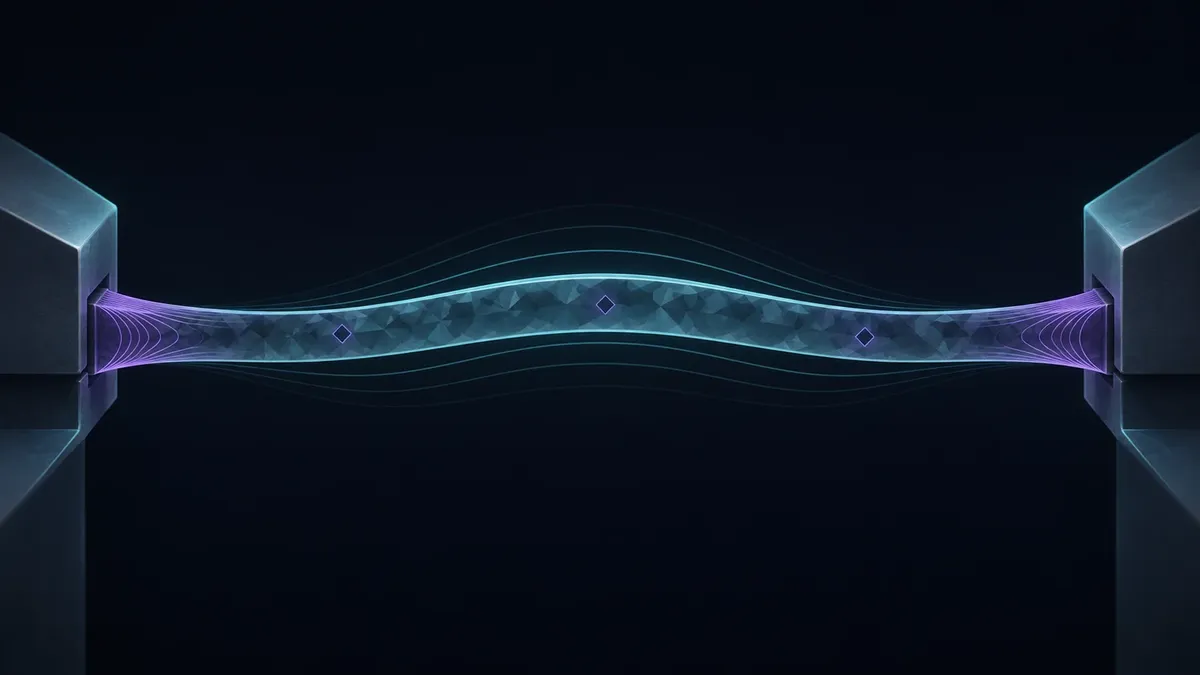
Can tension help a vibrating diamond beam keep its motion for longer without weakening its interaction with nearby defects? A preprint reports experiments suggesting that, in this design, strain localizes near the beam’s clamps and strengthens coupling to silicon-vacancy orbital states. A spin-based quantum interface remains a future goal.
Mechanical resonators can store vibrations, while atomic-scale defects in diamond have quantum states that respond to strain. Combining them could connect mechanical motion with other quantum systems. But tension creates a possible trade-off: static tension can dilute mechanical losses, yet it was unclear whether it would also weaken the changing strain that defects sense.
In a preprint, Guanhao Huang and colleagues report experiments with tensioned diamond nanobeams containing negatively charged silicon-vacancy centres, or SiVs. Their measurements indicate that static tension can reduce mechanical losses while concentrating vibration-induced strain near the clamps. There, the measured coupling to SiV orbital states is stronger.
Why strain matters
A SiV’s electronic energy levels respond to strain in the surrounding diamond. As a beam vibrates, changing crystal strain shifts the defect’s optical transitions. Measuring those shifts lets researchers probe the interaction between the defect and mechanical motion.
Dissipation dilution occurs when static tension adds a restoring force that stores energy without adding the same material losses as bending. The paper asks whether this benefit comes at the cost of weaker strain-mediated coupling. Its results suggest that, in the tested geometry, strain can instead become concentrated near the clamps.
Measuring the response
The researchers implanted SiVs at five positions along the beam. They measured mechanical motion by interfering light reflected from the resonator with a reference beam. They also recorded SiV photoluminescence spectra: shifts in the optical lines indicate changes in strain at the defects.
To calibrate static strain, the team used the resonance frequency within a tensioned-string model to estimate stress. They also accounted for local variations in beam cross-section. Their approach is intended to reduce uncertainties associated with modelling more complex device structures, but it still depends on the model and calibration corrections. Measurements used low-density ensembles of about three to five SiVs, rather than a single defect.
For dynamical strain, the team drove mechanical modes and compared optical responses at different positions. The SiVs could probe strain near a clamp, where displacement is very small and therefore difficult to measure directly with interferometry. The researchers also compared their strain-sensitivity result with an analysis of previously published temperature-dependent orbital-relaxation data from bulk diamond; this was an independent analysis, not a new experiment by the team.
What the experiments found
The team estimates that the SiV orbital strain response is about 0.36 times the value used in earlier literature. The analysis of previously reported relaxation data gave a similar factor, about 0.37. Since coupling estimates depend on this strain response, revising it changes how strongly researchers expect SiVs to interact with mechanical motion.
As static tension increased, the measured dynamical strain became more localized near the clamps. In comparisons within these devices, SiVs near a clamp showed about ten times the orbital coupling rate measured for SiVs near the beam centre. This is a result for the tested locations and setup, not a general enhancement for every defect or resonator.
The mechanical quality factor, a measure of how slowly a resonator loses energy, reached 26 million. The paper reports a dissipation-dilution factor of up to about 30 relative to the intrinsic quality factor. Together, the results show that the measured reduction in mechanical losses did not require weaker orbital coupling in this design.
What remains uncertain
The demonstrated interaction is between mechanical motion and SiV orbital states. The experiment does not demonstrate a coherent interface between the vibration and the SiV spin. The paper’s stronger spin-coupling estimates and prospects for long-lived hybrid systems are based on simulations and projected operating conditions, not measured seconds-long coherence. Experiments were conducted at 4 kelvin; projections for other conditions do not establish that the same performance has been achieved there.
The researchers also report driven Duffing behaviour and a frequency-comb phenomenon in the mechanical motion. They studied related spectral effects systematically by driving two modes, rather than treating all nonlinear dynamics simply as measurement complications. The findings and calibration remain specific to the devices and assumptions examined.
This is a preprint and may not have undergone peer review. The article is based on the supplied paper text; extraction can affect equations, figures, and supplementary details. The study demonstrates enhanced coupling to SiV orbital states alongside reduced mechanical losses, while leaving a spin-based quantum interface for future work. Read the preprint on arXiv.
- diamond nanomechanics
- silicon-vacancy centres
- orbital strain coupling
- dissipation dilution
- mechanical resonators
- quantum devices
Reviewed cross-references
These connections were reviewed by a model, not independently fact-checked by a human. Similarity does not imply agreement; consult the original papers and the evidence below.
A Stepped Fiber Helps a Pendulum Meet an Entanglement Test
Supporting evidence: Huang et al. report that tension-induced dissipation dilution raises the mechanical quality factor of diamond nanobeams, while Sawada et al. report a stepped pendulum suspension whose measured loss gives a modeled gain over a uniform suspension. These findings are compatible with the bounded point that dissipation dilution can reduce mechanical loss; the different devices and measures are not directly comparable, and the selected preprint excerpts do not establish independent validation.
Model review: · openai-codex/gpt-6-luna
Evidence and provenance
Selected excerpts, not complete papers. PDF extraction can omit figures or damage equations, tables and reading order; sources may be preprints.
2610.39271v2 — Original paper
Excerpt reference:
static/papers/2610.39271v2.md:406-536
Basis: Paper text
Source SHA-256:63d83114b71c765a5e0dbdb127e01f48594ac1acf171e97c21463efece9025602608.02462v2 — Original paper
Excerpt reference:
static/papers/2608.02462v2.md:12-67
Basis: Paper text
Source SHA-256:41583096da963b87b6c188186c3e0da5b6bebf80ee2469965d8ff00da0f8b50a2608.02462v2 — Original paper
Excerpt reference:
static/papers/2608.02462v2.md:426-473
Basis: Paper text
Source SHA-256:41583096da963b87b6c188186c3e0da5b6bebf80ee2469965d8ff00da0f8b50a
Related reading
Automatically matched by shared topic keywords. These links do not imply that the sources agree or establish a consensus.
A Theoretical Proposal to Control Mechanical Dark Modes
Source published
Shared keywords: mechanical resonators
Tracing Thermal Noise Through Mechanical Systems
Source published
Shared keywords: dissipation dilution
A nonlinear resonator may make charge readout gentler
Source published
Shared keywords: quantum devices
AI layouts tailored to two-dimensional crystals
Source published
Shared keywords: quantum devices