TRANSMISSION // 2610.39091v2
Can squeezed light help an energy-harvesting optical relay?
Source published
A theoretical study models a quantum optical relay powered by harvested light. It finds squeezing can help in some moderate-energy, lower-loss conditions, but its advantage fades as the relay’s photon budget grows.
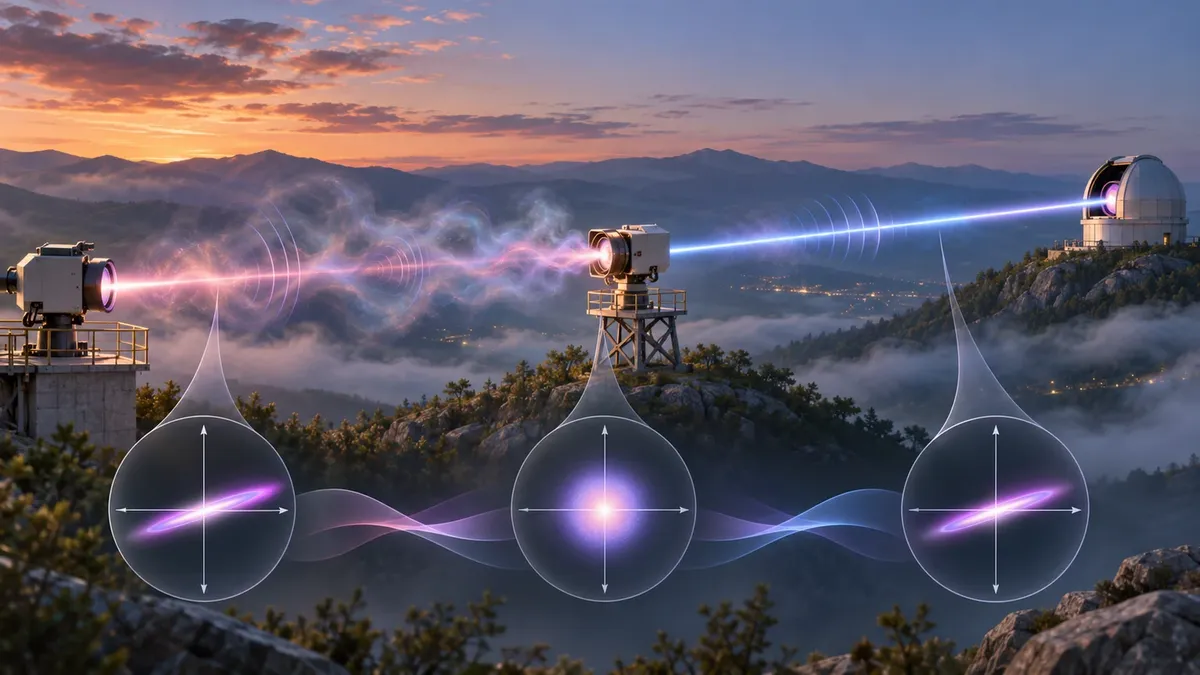
Free-space optical links can be disrupted by atmospheric turbulence, while a relay needs energy to receive and retransmit signals. Researchers model a relay that harvests optical energy and forwards information using squeezed light, asking when this more elaborate signaling actually pays off.
A relay with two jobs
A free-space optical communication link sends light through the atmosphere, where turbulence can make the received signal fluctuate. A relay can split a long route into two hops: it detects a message from the source, then sends its decision onward to a destination. But the relay also needs power.
In this theoretical study, Nizar Khalfet, Francisco A. Monteiro and Ioannis Krikidis analyze a relay that harvests energy from incoming light during part of each transmission block. It then uses the remaining time to receive and forward binary messages. The authors ask how the time spent harvesting should be balanced against the time available for communication—and whether the relay can improve its forwarding signal by using displaced squeezed states rather than ordinary coherent light.
Squeezing redistributes quantum noise between two properties of light, reducing it in one while increasing it in the other. That can make two signals easier to distinguish, but the benefit depends on how much light is lost along the way.
A model of fading and quantum detection
The authors represent each atmospheric hop as a pure-loss optical channel. Its transmission varies randomly according to a truncated Gamma-Gamma distribution, a model used for turbulence-related changes in received light. “Truncated” means the distribution is conditioned on transmission values that are physically possible: between zero and one. The paper describes this choice as a tractable modeling approximation.
The relay uses a time-switching, decode-and-forward design. It first makes a decision about the received bit, then encodes that decision for the next hop. It is assumed to have no battery for storing energy between blocks: energy harvested in a block is used in that same block. The researchers also assume the receiver knows the instantaneous transmission, tracks the optical phase and frequency, and faces no additional background or Gaussian noise.
To assess reliability, the study uses Helstrom-optimal detection—the quantum-mechanical measurement that minimizes the error when distinguishing two possible signals. For the first hop, which uses coherent signals, the authors derive an exact series expression for the average error. For the squeezed signals on the second hop, they derive the states after loss and calculate their Gaussian fidelity, a measure related to how distinguishable they are. Fidelity gives rigorous bounds on detection error, but the authors also numerically evaluate the exact mixed-state Helstrom error to compare signaling choices.
They then combine the two hops’ errors with the time allocated to harvesting to define an effective throughput: the fraction of channel uses that carry correctly detected bits. Their analysis proves that an optimal squeezing allocation exists for a fixed relay photon budget, and that a throughput-maximizing harvesting fraction lies inside the allowed range. It does not prove that either optimum is unique.
Squeezing helps only in a limited regime
The central physical complication is that loss affects squeezed light differently from coherent light. A coherent state remains pure under the modeled loss, while a squeezed state becomes mixed: the vacuum entering the loss channel adds noise that can undermine the benefit of squeezing.
In the paper’s numerical examples, squeezing improves second-hop detection only under sufficiently mild loss. In one illustrative case, the improvement appears when transmissivity is roughly above 0.6; that is a result for the chosen conditions, not a universal cutoff. Across other simulations, the benefit is described as modest for the study’s baseline turbulence, but larger—reported as a 10–30% reduction in second-hop error—in examples with weaker turbulence. Strong turbulence creates more deep fades, where squeezing is less effective.
The best allocation under loss uses less squeezing than the rule that would be optimal in a lossless channel. Applying that lossless rule in the modeled turbulent setting can even perform worse than coherent relaying. The paper’s analysis further finds that as the relay photon budget grows, the optimized squeezing fraction tends toward zero. At high budgets, squeezing does not change the leading asymptotic error behavior relative to coherent relaying; its gains are a finite-budget effect.
Harvesting also involves a trade-off: more harvesting can increase the relay’s photon budget, but leaves less time to send information. The model guarantees an interior throughput optimum, and the numerical throughput curves show a peak rather than a benefit from harvesting as much as possible.
What the results do—and do not—show
These findings come from mathematical analysis and numerical calculations, not a demonstration of a working optical relay. The authors assume ideal Helstrom detection, and note that implementing it exactly can be difficult. Their model also excludes excess receiver noise and background radiation, assumes independent fading on the two hops, and treats harvesting energy as deterministic because the harvesting phase spans many fading intervals. The authors identify more practical receiver designs, additional noise and correlated fading as topics for future work.
The conclusions therefore describe performance within a specific set of assumptions. The truncated turbulence model is an approximation, and real links may violate the assumptions about phase tracking, energy harvesting or noise. The paper is a preprint, so its findings should be regarded as research results that may change with further scrutiny—not as evidence that this design has been experimentally validated.
- quantum optical communication
- free-space optics
- energy harvesting
- displaced squeezed signaling
- atmospheric turbulence
- quantum relay