TRANSMISSION // 2610.37383v2
Inflation models face a small-scale test—and a black-hole problem
Source published
Three modified single-field inflation models can amplify tiny early-universe fluctuations while matching ACT and SPT measurements of the scalar spectral index. But when the researchers test whether those fluctuations could explain pulsar-timing signals, primordial-black-hole limits become a major obstacle.
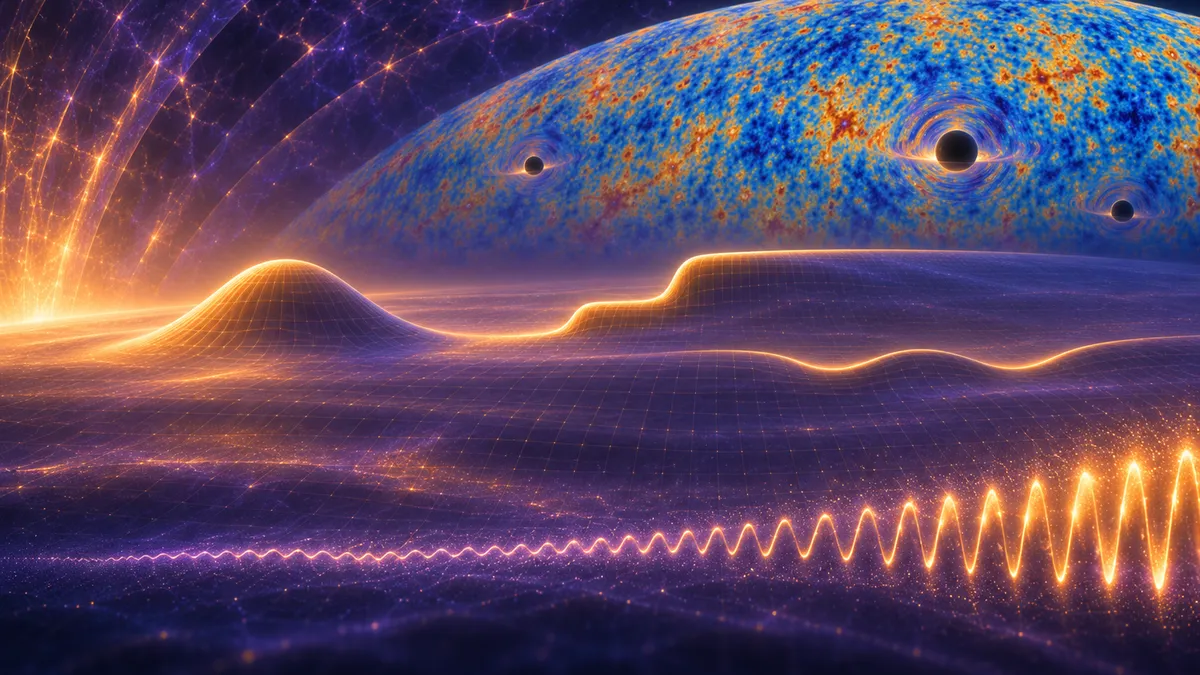
Could one simple field in the early universe produce both the large-scale pattern seen in the cosmic microwave background and much stronger fluctuations on smaller scales? A new preprint explores three ways to shape inflation’s potential to do this. Its calculations find parameter ranges compatible with several observations, but the most promising fits to pulsar-timing data often produce too many primordial black holes.
During inflation, the proposed rapid expansion of the early universe, quantum fluctuations could have been stretched into the initial variations that later shaped cosmic structure. Their imprint is described by a primordial curvature power spectrum: broadly, a measure of the strength of those variations at different scales. Observations of the cosmic microwave background (CMB) tightly constrain the spectrum on large scales, while its behavior on much smaller scales is less directly known.
The authors ask whether single-field inflation—a model with one main driving field—can produce a strong small-scale enhancement without conflicting with measurements of the scalar spectral index, nₛ. This index describes how the fluctuation strength changes with scale. The paper highlights a specific modeling difficulty: an ultra-slow-roll phase can boost small-scale fluctuations, but it also uses up some of inflation’s expansion, potentially lowering the predicted nₛ below the range favored by ACT and SPT observations.
Three ways to reshape the potential
The researchers study three proposed classes of inflationary potentials: a background potential with a bump or dip, a potential with step-like features, and a potential with two inflection points. Such features can briefly alter how the inflation-driving field moves. The authors numerically solve for the field’s evolution and the fluctuations it produces, then calculate the resulting primordial spectrum.
They compare these predictions with constraints from several sources: CMB measurements and baryon acoustic oscillations (BAO), limits on the total gravitational-wave energy density, CMB spectral distortions, and limits on primordial black-hole (PBH) abundance. They also calculate scalar-induced gravitational waves (SIGWs). These are gravitational waves that can arise when large scalar fluctuations interact after inflation.
In the parameter regions they identify as viable, all three model classes can produce a spectrum of roughly 10⁻² in the pulsar-timing-array (PTA) frequency range while keeping nₛ within the paper’s stated 2σ observational range. This is a model result, not a direct measurement of the small-scale spectrum. The three cases do not fare equally under the paper’s combined constraints: the step-modified model has the broadest allowed region in the scans, while the double-inflection-point model has the narrowest. “Allowed” here means satisfying the particular bounds and assumptions included in the analysis.
Matching a signal is not the same as explaining it
The authors then ask a narrower, conditional question: if SIGWs from inflationary fluctuations dominate the nanohertz gravitational-wave signal studied by the NANOGrav 15-year data, can any of these models fit it while also meeting the other limits? They compare model spectra with the reported frequency-bin data using a Bayesian analysis, and set the resulting parameter regions against their cosmological constraint maps.
The answer depends on the model. The bump- and dip-modified cases can fit the PTA spectrum about as well as the paper’s supermassive-black-hole-binary comparison, but their best-fitting regions lie mostly beyond the PBH abundance limit. The authors report that 93.9% of the bump-model and 96.3% of the dip-model posterior samples violate that limit. The double-inflection-point case gives the strongest relative spectral fit in their comparison, yet 82.3% of its PTA-fit samples also exceed the PBH bound; only a smaller part remains in the allowed region. The step model’s calculated spectrum does not reproduce the observed broadband shape well, so the analysis disfavors it as the dominant source of the PTA signal.
The takeaway is not that these models explain the PTA signal. Rather, the calculations show that matching the signal’s spectrum and satisfying independent cosmological bounds are different tests. Under the paper’s assumptions, none of the three models can dominate the current PTA signal while remaining inside its allowed parameter space. The authors mention possible extensions, including primordial non-Gaussianity, but do not establish that these would resolve the conflict.
What remains uncertain
These are numerical tests of specified theoretical models, not a detection of inflationary features, primordial black holes, or inflation-generated gravitational waves. The PTA signal’s origin remains unsettled, and the SIGW interpretation is explicitly conditional. PBH abundance limits also depend on the modeling choices used to translate a predicted fluctuation spectrum into black-hole formation; this analysis assumes Gaussian primordial curvature perturbations. Its reported parameter ranges therefore should not be read as model-independent exclusions.
The source is an arXiv preprint, so its claims should be treated as provisional rather than as settled scientific consensus. The paper’s conclusions describe its selected models, data inputs, and assumptions; they do not rule out other inflation models or other explanations for the PTA observations. Future measurements may narrow the possibilities, but the present result is a calculation showing how multiple observational scales can pull a proposed explanation in different directions.
- cosmic inflation
- primordial black holes
- pulsar timing arrays
- gravitational waves
- cosmic microwave background
- early universe
Reviewed cross-references
These connections were reviewed by a model, not independently fact-checked by a human. Similarity does not imply agreement; consult the original papers and the evidence below.
A Python tool traces possible signals from the early universe
Shared method: Both studies numerically evolve single-field inflation and calculate primordial perturbation spectra and their consequences for primordial black holes and scalar-induced gravitational waves. The comparison is methodological: PrimordialPy is a general-purpose software library, while the other paper applies numerical calculations to three specific models; it does not independently validate those models’ findings.
Model review: · openai-codex/gpt-6-luna
Evidence and provenance
Selected excerpts, not complete papers. PDF extraction can omit figures or damage equations, tables and reading order; sources may be preprints.
2610.37383v2 — Original paper
Excerpt reference:
static/papers/2610.37383v2.md:2404-2465
Basis: Paper text
Source SHA-256:09343da96d493c9563071852f9ec05e6cc90d27a8c7e1df08d5cbcab14b2fc522611.05566v1 — Original paper
Excerpt reference:
static/papers/2611.05566v1.md:16-74
Basis: Paper text
Source SHA-256:db490744793203bca59954b00637c45c5fbc86e44a240c246c8e9b5e6873cbdd
Related reading
Automatically matched by shared topic keywords. These links do not imply that the sources agree or establish a consensus.
A Python tool traces possible signals from the early universe
Source published
Shared keywords: cosmic inflation, primordial black holes
How the early Universe’s changing particle soup could reshape gravitational waves
Source published
Shared keywords: early universe, gravitational waves, pulsar timing arrays
Could primordial black holes explain Webb’s Little Red Dots?
Source published
Shared keywords: cosmic microwave background, primordial black holes
Cosmic microwave background could limit exceptionally massive primordial black holes
Source published
Shared keywords: cosmic microwave background, primordial black holes
Neutrino patterns could leave a different gravitational-wave imprint on the early sky
Source published
Shared keywords: cosmic microwave background