TRANSMISSION // 2610.36672v2
A registration model that knows when its matches are shaky
Source published
ReliMorph estimates how trustworthy local image matches are, then uses that estimate to choose spatial context and temper deformation updates. In tests on three brain MRI and abdominal CT–MR benchmarks, it reported stronger anatomical alignment than the comparison methods overall, with trade-offs and important limits.
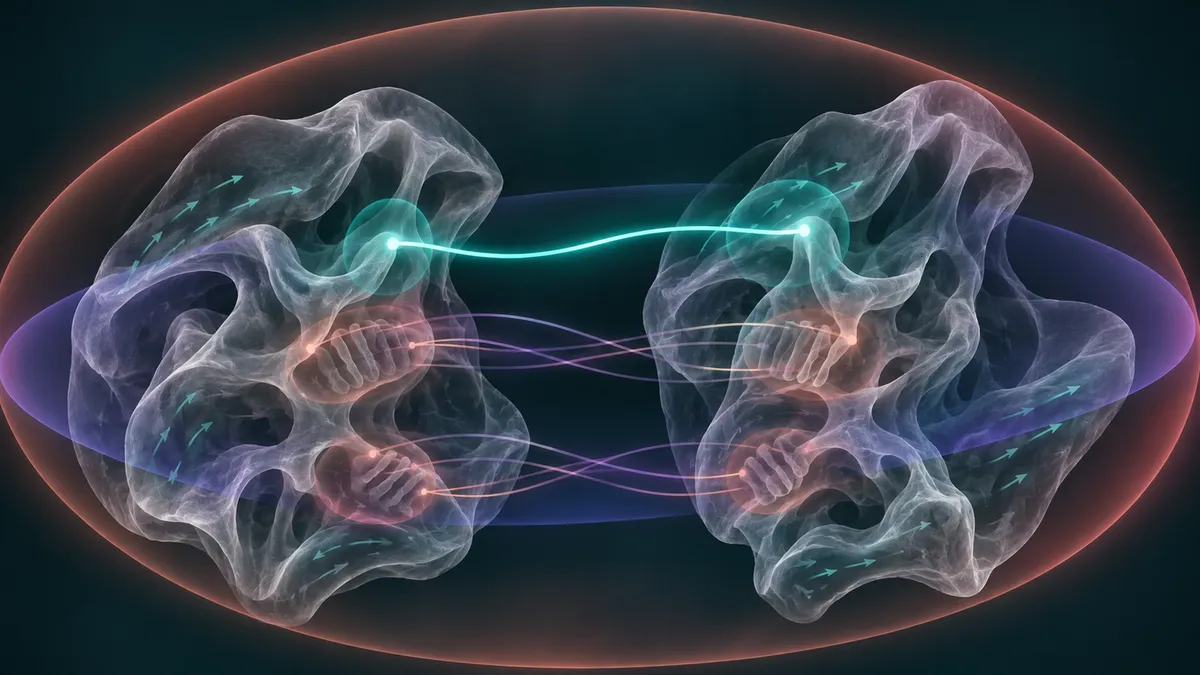
Aligning two medical scans is not simply a matter of matching similar-looking patches. Some tissues have little texture, repeated patterns or different appearances across imaging types, making several locations plausible matches. A new research preprint proposes a way for a registration model to assess that ambiguity and adjust how it processes and moves each region.
The challenge: when a match is not a sure thing
Deformable image registration aims to align corresponding anatomy across two medical images, even when the shape or position of tissues differs. It is used in research and medical-imaging workflows, including comparisons across time and between imaging modalities. Many learning-based systems estimate a dense field of movements, effectively deciding where each voxel in one scan should map in another.
But a local image patch may not provide enough information to make that decision confidently. Homogeneous tissue, repeated structures, weak contrast or differences between modalities can leave several possible matches. If a system treats all its estimates as equally dependable, an ambiguous match may lead to a misleading deformation. The authors of ReliMorph ask whether a model can use local matching reliability both to choose what spatial context to examine and to control how strongly it updates its estimate.
A confidence-aware route through the images
The method processes image pairs in both directions and refines their alignment from coarse to fine. At each level, it compares features from one image with features from the currently warped version of the other, forming a distribution over candidate local offsets. Rather than retaining only the strongest candidate, ReliMorph summarizes the distribution with measures including its entropy, the probability assigned to its leading candidate, and the gap between the top two candidates. In plain terms, these statistics help describe whether one match stands out or several remain plausible.
That information feeds two parts of the model. First, it guides a voxel-by-voxel blend of three processing “experts”: one focused on nearby detail, one that gathers context along the three image axes, and one that samples a broader neighborhood. Second, a gate scales the predicted residual velocity—the model’s proposed local movement—so uncertain estimates can have less influence. Forward–backward disagreement from a coarser stage is also passed to the next, finer stage as another cue about the registration’s state.
The authors trained the system without using anatomical segmentation labels as training targets. Instead, its objective combines image-alignment terms with regularization, including smoothness and consistency-related terms, as well as supervision for confidence. The evaluation then used anatomical labels to measure alignment; those labels were not included in the training loss.
What the tests found
The researchers evaluated ReliMorph on IXI and OASIS brain MRI registration and AbdomMRCT abdominal CT-to-MR registration. These experiments cover two single-modality brain MRI settings and one cross-modality abdominal setting. Across the three benchmarks, the paper reports that ReliMorph had the highest Dice similarity coefficient (DSC)—an overlap measure where higher is better—and the lowest 95th-percentile Hausdorff distance (HD95), a measure of boundary discrepancy, among the methods in its main comparison table.
On IXI, for example, ReliMorph’s DSC was 0.8093, compared with 0.8070 for CorrMLP, the strongest comparison listed there by DSC. On OASIS, its DSC was 0.8258, versus 0.8164 for LGANet++. On AbdomMRCT, the reported DSC was 0.8868, compared with 0.8798 for TransMorph. These results support the authors’ case that reliability-guided processing can help on the tested data; they do not establish that it will improve registration in every dataset or clinical setting.
Ablation tests on IXI offer evidence that the components matter within this experimental setup. Conditioning routing and velocity gating on explicit descriptors together produced a higher DSC than conditioning either component alone. Removing ambiguity statistics, consistency feedback, expert routing or velocity gating also lowered the reported DSC relative to the full model. These comparisons suggest that the combined design contributed to performance, though they do not show that each component will help equally in other settings.
The caveats behind the result
The gains do not mean every measure improved on every dataset. On OASIS, ReliMorph’s folding rate—the percentage of voxels with non-positive Jacobian determinants, used here to assess deformation regularity—was higher than LGANet++’s: 0.0423% versus 0.0013%. The supplementary analysis also found a trade-off in the tested velocity-gate settings: the default gate floor achieved the best reported alignment measures on IXI and OASIS, but also the highest measured folding rate among those settings. Good overlap therefore does not, by itself, guarantee the most regular deformation.
The evidence is limited to three public benchmarks and the study’s particular data splits, preprocessing, comparison methods and evaluation measures. The authors state that symmetry does not guarantee exact inverse consistency or fold-free discrete transformations. The paper also describes the confidence output as a quality-assessment aid, not proof that a particular region is anatomically correct. Results on research datasets do not establish clinical benefit or suitability for patient care.
Finally, the source is an arXiv preprint. The supplied material does not establish that it has undergone peer review, so the reported methods and findings should be treated as provisional. Independent replication and evaluation on broader data would help clarify how robust the approach is and where it is useful.
- medical imaging
- image registration
- MRI
- CT–MR
- computer vision
- deep learning
- uncertainty
Related reading
Automatically matched by shared topic keywords. These links do not imply that the sources agree or establish a consensus.
How separate image generators can make coordinated outputs
Source published
Shared keywords: medical imaging
EvoML checks machine-learning workflows in stages and saves successful fixes
Source published
Shared keywords: medical imaging
Can remote-sensing AI learn without perfectly matched pairs?
Source published
Shared keywords: computer vision
Reading smoke’s motion to find hidden wildfire flames
Source published
Shared keywords: computer vision
Using generated ultrasound images to choose real ones worth labeling
Source published
Shared keywords: medical imaging