TRANSMISSION // 2610.36634v3
How economic shocks travel through good times and bad
Source published
A new time-varying quantile VAR framework aims to trace how economic shocks affect different parts of the outcome distribution—and how those effects change over time.
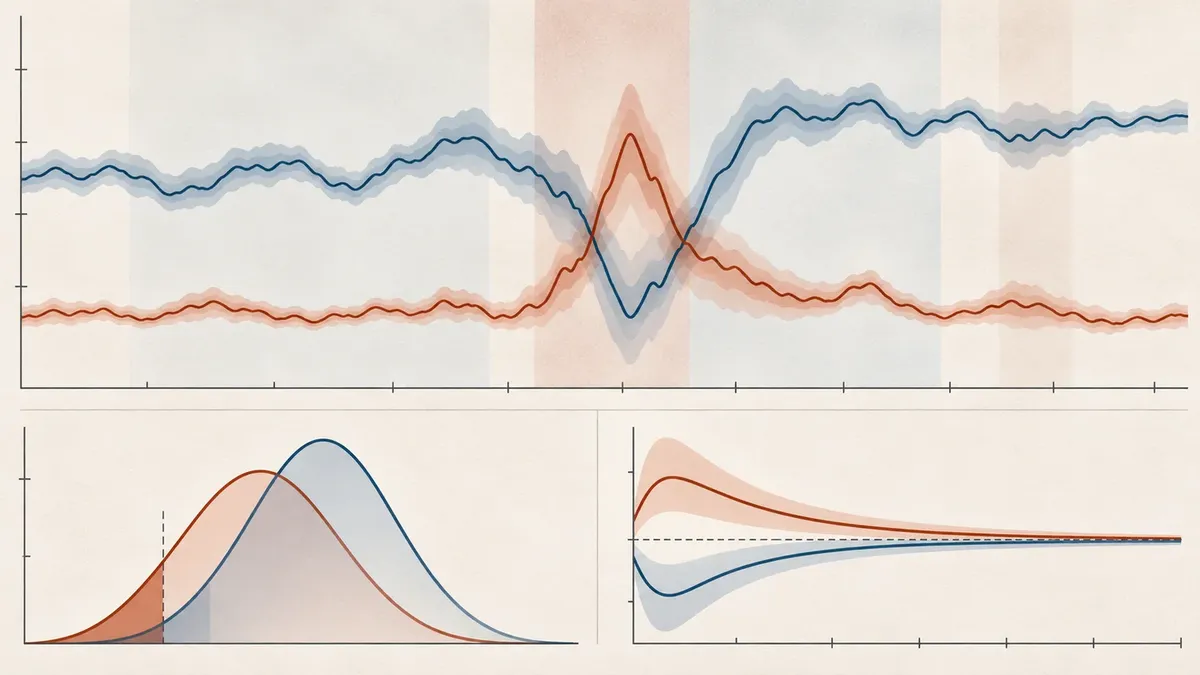
Economic downturns and financial stress can affect relationships between indicators differently from ordinary conditions. A new statistical framework studies these changing links in the tails of the data, with an application to U.S. industrial production growth and credit spreads.
The question: do economic shocks travel differently in the tails?
Many familiar economic models describe how variables move together by tracking their conditional averages. But an average relationship may not capture what happens in unusually bad or unusually good conditions. Researchers may want to know, for example, whether a change in credit spreads is linked differently to industrial production growth when growth is especially weak.
Jiti Gao, Fei Liu and Bin Peng introduce a framework for studying such questions with a time-varying quantile vector autoregression, or TV-QVAR. In plain language, it is a way to model several economic time series together, focus on different points in their outcome distributions rather than only their averages, and allow the relationships to change over time.
The key challenge is that these models do not behave like ordinary linear systems. In a standard conditional-mean VAR, researchers can often trace a shock forward through the equations using linear recursions. In a quantile model with changing parameters, neither the parameters nor the conditional quantiles generally carry through those recursions linearly. That makes it harder to define and estimate an impulse response: a description of how a system responds over time after a disturbance.
Building a workable response measure
The authors develop several connected tools. First, they establish a uniform Bahadur representation for local quantile VAR estimation. This is a technical result that describes how estimation errors behave across the time-varying model, providing a foundation for statistical inference.
Second, they propose a smoothed version of the check function, the loss function commonly used to estimate quantiles. Smoothing is intended to make inference about the model’s parameters more tractable.
Third, they define a best linear projection of the time-varying quantile impulse response, or TV-QIR. This projection provides a well-defined way to summarize dynamic effects even though the underlying quantile responses do not propagate linearly through the system. The authors present this as a method for recovering dynamic causal effects within their framework; that interpretation depends on the model’s assumptions and does not by itself establish causality in every empirical setting.
What the application reports
The researchers apply the method to U.S. industrial production growth and credit spreads over the period 1919–2025. According to the abstract, the analysis finds pronounced structural shifts in the way the two series are connected in the tails of their distributions.
The reported pattern is asymmetric across the downside and other parts of the distribution: downside asymmetry is concentrated at short horizons and diminishes as the forecast horizon lengthens. Put simply, the authors report that differences associated with adverse conditions are most apparent over shorter periods, with those differences becoming less pronounced at longer horizons. The abstract does not provide numerical estimates or enough detail to describe the size, timing, or precise direction of individual responses.
What remains uncertain
These results should be read as a methodological contribution and an abstract-level summary of one application, not as a complete account of the evidence. The available source does not specify the quantile levels, exact model assumptions, uncertainty intervals, robustness checks, or how the reported pattern varies across historical episodes. Without those details, it is not possible to assess how precisely the estimates are determined or how sensitive the findings are to alternative choices.
The term “causal” also needs care. An impulse-response framework can be used to interpret the consequences of a disturbance, but causal conclusions depend on how that disturbance is defined and on the assumptions that identify it. The abstract describes the projection as recovering well-defined dynamic causal effects, but the evidence provided here is not enough to evaluate the identifying assumptions or their empirical plausibility.
The source is an arXiv preprint, and the available evidence for this article is its abstract rather than the full paper. Preprints may not have undergone peer review, and abstract-only reporting leaves important methodological and empirical details unexamined. The study therefore offers a proposed way to analyze changing tail relationships in economic time series, along with an application whose interpretation merits checking against the full paper and subsequent scrutiny.
- quantile VAR
- time-varying models
- impulse responses
- industrial production
- credit spreads
- econometrics
Related reading
Automatically matched by shared topic keywords. These links do not imply that the sources agree or establish a consensus.