TRANSMISSION // 2610.36625v2
How an event camera can help track a spacecraft
Source published
A new pose-estimation system weighs event-camera measurements by their timing, geometry and reliability. It improves benchmark scores, though important limits remain.
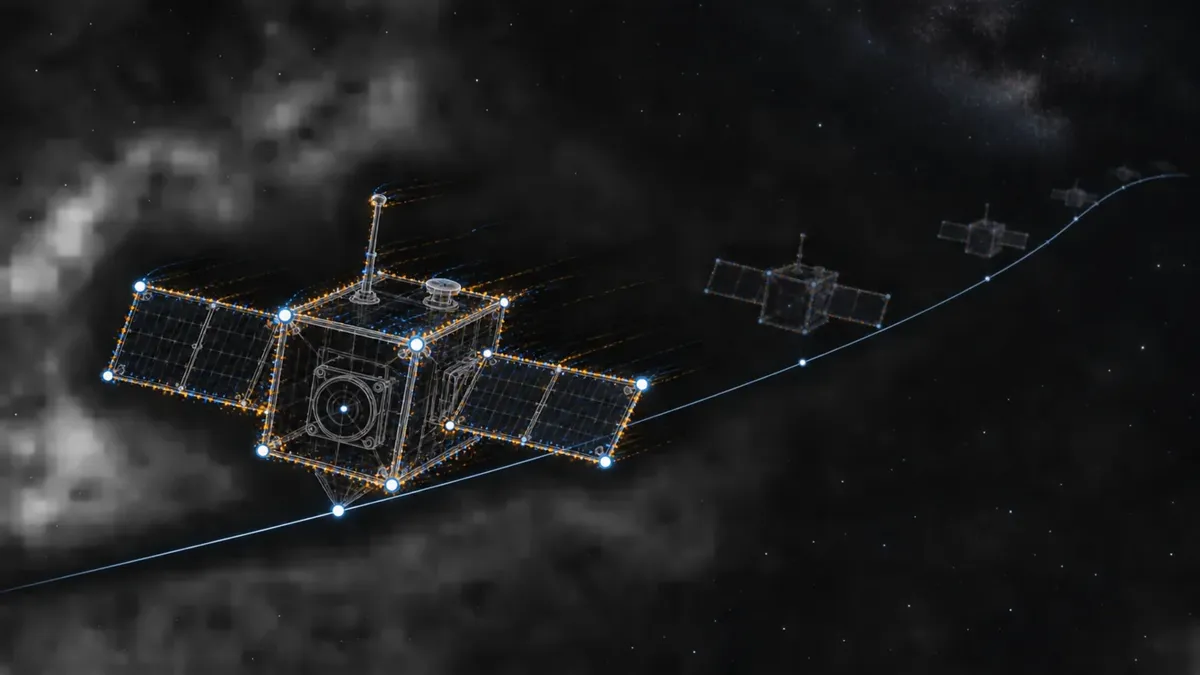
Event cameras record changes in brightness rather than ordinary images. For tracking a spacecraft, that can provide useful motion cues—but sparse, uneven events make some measurements more trustworthy than others. A new framework tries to account for that uncertainty from individual keypoints through to a full pose sequence.
Tracking a spacecraft from flashes of change
A spacecraft pose estimate describes its position and orientation relative to a camera. It is a key ingredient in tasks such as rendezvous and inspection. But a camera observing an uncooperative spacecraft may face shadows, reflections and large changes in apparent size. Event cameras offer a different kind of data: they report when brightness changes at a pixel, along with the change’s polarity and timing, rather than capturing conventional frames at regular intervals.
That stream can be informative, but it is uneven. Some parts of the spacecraft may produce many events while others produce few, and a detected landmark’s effect on the final pose depends not only on how clearly it was located but also on the camera view and the arrangement of landmarks on the spacecraft model. Yonglong Zhang, Zongwu Xie and Yang Liu propose a system that tries to track this reliability through several stages of pose estimation.
From event timing to a pose sequence
The method begins by detecting the spacecraft and stabilizing a region of interest around it. It then processes five neighboring event windows, combining positive-polarity events, negative-polarity events and a channel representing how recently events occurred. Attention and gating let the network mix information across these three branches; temporal aggregation then brings together information from adjacent windows.
The network predicts locations for 11 semantic points defined on the spacecraft’s computer-aided-design (CAD) model. Those points provide image-to-model correspondences for geometric pose recovery. A separate reliability model estimates the relative precision of each point using local heatmap responses and information about the point’s camera ray and CAD geometry. In plain language, it aims to judge not just whether a point looks clear, but how much an error at that point could matter for the recovered pose.
Next, event edges are compared with edges rendered from the CAD model at candidate poses. The system does not accept a pose update just because one candidate scores well: it applies geometric checks, requires improvement over a geometric reference, and checks that the selected candidate agrees at two rendering-integration resolutions. If the event evidence does not pass these safeguards, it can fall back to a geometric estimate.
Finally, the system assigns each accepted observation separate translation and rotation weights. These weights use a ten-feature description of heatmap shape, reprojection agreement and geometric conditioning, evaluated after event-based refinement. A trajectory optimizer combines the observations with motion constraints across time.
What the tests found
On the official SPADES challenge test set, the complete system achieved a combined pose score of 0.0474; lower is better. The authors report this as about 5.4% below the PASAN+IRIS score of 0.0501. The comparison is not a clean, controlled experiment between newly rerun systems: the other challenge results are published scores from their respective pipelines. The proposed system also did not have the lowest rotation-error score in the table; the RF-DETR cascade’s reported rotation score was slightly lower.
The authors’ validation ablations help show how parts of the system behaved under matched conditions. The combined score fell from 0.0772 for base localization with uniform-weight pose recovery to 0.0514 for the complete cascade. On identical post-refinement observations, quality-aware weighting reached 0.0514, compared with 0.0549 using constant weights. These results support the value of the added components in the reported tests, but do not establish that each will help equally in other settings.
Five event windows gave the best combined validation score among the window lengths tested. The paper reports a processing cost of 52.7 milliseconds per frame for that setting. This is not an end-to-end online-latency figure: the input uses future as well as past windows, and trajectory optimization operates over complete sequences.
What remains uncertain
The work evaluates the method on the SPADES spacecraft dataset, which includes synthetic and laboratory trajectories. A benchmark result is evidence about performance under that dataset and protocol, not a demonstration of reliable operation during an actual rendezvous or on different spacecraft, cameras or lighting conditions. The paper also notes that smoothing can reduce rapid fluctuations while sustained deviations from ground truth remain; persistent observation bias and temporal look-ahead are identified as future challenges.
The source is an arXiv preprint, and the supplied record does not establish whether this version has undergone peer review. Its reported results should therefore be read as the authors’ findings, not as settled evidence. In particular, comparisons with published challenge entries and the validation ablations answer different questions, and neither alone proves real-world robustness.
- event cameras
- spacecraft pose estimation
- computer vision
- robotics
- uncertainty estimation
- SPADES
Related reading
Automatically matched by shared topic keywords. These links do not imply that the sources agree or establish a consensus.
Teaching AI to Generate Event-Camera Signals
Source published
Shared keywords: computer vision, event cameras
How Event Cameras Learn Depth Without Dense Labels
Source published
Shared keywords: computer vision, event cameras
How EventSSM estimates depth from event-camera data
Source published
Shared keywords: computer vision, event cameras
How event polarity may help detect tiny drones
Source published
Shared keywords: computer vision, event cameras
How robots can estimate when their actions are uncertain
Source published
Shared keywords: uncertainty estimation