TRANSMISSION // 2610.36304v2
Could a third star help Be stars spin up?
Source published
Models identify stellar systems whose observed companions could drive a close pair toward interaction, potentially enabling stellar spin-up. The results establish dynamical plausibility, not proof of how these rapidly rotating stars formed.
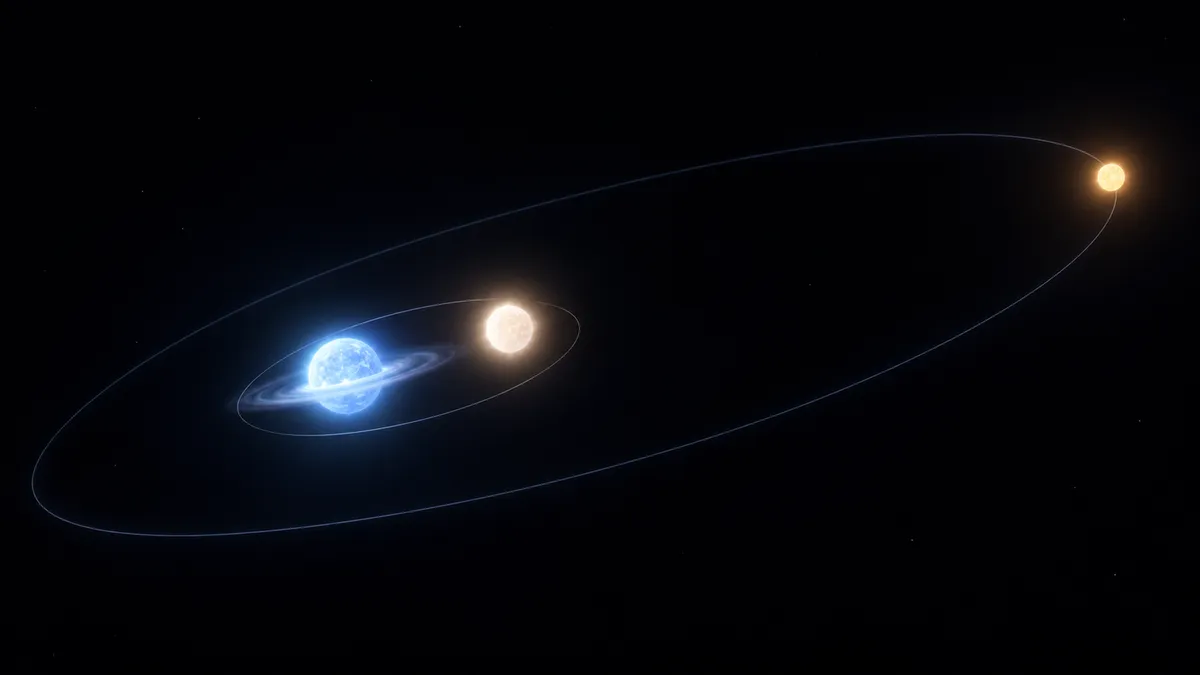
Classical Be stars rotate rapidly and carry gaseous disks, but the origin of their spin remains uncertain. A study by C. A. Guerrero, O. V. Maryeva and M. Kraus tests whether a distant third star could help bring an inner stellar pair close enough to interact.
A distant companion with an indirect role
A wide stellar companion need not donate material directly to influence a Be star’s evolution. In a hierarchical triple, two stars orbit closely while a third circles farther out. If the orbital planes are suitably inclined, the outer companion can drive Kozai–Lidov cycles: long-term changes that stretch the inner orbit, potentially bringing its stars much closer at their nearest approach.
That could enable tides, mass transfer or merger-like interaction inside the close pair. Such interactions might supply the angular momentum needed for rapid rotation. The question addressed here is narrower: do observed Be-star systems permit the orbital arrangements needed for this mechanism?
The study is available as an arXiv preprint, first submitted on 26 October 2026 and revised on 5 November. The supplied landing record does not establish journal publication.
Testing possible architectures
The researchers combined existing observations with synthetic populations of triple systems. Their inventory contains 33 distinct targets, but these are not all confirmed triples. Some have only a resolved companion; others have additional evidence of an unresolved inner companion.
Speckle interferometry supplied angular separations of resolved sources. Reported inner orbital periods constrained close pairs. Hipparcos–Gaia proper-motion anomalies supplied another, less direct clue: differences between short-term and long-term apparent motion that can indicate an unresolved companion.
Crucially, an image measures an instantaneous separation projected onto the sky, not the true size of an orbit. The team therefore projected synthetic outer orbits before comparing them with observations, accounting for orbital phase and viewing geometry.
Accepted configurations had to satisfy hierarchical stability and secular-regime requirements. Their estimated Kozai–Lidov timescale also had to be shorter than an approximate main-sequence lifetime inferred from the present-day Be star’s mass.
A further filter tested whether the predicted closest inner approach could fall within three times the sum of the stellar radii. This was an interaction proxy, not a calculation of actual mass transfer or collision. Refined simulations used target-specific masses, distances and observational constraints, with a common 30% matching tolerance. That tolerance was a modelling choice, not a statement of measurement precision.
Two particularly clear matches
HD 35079 and HD 55606 emerged as the cleanest dynamical matches because stable configurations could reproduce both their reported inner periods and resolved outer separations.
For HD 35079, approximately 0.879% of generated configurations passed the refined filters. For HD 55606, the figure was about 0.408%. Their median Kozai–Lidov timescales were respectively 0.0091 and 0.0285 times the adopted stellar lifetime scale.
These percentages are fractions of an assumed synthetic population—not probabilities that the proposed history occurred, and not estimates of how common such systems are.
HD 55606 is already known as an interacting Be-plus-subdwarf binary. The new analysis asks whether its resolved companion could have played a dynamically relevant role; it does not establish that the companion caused its past mass transfer.
HD 205329 also admitted compatible configurations, but its interpretation depends on the approximate proper-motion-anomaly constraint. HD 37330, HD 41600 and HD 71510 provide additional candidates with similar astrometric caveats.
A system that exposes the model’s limits
HD 41335 illustrates why combining observations matters. Its period and speckle separation could be matched together, as could its astrometric scale and speckle separation. But no configurations satisfied all three constraints simultaneously at the adopted 30% tolerance.
Relaxing that tolerance to 50% admitted a small fraction, around one in ten thousand. The tension suggests that the period and astrometric signal may trace different scales, or that a more complex architecture or revised interpretation is needed. It does not demonstrate that the system lacks additional companions.
Enough angular momentum—in principle
Separately, the authors estimated the material needed to spin a star from moderate to near-critical rotation. Sampling assumed stellar-structure, rotation and angular-momentum-delivery parameters gave a median requirement of 4.8% of the Be star’s mass, with a 16–84 percentile range of approximately 2.7–8.5%.
This is an angular-momentum budget, not a measured accreted mass. It does not predict how much material a donor lost or how efficiently the recipient retained it.
The dynamical model likewise does not follow detailed tides, mass transfer, merger evolution or disk formation. Its simplified lifetime and closest-approach estimates leave evolutionary histories unresolved. Continued speckle monitoring, spectroscopy and improved astrometry could constrain the orbits and distinguish viable architectures. For now, the result is a set of physically plausible pathways and observational targets—not proof that third stars created these Be stars’ rapid rotation.
- Be stars
- hierarchical triples
- Kozai–Lidov mechanism
- stellar rotation
- speckle interferometry
- proper-motion anomalies
- binary interaction
Related reading
Automatically matched by shared topic keywords. These links do not imply that the sources agree or establish a consensus.