TRANSMISSION // 2610.34176v2
Can light reveal a subtly altered phase space?
Source published
A theoretical proposal uses an oscillator and interferometric light measurements to look for signatures of phase-space noncommutativity. It outlines a measurement route, not an experimental detection.
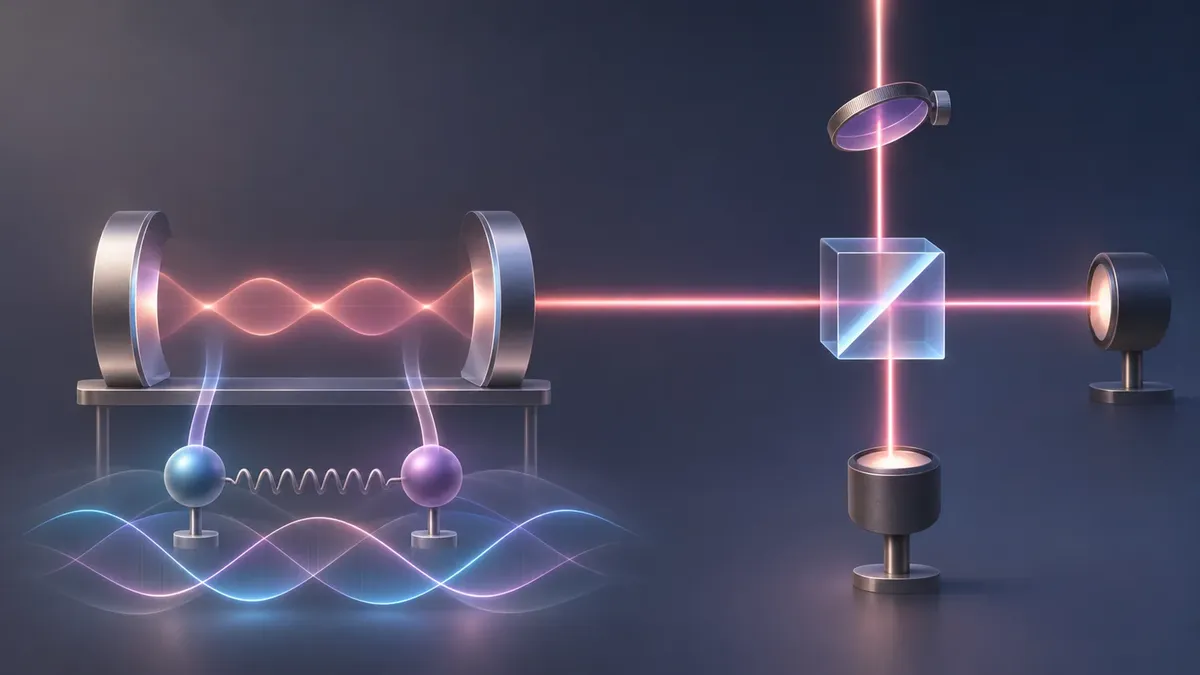
Could measurements of light reveal whether an oscillator’s position and momentum obey a slightly altered set of quantum rules? Pinaki Patra’s theoretical study models an anisotropic oscillator and proposes an optomechanical measurement scheme. Its calculations connect hypothetical changes in the oscillator’s dynamics to measurable properties of light—but the paper does not report that the scheme has been built or that noncommutativity has been observed.
A proposal to probe unusual quantum mechanics with light begins with a modest question: if an oscillator’s position and momentum obey a modified algebra, could that change leave a measurable trace in light interacting with it?
In the preprint Estimation of covariance matrix for Stokes-like measurement under phase-space deformation, Pinaki Patra studies a two-dimensional anisotropic harmonic oscillator. “Anisotropic” means its two directions have different frequencies. The model introduces two parameters: θ for position–position noncommutativity and η for momentum–momentum noncommutativity. These describe departures from the usual phase-space rules within a particular theoretical framework; they are not established properties of nature.
From altered mechanics to optical signals
To calculate the oscillator’s behavior, the paper uses a Darboux transformation, a mathematical change of variables that rewrites the deformed system in canonical coordinates. In that representation, the oscillator’s effective Hamiltonian contains couplings between its degrees of freedom. Patra derives its normal-mode frequencies and the covariance matrix of its Gaussian ground state. A covariance matrix summarizes how quantities such as position and momentum fluctuate together.
The model predicts that the deformation can generate correlations between oscillator coordinates, with the details depending on the oscillator’s parameters. The paper discusses when the Gaussian ground state is entangled, but correlation alone is not presented as proof of a noncommutative space. The proposed test instead looks for changes in the oscillator’s spectrum and in light’s response.
The next step is a theoretical optomechanical interaction: a coherent optical probe enters a cavity and couples to the oscillator’s displacement. The calculations predict time-dependent attenuation of optical coherence and a nonlinear Kerr phase—an intensity-dependent shift in the light’s phase. In the model, both are linked to the oscillator’s normal-mode frequencies.
To read out the optical field, the proposal combines the outgoing signal with a phase-controlled reference beam at a balanced beam splitter. Photodetectors measure light from the two outputs. Differences in their photocurrents at selected reference phases provide information about the signal’s optical quadratures—the field components analogous to position and momentum. From these measurements, the paper sets out how to estimate an optical covariance matrix, infer the coherence attenuation and Kerr phase, and extract the oscillator’s frequencies. Those frequencies can then be used to estimate θ and η, given the model and other oscillator parameters.
What the study does—and does not—show
This is a calculation and measurement proposal, not an experimental demonstration. The paper does not report data from a working apparatus or a detection of either deformation parameter. Its account assumes an idealized, lossless optomechanical interaction and says sufficiently low temperatures could make the oscillator’s state approximately its ground state. Patra identifies practical ingredients still needing treatment, including cavity damping, mechanical dissipation, thermal fluctuations and finite detector efficiency.
There are also interpretation and estimation challenges. The paper notes that optical changes may be weak in the small-deformation regime: for the special case η = 0, the leading change in a Stokes-like measurement is proportional to θ². It also cautions that estimating both parameters unambiguously requires enough independent experimental information. Multiple parameter solutions and measurement uncertainties would need to be assessed in a real implementation.
A further caveat is conceptual. Phase-space noncommutativity is one proposed mathematical framework, not a universal prediction of quantum gravity. Even if an experiment found a frequency shift or altered optical response, researchers would need to establish that other effects could not explain it before interpreting it as evidence for this framework.
The contribution is a proposed chain linking a modified oscillator model to light measurements: calculate the altered dynamics, infer frequencies from optical signals, and use those frequencies to constrain the deformation parameters. Whether the signals would be strong enough, distinctive enough and measurable in a realistic apparatus remains an open experimental question. This article is based on an arXiv preprint, which may not have undergone peer review.
- optomechanics
- phase-space noncommutativity
- Stokes measurements
- quantum oscillator
- covariance matrix
- quantum physics
Related reading
Automatically matched by shared topic keywords. These links do not imply that the sources agree or establish a consensus.
A model for updating cosmology’s uncertainty estimates without new simulations
Source published
Shared keywords: covariance matrix
How fast can Yang–Baxter circuits grow in complexity?
Source published
Shared keywords: quantum physics
When boundaries amplify non-Hermitian waves
Source published
Shared keywords: quantum physics
Geometry as a shield for logical quantum information
Source published
Shared keywords: quantum physics
Can Partial Symmetry Protect Topological States?
Source published
Shared keywords: quantum physics