TRANSMISSION // 2610.33378v2
When a quantum wavepacket reaches infinity
Source published
A mathematical study links boundary choices for higher-order squeezing to how quantum wavepackets split and recombine when their classical paths escape to infinity.
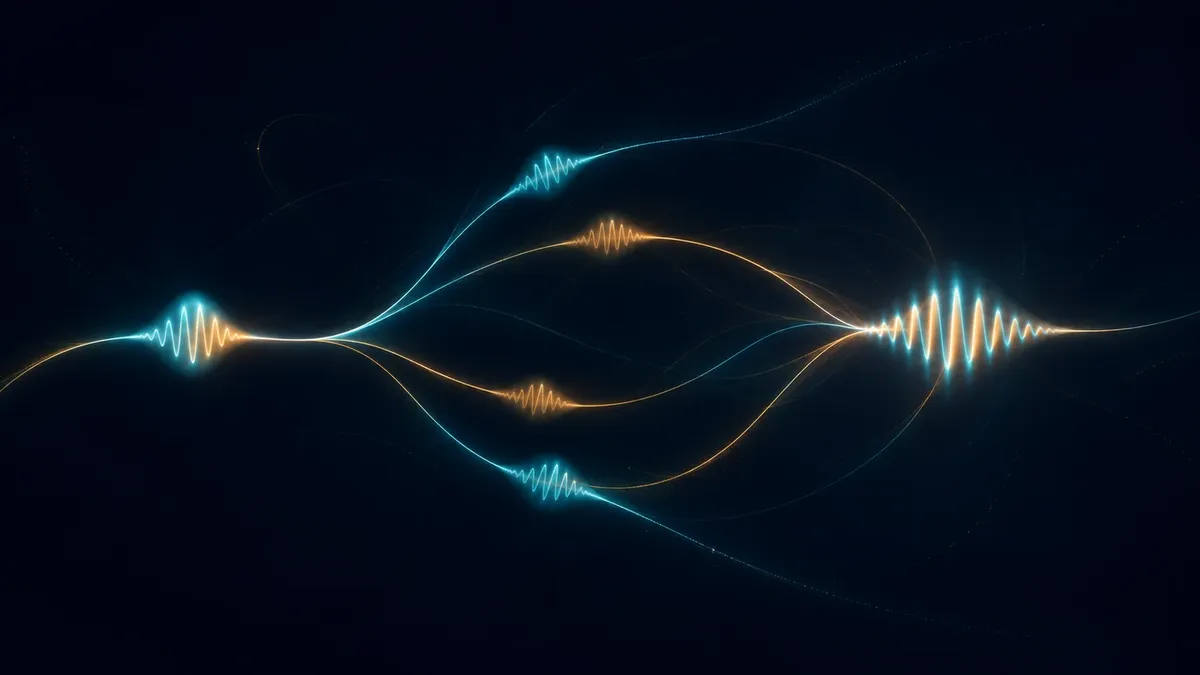
Some idealized oscillator models send classical trajectories to infinity in finite time. A quantum wavepacket, however, needs a rule for what happens as its classical path escapes. A mathematical study shows how different boundary rules can split a packet among outgoing paths—and why quantum phase matters when those paths later meet again.
A boundary problem in quantum dynamics
Higher-order squeezing changes an oscillator’s state by creating or removing several quanta at once. It can produce states with non-Gaussian structure. But in the higher-order models studied here, classical trajectories can reach infinity in finite time.
The equations describe a classical path only up to its escape; continuing it requires an additional rule. The quantum Hamiltonian likewise needs a boundary prescription to define its evolution fully. In this setting, there are multiple self-adjoint realizations—choices that allow the operator to generate consistent unitary quantum dynamics.
Alexander E. Teretenkov’s preprint asks how those quantum choices shape the semiclassical motion of a localized wavepacket. The question is not only where a packet goes before escape, but what happens after it reaches infinity in the model and continues along possible outgoing classical branches.
Connecting boundary choices to paths
The paper studies higher-order squeezing Hamiltonians of order greater than two. It describes their possible quantum boundary conditions using unitary matrices. A discrete Fourier transform connects amplitudes in oscillator sectors to amplitudes associated with classical rays. In this representation, each quantum realization has a “ray matrix”: a rule for how amplitudes arriving along incoming rays are distributed among outgoing ones.
The author analyzes coherent states—localized wavepackets—in the semiclassical limit, as Planck’s constant tends to zero. Their phase-space probability is represented by the Husimi distribution, a smoothed way to show where a quantum state is concentrated. The proof combines approximate solutions to the oscillator’s difference equation at large action, selected to satisfy the exact boundary condition, with Gaussian wavepacket approximations and estimates of their errors. This approach is important because stationary behavior near infinity alone would not establish how a moving packet propagates through the continuation rule.
What happens at the first passage
Before escape, the Husimi distribution follows the classical trajectory in the limit described. After the first passage through infinity, it concentrates on outgoing classical branches. The probability on each branch is the squared magnitude of the corresponding ray-matrix entry.
Some ray matrices describe deterministic gluings: each incoming channel connects to just one outgoing channel. More general matrices mix amplitudes across channels. The paper’s results distinguish this coherent mixing from a classical rule that simply selects one outgoing path.
The study also constructs a classical-amplitude representation. It extends transport along classical trajectories while carrying complex amplitudes between channels under a unitary boundary rule. For concentrated initial amplitudes, the resulting probability distributions reproduce the stated Husimi limits. This is a mathematical representation of those limits, not a claim that the full quantum and classical-amplitude dynamics are equivalent in every respect.
Why later returns are different
For positive-energy trajectories, the paper determines limits after any fixed number of passages. After one passage, branch probabilities follow from the squared magnitudes of the ray-matrix entries. But those probabilities alone do not generally predict later passages. Amplitudes instead evolve by powers of the unitary ray matrix, so relative phases can affect how branches combine.
A Fourier-type ray matrix illustrates the difference. In the example, the first passage distributes probability across branches; after the second, the limiting packet occupies a single branch. Repeatedly applying the one-pass probability rule would predict a spread-out distribution instead. Treating each passage as a fresh, incoherent random choice can therefore miss coherent recombination. This is an illustration of the mathematical result, not a prediction for every squeezing system or boundary condition.
Scope and limitations
These are theoretical results for a specified family of idealized Hamiltonians and boundary conditions. The paper reports no new experiment. Its description of escape and continuation is mathematical; it does not show that real devices send wavepackets through a physical infinity.
The limits concern Husimi probability distributions and fixed numbers of passages, with the positive-energy condition applying to the repeated-return result. A Husimi distribution records where probability is concentrated, not all phase information; the amplitude construction retains information needed to calculate later outcomes. The author explicitly does not claim convergence for a full hybrid quantum-classical observable algebra or equivalence of the complete quantum and Liouville evolutions.
This article is based on an arXiv preprint, which may not have undergone peer review. Its technical proofs and numerical illustrations support a mathematical analysis, but they do not establish how broadly the framework applies beyond the model studied.
- higher-order squeezing
- semiclassical physics
- quantum wavepackets
- self-adjoint extensions
- Husimi distribution
- coherent dynamics
Reviewed cross-references
These connections were reviewed by a model, not independently fact-checked by a human. Similarity does not imply agreement; consult the original papers and the evidence below.
How squeezed light can tip the balance of electron emission
Shared method: Both papers use Husimi phase-space distributions, but for different purposes: Teretenkov studies semiclassical concentration of quantum wavepackets, while Singh et al. use Husimi weights to average coherent-state responses in strong-field ionization. This is a shared representation, not evidence that the systems or results are equivalent.
Model review: · openai-codex/gpt-6-luna
Evidence and provenance
Selected excerpts, not complete papers. PDF extraction can omit figures or damage equations, tables and reading order; sources may be preprints.
2610.33378v2 — Original paper
Excerpt reference:
static/papers/2610.33378v2.md:13-42
Basis: Paper text
Source SHA-256:52335008ea64043dd04cfa2bbb6a51ec5f2dc7a5cf3078db6622ed20de11a0c32604.12646v2 — Original paper
Excerpt reference:
static/papers/2604.12646v2.md:1699-1753
Basis: Paper text
Source SHA-256:11dcac18bd6d8e2a0d2325a1254b1693006740a0ba18ffae8fce8563623a2e84
Related reading
Automatically matched by shared topic keywords. These links do not imply that the sources agree or establish a consensus.