TRANSMISSION // 2610.31285v2
Reading a solar jet from its chromospheric traces
Source published
A close study of one solar jet links spectral clues in the chromosphere and transition region to a possible mini-filament eruption, while leaving its trigger uncertain.
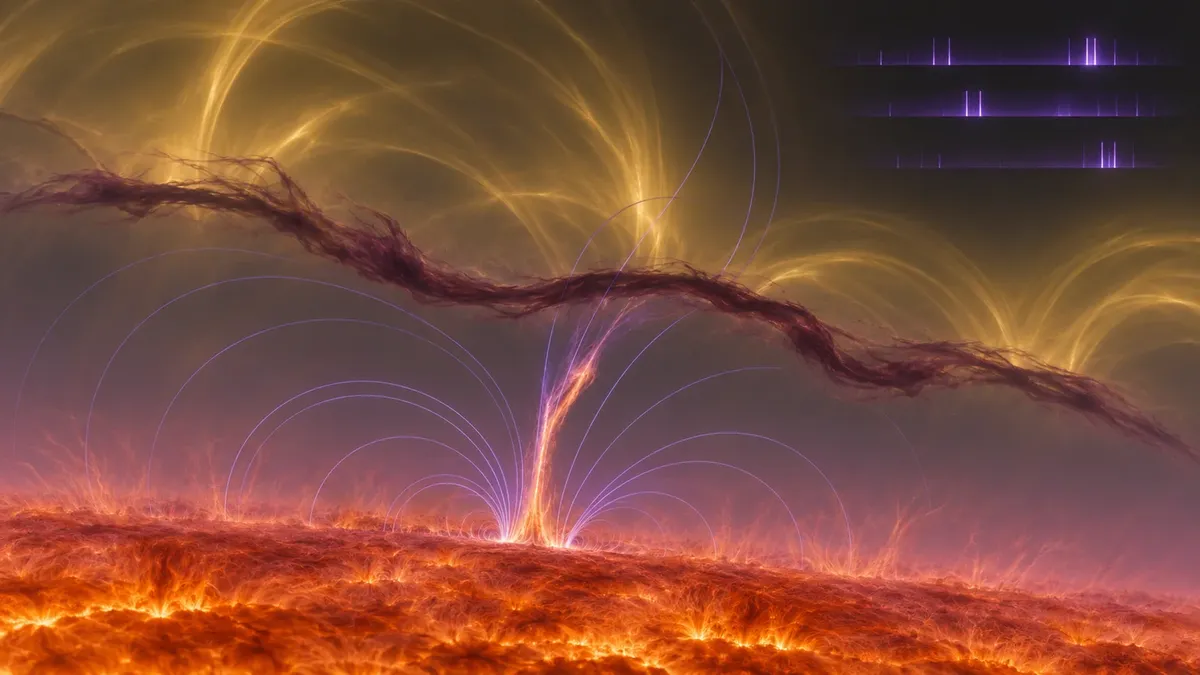
A brief jet on the Sun can leave clues in layers far below the corona. By combining ultraviolet spectra with solar images and magnetic-field measurements, researchers traced one small jet’s signatures into the chromosphere—and examined how its eruption might have begun.
A solar jet is a short-lived stream of hot or cooler plasma guided by magnetic fields. These eruptions are studied in part because they may help move material into the solar wind. But how does a jet that is conspicuous in the outer atmosphere connect to activity in the lower layers? A study by M. Koletti and colleagues follows one small jet across that boundary, while asking whether a compact, filament-like feature and changing magnetic fields preceded its launch.
The event occurred on 9 October 2013 in a low-latitude coronal hole, a region where the Sun’s magnetic field extends outward. The team combined ultraviolet spectra from NASA’s IRIS spacecraft with images and magnetic-field measurements from the Solar Dynamics Observatory (SDO). They focused on two spectral lines: magnesium II k, which provides clues about the chromosphere, and silicon IV, which probes the hotter transition region above it. They also used non-local thermodynamic equilibrium inversions—calculations that infer atmospheric conditions from light while accounting for how radiation and matter interact—and modeled the region’s magnetic structure.
One reason to combine these tools is that an image alone may not reveal how material is moving or what conditions it experiences. The shape of a spectral line can help: its peaks, central dip and wavelength shifts carry information about plasma and motion along our line of sight. The researchers fitted the magnesium line profiles and compared their measured features with silicon-line velocities. They also examined SDO images for the event’s evolution and magnetograms for changes in the photospheric magnetic field.
The results show related signatures in the chromosphere and transition region. Along the jet’s narrow column, or spire, magnesium profiles tended to have deeper central reversals and wider spacing between their peaks. Silicon measurements indicated higher transition-region Doppler velocities there. The authors interpret this pattern as evidence that plasma dynamics in the two atmospheric layers are connected. They suggest that material associated with the jet changes the opacity—the amount of light absorbed or scattered—in the magnesium line. The spectra therefore provide a chromospheric trace even though the jet itself was not directly visible in magnesium-line intensity images.
The observations also capture a possible precursor. Before the jet appeared, the team saw a dark, elongated feature in ultraviolet images. It grew and rose, then the cooler jet component appeared; a hotter component and a loop followed later. The feature looks like a small filament, but its faintness and proximity to the instruments’ resolution limit make its identification uncertain. For that reason, the paper calls it a “mini-filament-like structure,” rather than treating its nature as settled.
Magnetograms showed changes near the feature’s location before the eruption, including possible flux emergence, motions along the magnetic boundary, and a decrease in measured magnetic flux. A magnetic-field model placed a null point—where the modeled field vanishes—near the feature, and a quasi-separatrix layer, where magnetic connections change rapidly, near the jet base. Together, these clues are consistent with magnetic reconnection helping destabilize the structure and launch the jet. They do not demonstrate that reconnection was the trigger: the field model is an extrapolation, and the authors note that it may not locate the null precisely.
At one footpoint, magnesium profiles were often single-peaked and shifted toward longer wavelengths, a pattern the authors say may indicate material draining downward. That interpretation is plausible, not unique: line shapes can also be affected by temperature, density and unresolved motions. The inversions used to estimate atmospheric conditions likewise require caution, especially for the optical-depth level associated with this feature.
The study’s reach is limited by its focus on one event, the difficulty of resolving structures near the instruments’ resolution limit, and uncertainty in defining some regions and interpreting line profiles. Statistical relationships among measurements can support a connection without proving a physical cause. The authors call for more observations to test how widely these patterns apply and suggest that the detailed spectra could help constrain future magnetohydrodynamic simulations.
The source manuscript is presented as an Astronomy & Astrophysics proof and reports that an anonymous referee provided comments; the supplied record is an arXiv preprint, not independent confirmation of the findings. The conclusion to draw is therefore specific: in this event, several kinds of observations link a jet’s chromospheric signatures with higher-layer motions and a possible filament-like precursor. Whether that sequence is typical, and exactly what set it in motion, remains open.
- solar jet
- chromosphere
- transition region
- IRIS
- Solar Dynamics Observatory
- magnetic reconnection
- mini-filament
Related reading
Automatically matched by shared topic keywords. These links do not imply that the sources agree or establish a consensus.
Late solar radio bursts point to particle acceleration after a flare’s peak
Source published
Shared keywords: magnetic reconnection
Solar-wind waves carry a clue to their origin
Source published
Shared keywords: magnetic reconnection
How Neutral Gas Reshapes Magnetic Reconnection
Source published
Shared keywords: magnetic reconnection
How Magnetic Reconnection May Heat Ions Behind Shock Waves
Source published
Shared keywords: magnetic reconnection
How shock-driven plasma jets may spark magnetic reconnection
Source published
Shared keywords: magnetic reconnection