TRANSMISSION // 2610.29279v2
A quieter diamond spin bath—if the magnetic field is low
Source published
Simulations suggest that optically polarizing nitrogen-vacancy centres in diamond can make them a quieter source of magnetic noise than the usual nitrogen-spin bath—but mainly at low magnetic fields. The predicted benefit depends on polarization, probe design and spin relaxation; it has not yet been demonstrated experimentally in this study.
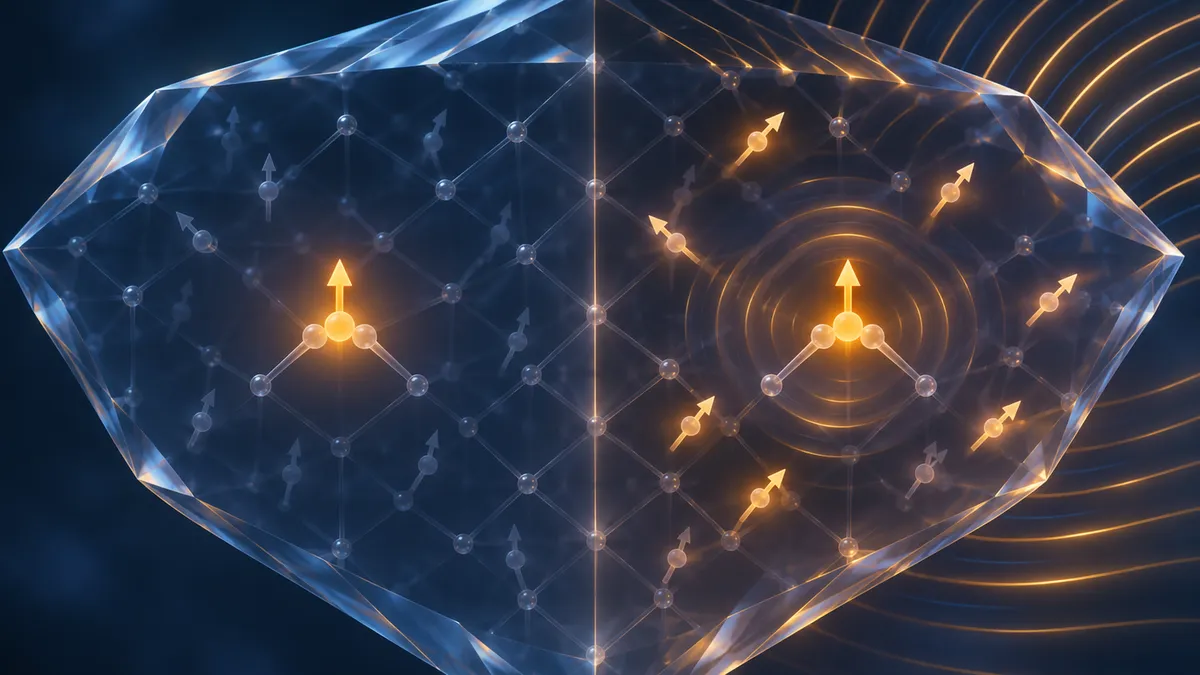
Diamond’s nitrogen-vacancy (NV⁻) centres can act as tiny magnetic sensors, but nearby electron spins disturb their signals. Could turning those neighbours into NV⁻ centres—and using light to polarize them—reduce that disturbance? A new theoretical study says yes under particular conditions, with an important catch: the magnetic field can make a supposedly quiet spin bath noisy again.
A diamond spin sensor is a little like a compass whose needle is nudged by nearby magnetic objects. In nitrogen-rich diamond, one important source of those nudges is the P1 centre: a substitutional nitrogen atom with an unpaired electron. The denser the spins around a sensor, the more quickly its signal can lose coherence.
Chikara Shinei’s study asks whether that familiar limit can be improved by converting some of the nitrogen into negatively charged nitrogen-vacancy centres, or NV⁻ centres. These defects can be prepared with laser light in a spin state called mₛ = 0. In an idealized picture, that state has no magnetic moment along the centre’s own axis and cannot readily exchange spin with its neighbours. A polarized NV⁻ bath might therefore disturb a nearby sensor less than a bath of P1 centres at the same density.
The catch is that the defects point in different directions. The calculations apply a magnetic field along one diamond [111] axis. Of the four possible NV orientations, one is aligned with the field; the other three are tilted. At low field, those tilted centres in the mₛ = 0-like state have very little magnetic moment along the field. At higher fields, their spin states mix differently, and the moment grows. The bath’s effect on the sensor therefore depends not just on whether it is polarized, but on the field strength.
Simulating a spin bath
This is a computational study, not a report of new measurements. The author combines cluster-correlation-expansion calculations—used to model interactions among groups of bath spins—with a dynamical treatment of spin exchanges in the wider bath. A separate exact solver handles the transfer of an excitation between the sensor and resonant bath spins, while a model includes longitudinal relaxation, or T₁. The calculations compare NV⁻ and P1 baths at several fields and concentrations, and consider a single selectively addressed sensor as well as an ensemble measurement. The reported coherence times are extracted from simulated decays, not from experimental fits.
One key quantity is T₂*, the time over which a sensor’s signal dephases without an echo sequence. At a simulated density of 0.57 parts per million and a field of 25 gauss, a separately addressed ¹⁵NV⁻ probe in a fully polarized NV⁻ bath has a predicted T₂* of 112 microseconds, compared with 18.0 microseconds for the P1 reference. At 90% polarization, the predicted time falls to about 43 microseconds—still above the P1 value. An ensemble measurement, in which many NV⁻ centres are driven together, has a smaller benefit: its T₂* rises from about 10.8 to 35 microseconds.
As the field rises, the advantage fades. At 300 gauss, the separately addressed probe’s predicted T₂* is 15.8 microseconds, about 1.4 times the P1 result. At 800 gauss it is 9.1 microseconds, below the P1 value of 11.5 microseconds. In the model, the tilted NV⁻ centres acquire larger moments along the field as field strength increases. Polarization then no longer makes them nearly magnetically silent—and at 800 gauss it can worsen dephasing.
The story differs for T₂, the coherence time measured using a Hahn-echo sequence. At 0.57 parts per million, the model includes a room-temperature T₁ of 6 milliseconds, which limits how long the bath stays polarized. For a separately addressed ¹⁵NV⁻ probe, the predicted echo time in a fully polarized bath is 264 microseconds at 25 gauss, versus 177 microseconds for P1. The advantage is smaller at 300 and 800 gauss: 350 and 374 microseconds, respectively, compared with 306 and 321 microseconds for P1. These are modest gains, and the results depend on the assumed relaxation and polarization.
Promising, but not yet a demonstration
The calculations suggest a design trade-off, not a universal improvement. Low fields favour reduced free-induction dephasing; higher fields can help preserve echo coherence by detuning or localizing spin exchange. A probe that can be distinguished spectrally from the bath also avoids some unwanted excitation transfer. The paper notes that practical gains require substantial conversion of paramagnetic nitrogen into NV⁻ centres and polarization close to unity. It also identifies model limitations, including an assumed T₁, approximations to parts of the bath dynamics, and a P1 dephasing estimate that differs from an experimental slope by about 30%; the author argues that this discrepancy does not change the calculated ratios.
The source is an arXiv preprint (version 2), and its central results are simulations rather than experimental validation. The article therefore describes a theoretically predicted route beyond the P1 dephasing limit under specified conditions—not a demonstrated improvement in a working sensor. Experimental tests will be needed to establish whether the required material conversion and polarization can be achieved together in practice.
- diamond
- NV centres
- quantum sensing
- spin coherence
- dephasing
- spin bath
- magnetic field
- theoretical simulations
Reviewed cross-references
These connections were reviewed by a model, not independently fact-checked by a human. Similarity does not imply agreement; consult the original papers and the evidence below.
How moving nitrogen spins reshape diamond’s quantum echo
Shared method: Both studies use cluster-correlation-expansion calculations with a dynamical treatment of bath-spin pair flip-flops. The first applies this to optically polarized NV⁻ baths and compares dephasing and echo times with P1 baths; the second focuses on Hahn-echo decoherence in a P1 bath, so their results concern different bath states and observables.
Model review: · openai-codex/gpt-6-luna
Evidence and provenance
Selected excerpts, not complete papers. PDF extraction can omit figures or damage equations, tables and reading order; sources may be preprints.
2610.29279v2 — Original paper
Excerpt reference:
static/papers/2610.29279v2.md:60-106
Basis: Paper text
Source SHA-256:fa10853d610298798cebb3eba56576ef9b7a3f35077d627136c45d40cbceae412611.02528v3 — Original paper
Excerpt reference:
static/papers/2611.02528v3.md:13-64
Basis: Paper text
Source SHA-256:c33376fede80a63368337bec68d6152cbce6eade79bd51215b0a82372b4cebe7
When diamond’s vacancies combine, a qubit may keep its coherence longer
Shared method: Both studies use CCE with outer-bath pair flip-flops treated through a dynamical mean field. The first examines polarization and field effects in NV⁻ baths, while the second predicts echo times for multi-vacancy baths; the shared calculation approach does not make their distinct bath-specific findings directly comparable.
Model review: · openai-codex/gpt-6-luna
Evidence and provenance
Selected excerpts, not complete papers. PDF extraction can omit figures or damage equations, tables and reading order; sources may be preprints.
2610.29279v2 — Original paper
Excerpt reference:
static/papers/2610.29279v2.md:60-106
Basis: Paper text
Source SHA-256:fa10853d610298798cebb3eba56576ef9b7a3f35077d627136c45d40cbceae412609.24295v4 — Original paper
Excerpt reference:
static/papers/2609.24295v4.md:145-184
Basis: Paper text
Source SHA-256:f393682ceff7e5ca3935f3218d19b3b4c28c5b01808be705eb7e965c066755c0
Related reading
Automatically matched by shared topic keywords. These links do not imply that the sources agree or establish a consensus.
When diamond’s vacancies combine, a qubit may keep its coherence longer
Source published
Shared keywords: quantum sensing, spin coherence
How moving nitrogen spins reshape diamond’s quantum echo
Source published
Shared keywords: quantum sensing, spin bath, spin coherence
Two microwave tones sharpen a quantum sensor in boron nitride
Source published
Shared keywords: quantum sensing
When a quantum sensing limit depends on the model
Source published
Shared keywords: quantum sensing
Designing a quantum sensor by shaping its answer
Source published
Shared keywords: quantum sensing