TRANSMISSION // 2610.29172v2
When a model’s uncertainty may be a sign it has not learned enough
Source published
Conditional flow models can produce more variation than the true data warrant. A new preprint links this excess spread to model underfitting—and suggests a possible use for it.
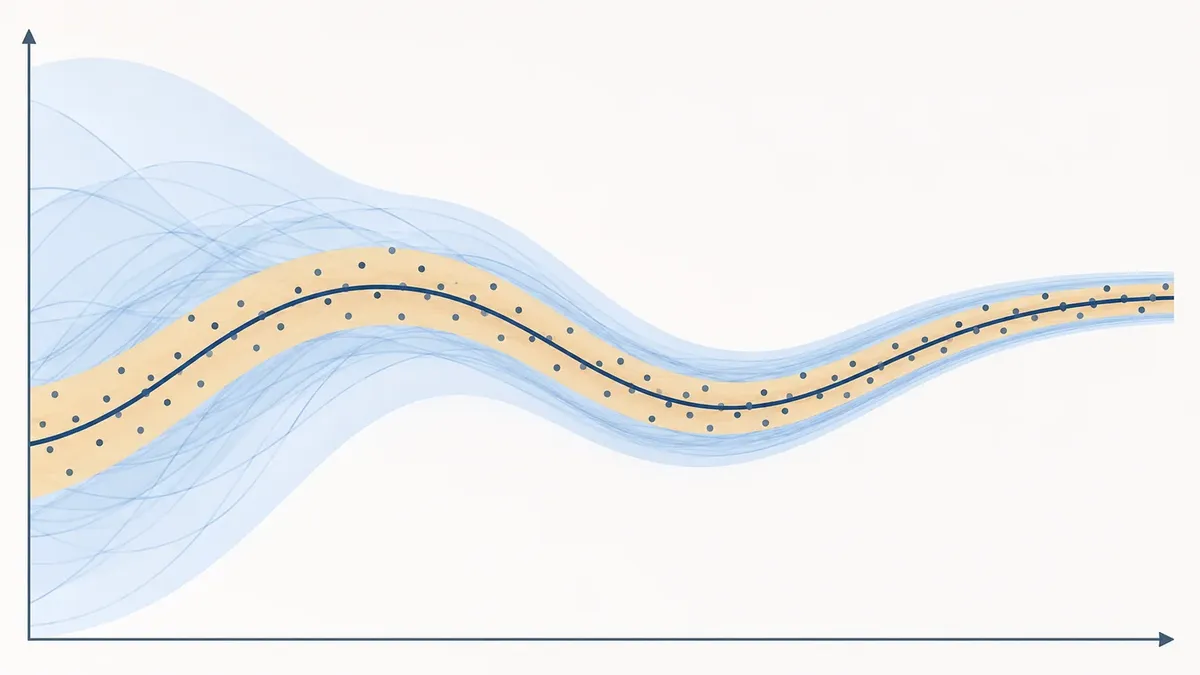
A model that gives a range of possible answers can look more informative than one that gives a single prediction. But that range may not reflect real-world randomness: it can also arise because the model has not learned how the answer depends on its inputs.
When a prediction model gives several possible answers, the spread between them is often treated as a measure of uncertainty. But where does that spread come from? It might reflect genuine randomness in the outcome, or a model’s incomplete grasp of the relationship between inputs and answers. A new preprint argues that conditional flow models can blur those two sources of uncertainty.
The paper, “Conditional Flow Models Convert Epistemic Uncertainty into Apparent Aleatoric Variance,” is by Navodita Sharma, Abhishek Shetty, Max Simchowitz and Pulkit Agrawal. It examines conditional flow models, or CFMs: machine-learning models that produce a distribution of possible outputs for a given input, rather than just one prediction. The authors ask what these distributions tell us beyond a point prediction—and whether their variability faithfully represents the underlying data.
Two kinds of uncertainty help explain the question. Aleatoric uncertainty is variability that belongs to the data-generating process: even with a perfect model, outcomes may differ under the same conditions. Epistemic uncertainty comes from what the model has not learned, such as an inadequately fitted relationship between inputs and outputs. In practice, the distinction matters: a noisy world calls for a different interpretation from a model that needs more training or data.
What the authors report
According to the abstract, the researchers find that CFM-generated samples often have greater variance than the true conditional distribution—even in regression problems that are nearly deterministic. The effect is most pronounced where the model has not learned the dependence of the output on the conditioning input well. In that situation, the model’s lack of knowledge can appear in its samples as extra, aleatoric-looking variation.
The researchers say they studied this pattern using controlled synthetic experiments and real-data experiments, and compared it with explicit smoothing estimators. Their abstract reports that the extra variance tracks underfitting on complex or difficult-to-fit targets, and decreases with more training or more data. It also describes a theoretical account in a simplified setting. These are reported conclusions; the abstract does not give experiment sizes, datasets, detailed results, or the assumptions behind the theoretical analysis, so those details cannot be assessed here.
The authors further report that the excess variance has a structure they describe as surprising and seemingly absent from the other standard probabilistic models they tested. The abstract does not identify those models or explain the comparison, so the scope of this contrast remains unclear from the available source.
A possible use—and an important distinction
The authors suggest that CFM variability could still be useful, even if it should not automatically be read as intrinsic randomness. They report using conditional flow matching to design predictive sets with high coverage of the ground-truth regression target. A predictive set is a range or collection of values intended to include the correct answer at a specified rate. The abstract does not state the coverage rates or how the approach performs against alternatives, so it supports a proposed practical use, not a claim that the method is universally better.
The broader lesson is to be cautious when interpreting a model’s spread. A wide range of generated predictions may reflect ambiguity in the world, but it may also signal that the model has not yet captured the input-output relationship. Treating those explanations as interchangeable could lead users to mistake a model limitation for natural variation.
This account has important limits. The available evidence is the paper’s abstract, not its full text; experimental setups, quantitative findings, and qualifications are therefore unavailable. The work is an arXiv preprint, which may not have undergone peer review. The authors’ claims should be read as findings they report, not as settled conclusions. The abstract also does not establish how broadly the pattern applies beyond the studied settings. Further detail and independent evaluation would help determine when CFM-generated variance is a useful signal and when it risks being misleading.
- conditional flow models
- uncertainty quantification
- epistemic uncertainty
- aleatoric variance
- regression
- machine learning
Reviewed cross-references
These connections were reviewed by a model, not independently fact-checked by a human. Similarity does not imply agreement; consult the original papers and the evidence below.
How robots can estimate when their actions are uncertain
Shared method: Both study flow-matching models: Sharma et al. examine how underfitting in conditional flow models can appear as excess conditional sample variance, while Saavedra-Ruiz et al. propagate weight uncertainty through flow-matching robot policies using CoMP. The shared modeling approach does not make their uncertainty measures or findings equivalent; the settings and methods differ.
Model review: · openai-codex/gpt-6-luna
Evidence and provenance
Selected excerpts, not complete papers. PDF extraction can omit figures or damage equations, tables and reading order; sources may be preprints.
2610.29172v2 — Original paper
Excerpt reference:
static/papers/2610.29172v2.md:13-76
Basis: Paper text
Source SHA-256:ca32f2808a197c605014e9849ac995b71d1ad7abb8cf4834e2e50a44d9731fbf2611.26855v1 — Original paper
Excerpt reference:
static/papers/2611.26855v1.md:142-200
Basis: Paper text
Source SHA-256:d754f54ea3baef661a6e4ae8c5e820b2e3b71061c238c8fdf3faf38ba69579d8
Related reading
Automatically matched by shared topic keywords. These links do not imply that the sources agree or establish a consensus.
Using AI Disagreement to Improve Microdroplet Design
Source published
Shared keywords: uncertainty quantification
Why Language-Model Ensembles May Become More Informative at Scale
Source published
Shared keywords: epistemic uncertainty
How Forecasting Methods Handle Uncertainty
Source published
Shared keywords: uncertainty quantification
Putting measurable uncertainty around distribution predictions
Source published
Shared keywords: uncertainty quantification
A New Way to Calibrate AI Prediction Sets
Source published
Shared keywords: machine learning, uncertainty quantification