TRANSMISSION // 2610.28709v2
A set-aware AI model estimates X-ray shielding in milliseconds
Source published
STAR-XPC predicts simulated X-ray transmission through polyethylene-based composites far faster than the Monte Carlo runs used to generate its training data. Its results are promising within a limited test domain, but do not yet establish performance on real materials or broader designs.
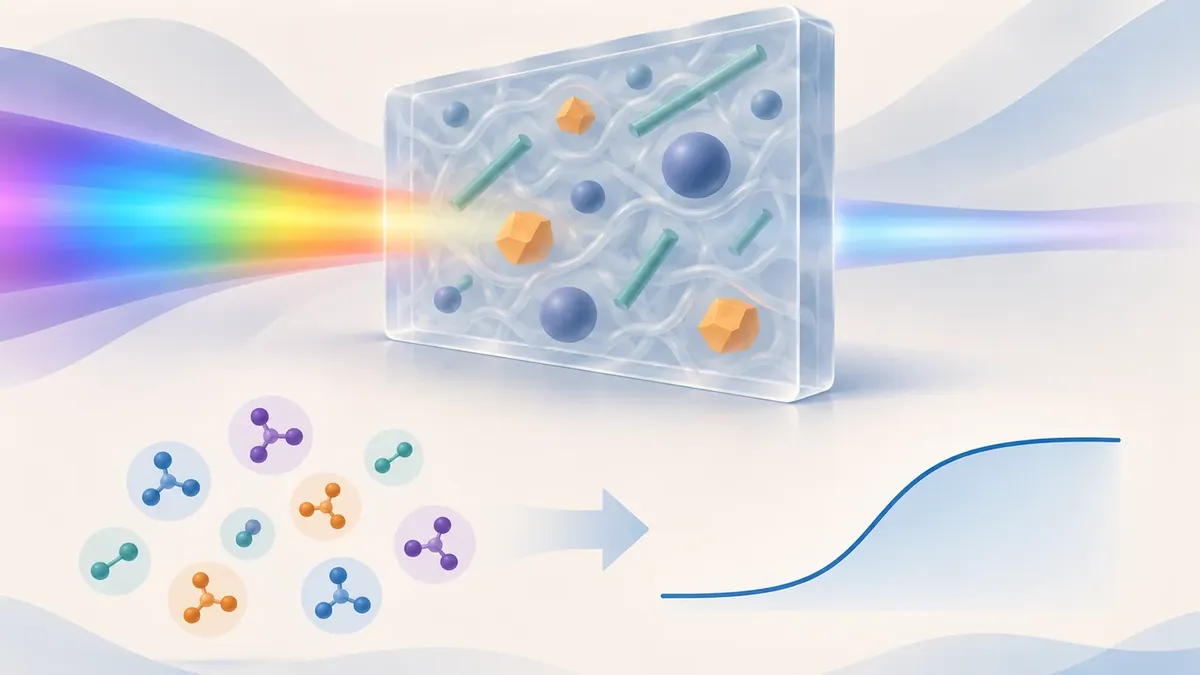
How much of an X-ray beam passes through a composite depends on its ingredients, proportions, thickness and beam spectrum. A new machine-learning model aims to estimate that transmission quickly enough to help screen designs—while its evidence so far comes from computer simulations, not measurements of physical samples.
Why estimate transmission?
Radiation-shielding designers often consider composites: a polymer matrix mixed with materials such as bismuth oxide or tungsten. Predicting how much X-ray energy passes through such a material is difficult because the beam contains a range of photon energies, and photons may scatter or produce fluorescence inside the material. Detailed Monte Carlo transport simulations can represent these processes, but the authors say their reference runs can take several hours. Simple analytical calculations, meanwhile, do not capture all the effects they target.
Can a machine-learning model approximate those simulations quickly, while handling mixtures whose ingredients can be listed in any order? Can Erer, H. Birkan Yilmaz and Nebahat Aral introduce STAR-XPC, a Set Transformer designed for that task.
How the model was tested
The researchers generated training examples using an automated PENELOPE/penEasy simulation pipeline. The simulated materials used polyethylene and up to three shielding materials drawn from a set of 12 elements and compounds. The simulations covered four tube voltages—30, 80, 100 and 120 kV—and slab thicknesses from 0.15 to 2.5 millimetres. After filtering, the dataset contained 4,697 configurations.
For each configuration, the target was the energy transmission ratio: transmitted intensity divided by incident intensity. STAR-XPC represents each ingredient as a token, combining a chemistry-language-model embedding with its mass fraction. It also includes four bulk descriptors: tube voltage, density, thickness and a mean excitation energy. Its set-based architecture is designed to give the same result if the ingredients are listed in a different order, because that order has no physical meaning.
The authors evaluated the model with jointly stratified 10-fold cross-validation, keeping normalization statistics within each training fold. They also tested six new combinations of familiar ingredients and, separately, two previously unseen elements, lead and gadolinium. These additional tests still relied on simulation-generated targets.
What the authors report
Across the cross-validation folds, STAR-XPC achieved a mean squared error of (1.12 ± 0.56) × 10⁻⁴ and an R² of 0.9988. That R² indicates a close overall fit to the simulated values in this evaluation; it is not, by itself, a guarantee of small errors for every material. Relative-error summaries give useful context: the median absolute percentage error was 1.15%, and the mean after trimming the highest and lowest 10% of percentage errors was 1.66% across all four voltages.
The untrimmed mean percentage error was much larger, at 203%. The paper attributes this to 129 near-opaque samples, where transmission was below 0.01: when the true value is close to zero, even a small absolute error can become a very large percentage. This is why the trimmed measure and median tell a different story from the untrimmed average.
On the six held-out combinations of familiar materials, the authors report normalized mean squared error percentages no higher than 0.129%. For lead and gadolinium, neither seen in training, reported values were 0.192% and 0.198%, respectively. These are encouraging tests of generalization, but they cover only two unseen elements under a specific set of conditions—not every unfamiliar material or composite.
The model also has a clear structural advantage over the flattened-input baselines tested: its predictions are invariant to ingredient order by design. In a separate test, the researchers randomly reordered the inputs for the same sample 40 times. STAR-XPC’s predictions remained effectively unchanged, while the baseline models varied. The authors report inference times in the millisecond range, compared with hours for reference simulations; exact timing depends on hardware and batching.
What remains uncertain
The central limitation is that STAR-XPC was trained and assessed against simulations, not laboratory measurements. Its accuracy therefore describes how well it reproduces the chosen simulation pipeline within the tested domain; it does not establish agreement with real-world shielding performance. The study also fixes polyethylene as the polymer, and its training examples contain no more than three shielding ingredients. Although the input can accept more, accuracy for mixtures with more ingredients has not been established. The authors further caution that ChemBERTa’s pretraining data may not represent inorganic shielding materials well.
The paper describes itself as a preprint submitted to Elsevier. A preprint is a public research manuscript, but its posting or submission does not establish that it has passed peer review. Results should be read as promising evidence for a fast simulation surrogate, not as a validated design tool for clinical or industrial use. Independent replication and comparisons with physical measurements would help clarify how well the approach transfers beyond the simulations reported here.
- X-ray transmission
- radiation shielding
- polymer composites
- Set Transformer
- Monte Carlo simulation
- machine learning
Reviewed cross-references
These connections were reviewed by a model, not independently fact-checked by a human. Similarity does not imply agreement; consult the original papers and the evidence below.
DosePET opens a library of PET/CT radiation maps
Shared method: Both studies use Monte Carlo radiation-transport simulations to generate reference data: STAR-XPC uses PENELOPE/penEasy for X-ray transmission through composite slabs, while DosePET uses GATE for patient-specific PET dose maps. The shared method is simulation-based reference generation; the different radiation sources, targets and codes mean their results are not directly comparable.
Model review: · openai-codex/gpt-6-luna
Evidence and provenance
Selected excerpts, not complete papers. PDF extraction can omit figures or damage equations, tables and reading order; sources may be preprints.
2610.28709v2 — Original paper
Excerpt reference:
static/papers/2610.28709v2.md:85-162
Basis: Paper text
Source SHA-256:3464f7e231dba088915a0a988da156c6ab8b5b5cd0d166f1c8b238a2e0d1c8702610.28709v2 — Original paper
Excerpt reference:
static/papers/2610.28709v2.md:238-367
Basis: Paper text
Source SHA-256:3464f7e231dba088915a0a988da156c6ab8b5b5cd0d166f1c8b238a2e0d1c8702611.34008v1 — Original paper
Excerpt reference:
static/papers/2611.34008v1.md:137-197
Basis: Paper text
Source SHA-256:48c5aacdaa9583dd751121060f615c2b8970af30c011147000c8c0a0bdb100c6
Related reading
Automatically matched by shared topic keywords. These links do not imply that the sources agree or establish a consensus.
When Repeat Healthcare Calls Become a Costly Loop
Source published
Shared keywords: monte carlo simulation
DosePET opens a library of PET/CT radiation maps
Source published
Shared keywords: monte carlo simulation
Disaster-preparedness model shows why investment timing and extreme losses matter
Source published
Shared keywords: monte carlo simulation
Estimating rare failures in simulated quantum error correction
Source published
Shared keywords: monte carlo simulation
Calibrating uncertainty when a full statistical likelihood is out of reach
Source published
Shared keywords: monte carlo simulation