TRANSMISSION // 2610.28596v2
How Much Memory Does a Quantum Switch Really Need?
Source published
A theoretical study derives the minimum persistent memory for distributing graph states through a quantum switch and proposes an online protocol that reaches that limit.
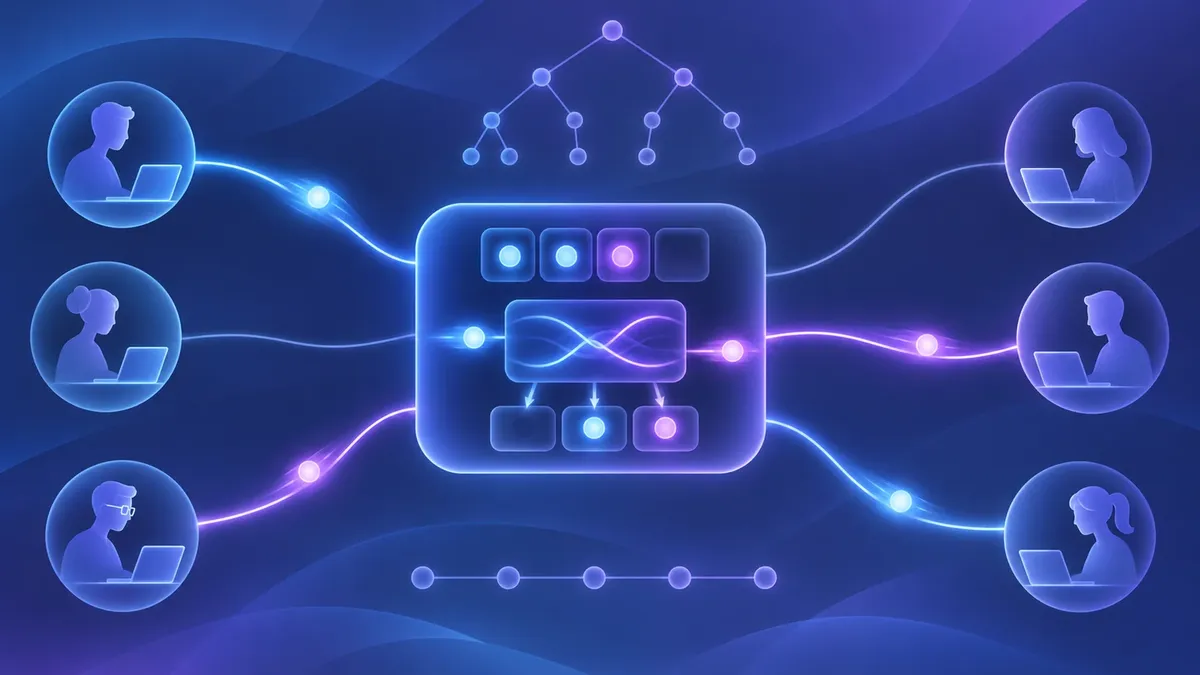
When quantum links succeed at different times, a network switch may have to hold some qubits while it waits. A new theoretical study asks how much memory is truly necessary—and describes a protocol that meets the derived limit without knowing which link will succeed next.
The waiting problem in a quantum network
Quantum networks can connect remote users by distributing entanglement, a resource that links quantum systems even when they are far apart. In the setup studied here, a central quantum switch helps multiple users share a graph state—a multipartite state whose pattern of connections is described by a graph.
The switch relies on Bell pairs generated separately between itself and each user. Those attempts are probabilistic, so links may become ready at different times. If one link succeeds early, the switch may need to keep its qubit in quantum memory while waiting for other links. That storage uses a limited resource, and reducing it could make network protocols more practical.
Earlier approaches had left two questions open, according to the authors: what is the least persistent switch memory needed at each stage of the process, and can a protocol reach that minimum without knowing future link successes? The authors also identify a computational drawback in the state-of-the-art Piecemaker protocol: its local-cover method can be expensive for general target graphs.
A bound and an online protocol
The researchers mathematically characterize the minimum persistent switch memory required after any subset of users’ Bell links has been generated and processed. They then introduce an online protocol based on transitions between stabilizer states. “Online” means it makes decisions using the links available so far, without needing advance knowledge of which links will succeed later.
The abstract reports that the protocol attains the derived memory limit and can be implemented in polynomial time in the number of qubits, n. Polynomial time means the computational work grows according to a polynomial function of n, rather than requiring an unrestricted search through possibilities. The source summary does not give enough detail to explain the protocol’s individual operations or the proof, so those cannot be assessed here.
What the examples show
The authors give specific results for path graphs, in which users form a line, and tree graphs, which branch without forming loops. They consider a simplified timing model: one Bell link succeeds per round, with each round lasting Δt.
For a path graph, the abstract says Piecemaker requires cumulative switch-qubit storage time of Θ(n²Δt) and peak memory of at least ⌊n/2⌋, regardless of link-arrival order. Cumulative storage time counts qubits held over time; peak memory is the largest number held at once. Under some arrival orders, the new protocol instead uses a cumulative storage time of (n−1)Δt and retains only one persistent switch qubit.
For tree graphs, the authors report that, under some arrival orders, their protocol reduces Piecemaker’s Θ(n²Δt) cumulative storage time to O(n log nΔt). These are theoretical results under the stated model, not measurements from a working quantum network. The improvements are also conditional: the especially low storage figures for paths and trees apply to some arrival orders, not necessarily every possible sequence.
What remains uncertain
The abstract establishes a mathematical memory limit and describes a protocol that achieves it, but it does not provide the paper’s full assumptions, derivations, or evidence. In particular, it does not tell us how the results change with realistic hardware imperfections, such as memory errors, imperfect operations, or constraints on communication. Nor does it establish that the theoretical storage reductions translate directly into better performance in an experimental network.
This account is based on the arXiv abstract for version 2 of the paper, not a full-text review. The work is a preprint; the available source information does not establish whether it has been peer reviewed. The results should therefore be read as a theoretical contribution whose methods and assumptions need checking against the full paper, rather than as an experimentally demonstrated network capability.
The central contribution is a sharper answer to a resource question: at each stage of graph-state distribution, how much switch memory must persist? The proposed online method is reported to meet that minimum, while selected path and tree scenarios illustrate how arrival order can matter for storage demands.
- quantum networks
- quantum switch
- quantum memory
- entanglement distribution
- graph states
- quantum information
Related reading
Automatically matched by shared topic keywords. These links do not imply that the sources agree or establish a consensus.
A faster, steadier route to entanglement across fiber
Source published
Shared keywords: quantum memory
Mapping the Limits of a Quantum Internet
Source published
Shared keywords: quantum networks
Why finite quantum circuits cannot reproduce the quantum switch
Source published
Shared keywords: quantum information, quantum switch
How usable is a quantum network?
Source published
Shared keywords: quantum networks
Measuring First Is Enough for Keys Across GHZ Networks
Source published
Shared keywords: quantum information, quantum networks