TRANSMISSION // 2610.28443v2
Listening to stellar pulses puts new limits on hidden magnetism
Source published
Gravity-mode pulsations in 30 hot subdwarfs let researchers estimate how strong their near-surface magnetic fields could be without quenching the observed waves. The model-based limits reach below a kilogauss for roughly half the sample, but constrain the field’s radial component—not every possible magnetic geometry.
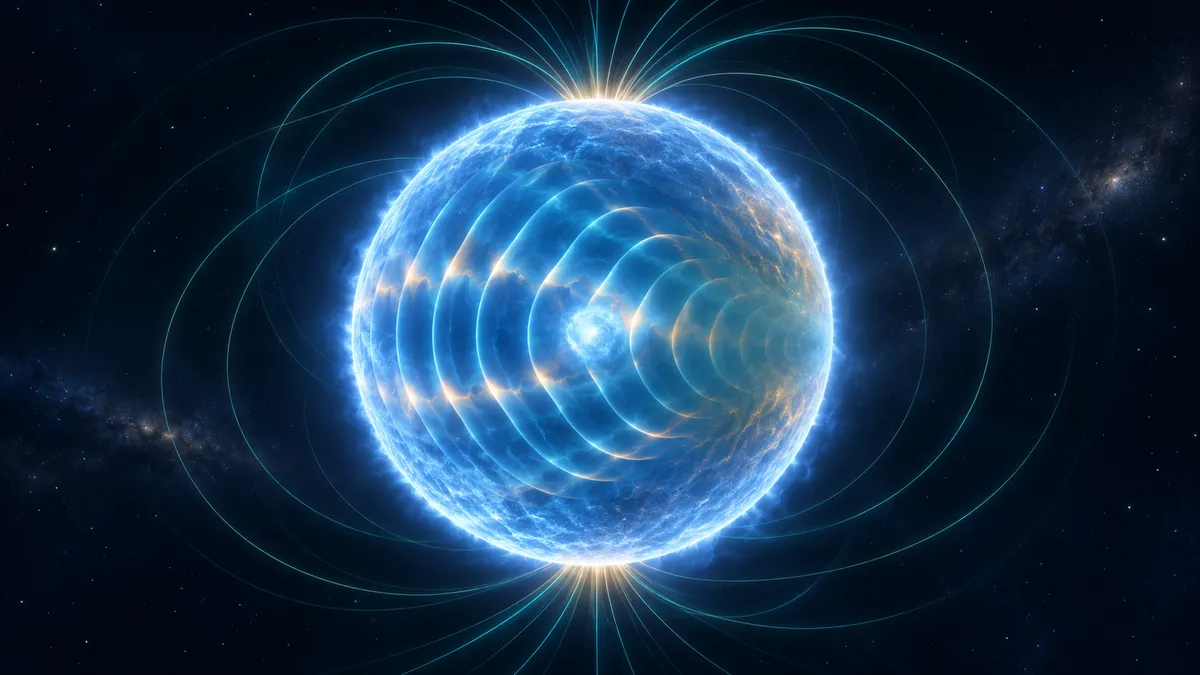
Hot subdwarf stars are expected to form through dramatic binary interactions, where magnetic fields might be generated. Yet strong fields have been detected in only a small, unusual subset. In a new preprint, Nicholas Z. Rui and Linhao Ma use the stars’ vibrations to test how much magnetism could be present but still go unnoticed.
Hot subdwarf B stars are compact, helium-burning stars that often emerge after a companion strips away much of a star’s outer envelope. Some form through mergers. These events involve complex flows that, in theory, could generate magnetic fields. But strong fields have rarely been found in ordinary hot subdwarfs, leaving astronomers with a puzzle: are the fields genuinely weak, or have observations missed them?
Nicholas Z. Rui and Linhao Ma explore a different way to look for magnetism: by studying stellar vibrations. Their study, Tight asteroseismic upper limits on hot subdwarf magnetism, examines 30 hot subdwarfs that pulsate in gravity modes, or g modes. These waves travel through a star’s stable interior, and their observed properties can reveal information about the conditions inside it.
Reading the waves
A sufficiently strong magnetic field can interfere with a g mode’s motion and damp the wave, reducing its amplitude. The researchers reasoned that if a star displays a g mode, the magnetic field cannot be so strong that it would have suppressed that mode—at least under the physical assumptions used in their calculations. The surviving pulsations therefore provide an upper limit: a ceiling on the field strength consistent with what is observed, rather than a direct measurement of the field.
To estimate those limits, the team built a grid of stellar-evolution models using the MESA code. The models vary in properties including mass, remaining hydrogen in the envelope and evolutionary stage. They compared model temperatures and surface gravities with observations, retaining models that were plausible matches. For each star, they used its lowest-frequency identified dipole or quadrupole g mode when available. Lower-frequency modes provide stronger constraints in this framework. The team also made conservative choices about uncertain mode identifications and selected the least restrictive limit among plausible stellar models.
The calculation estimates the field strength at which magnetic effects should suppress a mode, given the model’s internal structure. That structure matters: different stellar sizes and outer-layer conditions lead to different limits. The analysis focuses on the radial component of the magnetic field, which is the component the waves are most sensitive to under the study’s assumptions.
What the limits say
Across the 30 stars, the inferred upper limits span roughly 20 gauss to 30 kilogauss. The abstract reports limits below one kilogauss for roughly half the sample, even with conservative assumptions. The strongest individual constraint is about 20 gauss. These results support the picture that ordinary hot subdwarfs lack strong, detectable magnetism, while showing how pulsations can probe fields that other methods may not constrain as tightly in particular stars.
The result does not mean every star’s field was measured, or that every possible field is weaker than the stated limit. It means that, within the models and wave-suppression theory used, a stronger radial field would be expected to damp an observed mode. A field dominated by a horizontal, or toroidal, component could evade this particular constraint. The authors also note that magnetic damping is not fully settled: some studies suggest that g-mode energy can survive even when magnetic effects are important.
A promising test, with caveats
The limits depend on stellar models of the outer layers, where the analysis is especially sensitive. The researchers flag uncertainties in how those layers are represented, including the treatment of sharp composition changes and mixing. Their calculation uses an approximation that may break down when wave properties change over short distances. The team also identifies uncertainties in mode assignments and unusual formation histories, particularly for some helium-rich stars whose internal structures may not resemble the model grid.
The findings therefore sharpen the puzzle rather than solve it. Binary interactions may generate magnetic fields, but the study cannot establish how fields form, evolve or disappear. Nor does it rule out strong fields with a geometry that g modes do not effectively probe. Combining pulsation-based limits with spectroscopic and spectropolarimetric observations could help map different aspects of the fields.
This work is available as an arXiv preprint, a research manuscript that can be read before the publication process is complete. The supplied manuscript includes a placeholder for its acceptance date, so its final journal publication status cannot be established from the available source. Its conclusions should be treated as a model-dependent research result, not a settled measurement of all hot subdwarf magnetism.
- hot subdwarf stars
- stellar magnetism
- asteroseismology
- gravity modes
- magnetic fields
Related reading
Automatically matched by shared topic keywords. These links do not imply that the sources agree or establish a consensus.
Magnetic fields can weaken stellar waves—and help generate them
Source published
Shared keywords: gravity modes
Did two stars become one? Clues from the heaviest white dwarfs
Source published
Shared keywords: stellar magnetism
ALMA probes magnetic forces in a massive stellar nursery
Source published
Shared keywords: magnetic fields
Blazar polarization hints at magnetic changes that build on one another
Source published
Shared keywords: magnetic fields
Simple patterns emerge in models of magnetic neutron stars
Source published
Shared keywords: magnetic fields