TRANSMISSION // 2610.27415v2
A Pacific Neutrino Detector Takes Shape—Before It Reaches the Seafloor
Source published
P-ONE-1, the first line of a planned deep-sea neutrino telescope, passed integration and system tests in preparation for deployment. It has not yet been commissioned in the deep ocean or reported neutrino detections.
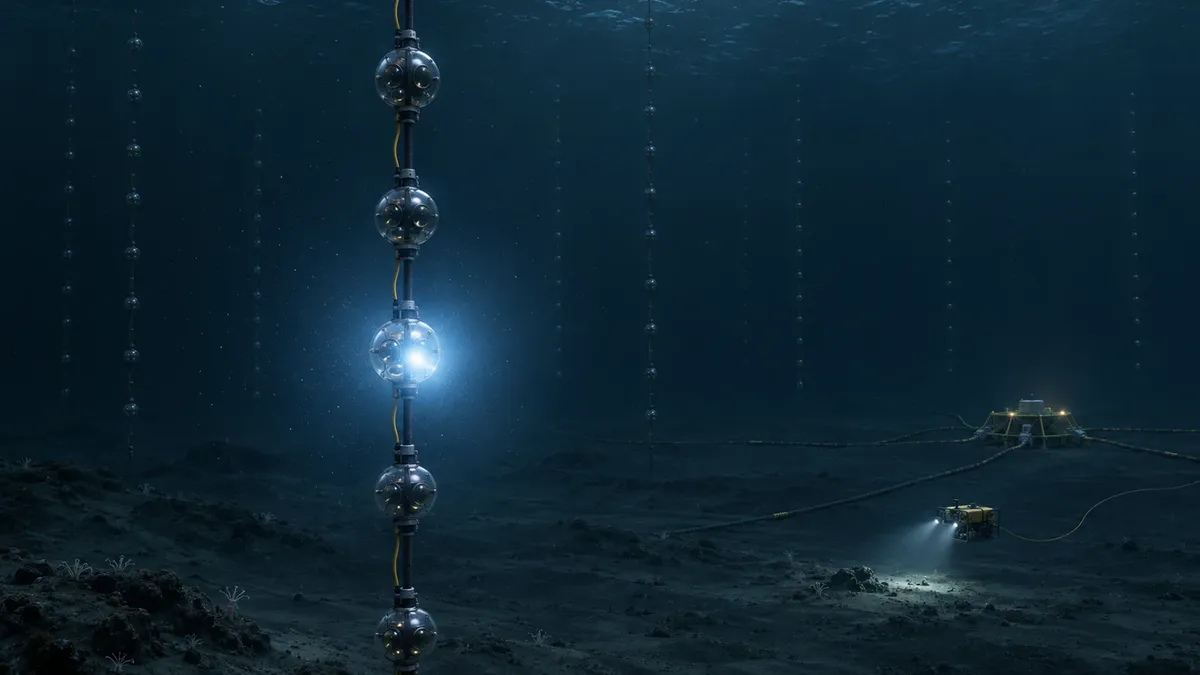
Neutrinos are elusive cosmic messengers, so detecting them takes enormous instruments. A new project plans to place one in the Pacific Ocean. Researchers report that its first detector line has been assembled and tested—but it is not yet a working deep-sea observatory.
Neutrinos can cross vast distances with little chance of being absorbed, carrying information from energetic places in the universe. But that same reluctance to interact makes them difficult to detect. A neutrino telescope looks for Cherenkov light: a faint glow produced when charged particles from a neutrino interaction move through water faster than light travels through that water. To catch enough of these rare events, scientists need sensors spread across a very large volume.
The Pacific Ocean Neutrino Experiment, or P-ONE, is being developed for the Northeast Pacific in collaboration with Ocean Networks Canada (ONC). Its eventual design calls for as many as 100 detector lines, each about a kilometre tall, connected to ONC’s NEPTUNE undersea observatory. The paper reports on P-ONE-1, the first line: its design, assembly and testing ahead of planned deployment. It does not report a neutrino observation.
A kilometre-long line, built in modules
P-ONE-1 has 20 modules distributed along a one-kilometre cable. Eighteen are optical modules, each containing 16 photomultiplier tubes (PMTs), which detect light. The line also includes a calibration module and a hybrid module with calibration equipment. Flashers send known light signals to help check timing and detector response; acoustic receivers help establish where modules sit in the water.
The line is designed to connect through a junction box to NEPTUNE, which can provide power and network communications. Data and timing must be coordinated across the modules, while measurements must be transmitted without exceeding the available connection capacity. In this first configuration, the available bandwidth is 1 gigabit per second.
Finding and fixing problems on land
The collaboration assembled the line at TRIUMF in Vancouver, using dedicated equipment to test modules and the completed system. Early tests revealed electrical noise in PMT signal cables—an important issue because extra noise can make faint light signals harder to distinguish. The team traced the main problem to a ground loop involving the PMT high-voltage base and mainboard. Changes to a resistor, added electrical filters and more controlled cable routing reduced the noise. The final measurements met the paper’s stated requirements.
Mechanical testing also identified a weakness: vibration tests damaged parts of an early optical-module prototype. The researchers reinforced its mounting and added a brace for capacitors. A reworked prototype then passed the required transport-related tests described in the paper. Such results show why building a detector involves more than making sensors work in a laboratory: it must also survive handling, transport and installation.
The team tested the assembled line’s data systems, including with artificial triggers that allowed it to stress-test readout without operating the light-sensitive PMTs. In a representative two-hour test, the line handled a high rate of forced triggers; the authors report that lost packets were below 0.3% and could be retransmitted. They also report that all 20 modules passed line-level checks for functionality, noise and timing.
What the water test did—and did not—show
At a Vancouver harbour site, the line was submerged in stages. It was fully submerged after about an hour, with no observed electrical faults or water ingress. The overall test lasted 14 hours and included additional monitoring, software tests and data-taking tasks. Researchers also checked telemetry and electrical grounding.
The line was later operated for about four weeks at ONC’s Marine Technology Centre, with a cooling system for the junction box. The reported slow-data-system uptime was 88.6% when planned downtime was excluded.
These are meaningful steps toward deployment, but they are not equivalent to operating the detector at its intended site. The harbour submersion was a shallow-water test, not a demonstration at the planned 2.6-kilometre depth. Tests at the technology centre likewise cannot establish how the line will perform amid deep-ocean conditions, optical backgrounds and long-term subsea operation. The authors say commissioning after deployment will be needed to validate data-taking and measure water and detector properties.
The article’s main finding is therefore an engineering one: the collaboration reports that P-ONE-1 was built, integrated and prepared for deployment after addressing problems found during testing. Its planned location is about 35 kilometres from the NEPTUNE node, with a custom cable connection. The paper describes deployment preparations and says the line is ready, awaiting mobilization; it does not say that deployment or deep-sea commissioning has taken place.
This distinction matters for interpreting the work. A successful test programme supports the next stage, but cannot establish future neutrino-detection performance or confirm the project’s broader scientific goals. The source is an arXiv preprint, and the evidence summarized here is the paper’s own account of its design and tests; it should not be treated as independent confirmation. For now, P-ONE-1 is substantial detector infrastructure prepared for the ocean—not yet a telescope reporting observations from it.
- neutrinos
- P-ONE
- neutrino telescope
- deep-sea detector
- Cherenkov light
- Ocean Networks Canada
Reviewed cross-references
These connections were reviewed by a model, not independently fact-checked by a human. Similarity does not imply agreement; consult the original papers and the evidence below.
Galactic Center Gamma Rays Stay Extreme, but IceCube Finds No Neutrino Counterpart
Supporting evidence: Both papers describe a planned Northern Hemisphere role for P-ONE in observing Southern-sky neutrino targets: the P-ONE paper says the Galactic Center would be seen as up-going neutrinos with reduced atmospheric-muon background, while the HAWC–IceCube paper identifies P-ONE as a future Northern Hemisphere observatory that could provide an Earth-filtered Galactic Center view. These are design rationale and future prospects, not evidence that P-ONE has been deployed or demonstrated this sensitivity.
Model review: · openai-codex/gpt-6-luna
Evidence and provenance
Selected excerpts, not complete papers. PDF extraction can omit figures or damage equations, tables and reading order; sources may be preprints.
2610.27415v2 — Original paper
Excerpt reference:
static/papers/2610.27415v2.md:140-177
Basis: Paper text
Source SHA-256:c5bd2a4279eb44f498353346ba198d23c3114b64b177311343817d6891bf5f032609.22577v2 — Original paper
Excerpt reference:
static/papers/2609.22577v2.md:793-835
Basis: Paper text
Source SHA-256:0961ca46f8efb7923036fe5c9aaf0a2ff77293a224fba19da67b17018f0a9b25
Related reading
Automatically matched by shared topic keywords. These links do not imply that the sources agree or establish a consensus.