TRANSMISSION // 2610.24744v2
How ReTRACE uses AI to plan chemical synthesis routes
Source published
ReTRACE combines a language-model coordinator with specialist chemistry software to plan routes backward from target molecules. Strong audit results are promising, but expert revisions and broader validation remain important.
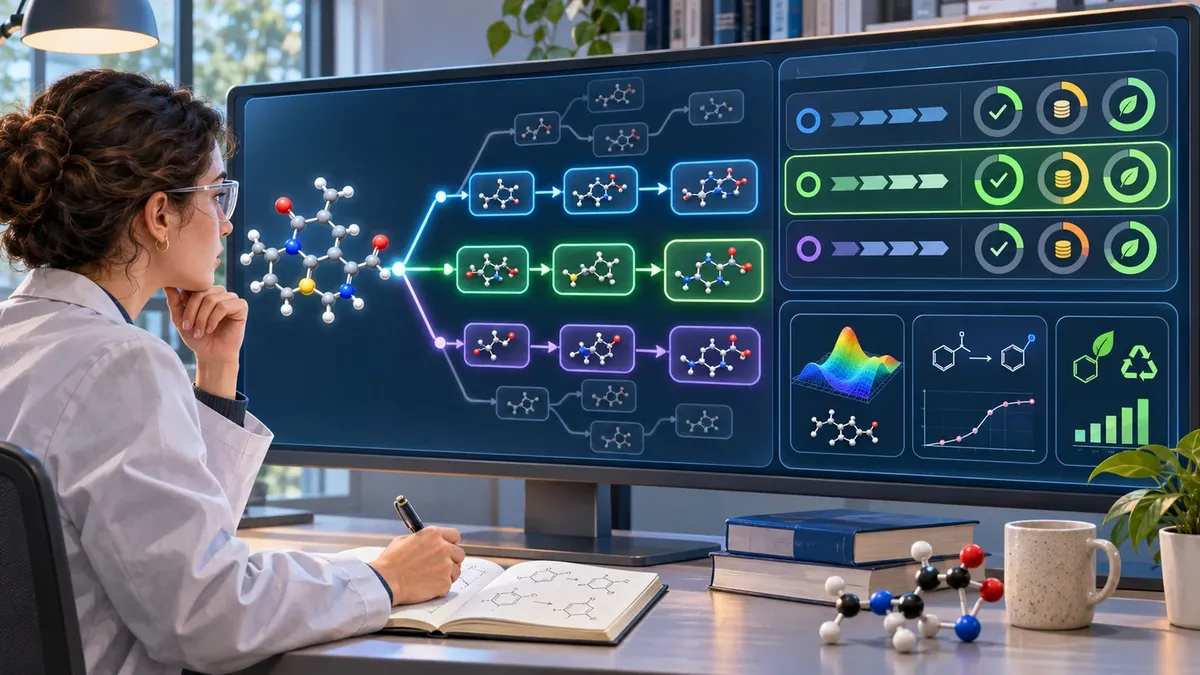
Planning how to make a complex molecule means more than finding reactions that lead to ingredients available for purchase. ReTRACE pairs a language-model coordinator with chemistry software and specialist prediction tools, then checks proposed routes with an automated audit. Its reported benchmark results are high, but they do not show that the system can work as an autonomous chemist.
Retrosynthesis is the process of working backward from a desired molecule to simpler ingredients and reaction steps. The challenge is not simply to find a sequence that ends with compounds available for purchase. A route also needs chemically credible steps and practical choices that may involve functional-group compatibility, cost and environmental impact.
The researchers built ReTRACE by placing a large language model (LLM) inside a chemistry “harness”: software that supplies tools, checks and structured feedback. Specialist reaction-prediction engines suggest ways to break down molecules. Other tools check molecular structures and whether proposed starting materials are purchasable. A route evaluator scores feasibility, cost and greenness. The LLM uses that information to compare options, revisit weak branches or try a different disconnection—the choice of which bond to break when reasoning backward. A route memory stores earlier attempts for use during a long search.
This division of work is important because a language model can discuss chemical strategy but may make mistakes with exact molecular structures. ReTRACE uses deterministic software for some structural checks and molecular operations, while the LLM coordinates tools and weighs route-level evidence. The system is designed to support planning, not to replace chemists.
Testing routes, not just endpoints
The researchers argue that a route should not count as successful merely because it ends in purchasable building blocks. They introduce Audit@k, which asks whether at least one of a target’s top k ranked routes passes a two-stage chemical audit. The first stage applies structural checks. A language-model judge then reviews reaction steps; routes judged to contain a fatal defect receive a second, adversarial review.
The team tested ReTRACE on Retro*-190, a set of 190 targets; JMC2025, with 141 targets from medicinal-chemistry literature; and FDA30, with 30 small-molecule drugs approved from 2020 to 2024. With the GPT-6.2 Astra coordinator and the standard search preset, Audit@1 was 97.9% on Retro*-190, 99.3% on JMC2025 and 96.7% on FDA30. At Audit@10, the reported rates were 99.5%, 100% and 100%. These figures describe performance under the study’s particular system, targets and audit. They are not guarantees that a proposed route will work in a laboratory.
In tests that removed individual tool groups, removing specialist single-step prediction engines caused the largest decline in audit performance. Removing route scoring reduced how often a passing route ranked first, though the difference was smaller when more candidate routes were considered. The results support the authors’ design: the LLM coordinates and compares evidence rather than replacing specialist reaction predictors.
What the checks can—and cannot—establish
The automatic audit agreed with one synthetic chemist’s pass-or-fail verdict on 57 of 59 reviewed routes. This comparison was limited: the routes came from the first six Retro*-190 targets, and the chemist could see the audit’s verdict and reasoning. The authors note that the audit relies on a single LLM judge and call for broader, blind assessments by multiple chemists. Agreement in this review does not establish that every route passing the audit is experimentally feasible.
The paper also reports two prospective laboratory syntheses. In both, chemists reviewed and revised ReTRACE’s proposal before carrying out the work. One route required changes to its protection strategy and reaction order. The other retained more of the proposed sequence but still involved changes to starting materials and experimental details. The authors say these demonstrations do not estimate autonomous synthesis success: they show that proposals can guide synthesis after expert review.
A separate open-weight coordinator, ReTRACE-27B, was evaluated on 40 targets. It completed routes to purchasable starting materials for all 40; 23 top-ranked routes passed the audit, compared with 11 for the base model. This result is encouraging, but comes from a small evaluation set and depends on the study’s training and audit setup.
ReTRACE is best understood as a route-planning assistant that can organize chemical evidence and revise plans in response to feedback. Its audit may still miss errors, results may not transfer to unfamiliar targets, and practical experimental decisions require human judgement. The paper is an arXiv preprint, so its claims should be treated as research findings awaiting independent scrutiny, not as established consensus. Wider chemical evaluation and replication will be needed to establish how reliably the approach works beyond these tests.
- retrosynthesis
- artificial intelligence
- chemistry
- large language models
- synthesis planning
- chemical auditing
Reviewed cross-references
These connections were reviewed by a model, not independently fact-checked by a human. Similarity does not imply agreement; consult the original papers and the evidence below.
An AI workflow checks quantum-chemistry calculations along reactions
Shared method: Both papers describe tool-integrated AI workflows that assess intermediate computational results and revise choices: ReTRACE uses harness sub-scores to backtrack on retrosynthetic routes, while CASPER iteratively assesses active spaces and modifies calculations along reaction pathways. This is a shared workflow pattern, not evidence of equivalent performance; the systems address different chemistry tasks and use different evaluation criteria.
Model review: · openai-codex/gpt-6-luna
Evidence and provenance
Selected excerpts, not complete papers. PDF extraction can omit figures or damage equations, tables and reading order; sources may be preprints.
2610.24744v2 — Original paper
Excerpt reference:
static/papers/2610.24744v2.md:106-155
Basis: Paper text
Source SHA-256:b6095bc2710913cf3150625a41c98a5acd8aab8dc6dfd226ce08431b31c442d62611.29902v1 — Original paper
Excerpt reference:
static/papers/2611.29902v1.md:90-202
Basis: Paper text
Source SHA-256:47cf971bad4b803a257fe1c9527f678bad7a9e1d218bc8fbcfbbe2492feab17d
Related reading
Automatically matched by shared topic keywords. These links do not imply that the sources agree or establish a consensus.
How AI Agents Schedule Useful Information
Source published
Shared keywords: artificial intelligence, large language models
AI radiology summaries can miss small words with important meanings
Source published
Shared keywords: artificial intelligence, large language models
AI debate partners can craft evidence that misleads automated fact-checkers
Source published
Shared keywords: artificial intelligence, large language models
Could AI Think by Watching Its Own Imagined Scenes?
Source published
Shared keywords: artificial intelligence, large language models
How Training Data Shapes AI’s Reusable Rules
Source published
Shared keywords: artificial intelligence, large language models