TRANSMISSION // 2610.23917v4
When an Announced Break Changes Forecast Reliability
Source published
A preprint distinguishes reliability of the next interval from the miss rate over a completed period, and gives each goal a separate restart strategy under stated conditions.
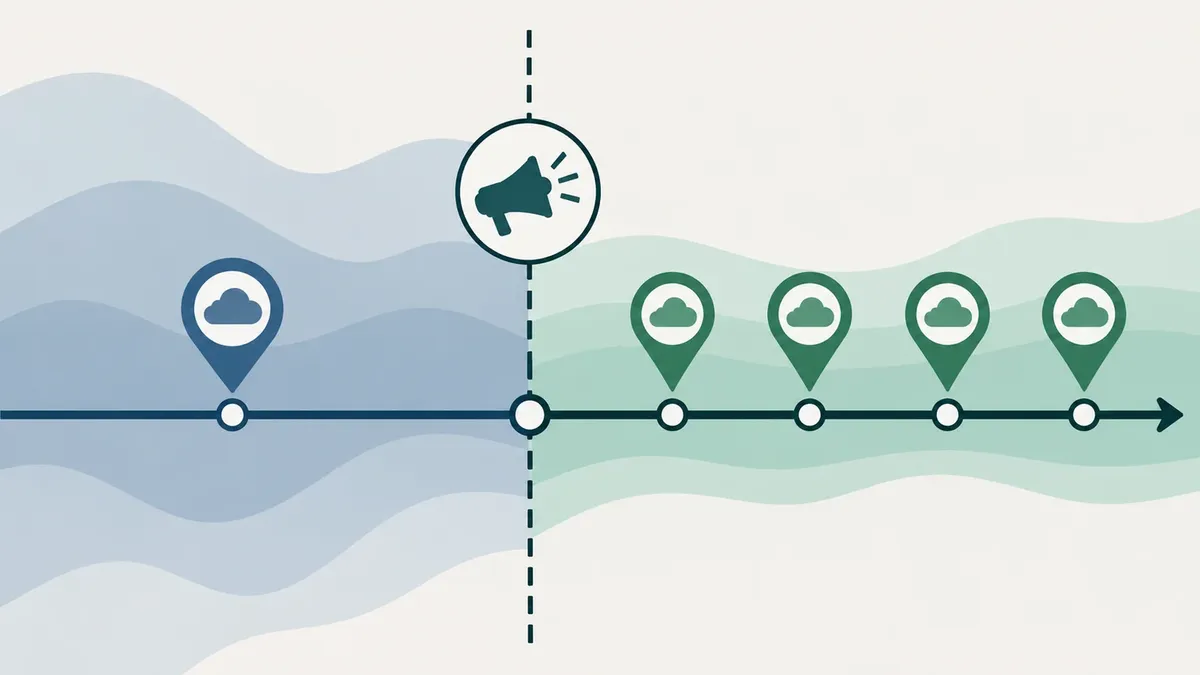
Prediction intervals can lose coverage when the process behind a time series changes. A preprint studies announced breaks and asks how to recalibrate for two different aims: covering the next outcome or keeping the miss rate near a target over a finished run of forecasts.
A prediction interval communicates uncertainty by giving a range intended to contain the outcome at a stated rate. For example, a 90% interval aims to cover outcomes about nine times in ten. Conformal prediction sets interval width using past forecast errors, without specifying a particular probability distribution for the data. But errors from before a change may no longer be useful afterward.
In Announced Breaks Separate Conformal Reliability from Frequency Calibration, Karl Li distinguishes two meanings of reliability. Next-forecast coverage asks whether the next interval will contain its outcome. Frequency calibration asks whether the share of misses over a completed period is close to a target, such as 10%. A method that brings the average miss share near its target does not necessarily make the next individual interval reliable.
The preprint’s proposed strategies depend on which goal matters. For next-forecast coverage, it recomputes the interval using the forecast errors accumulated since the announced break, rather than errors from before it. The abstract states a theoretical result under an independence condition: coverage approaches the target at order 1/√n, where n is the number of post-break errors. It describes this as the best attainable order. The result therefore concerns performance as post-break errors accumulate, not an immediate guarantee at the moment of the break.
For frequency calibration, the paper instead restarts adaptive conformal inference (ACI) at the break. Under the abstract’s stated conditions—bounded errors and a floor on interval width whose total contribution is bounded—the share of misses approaches its target at order 1/n. This claim concerns the miss rate over a period; it does not promise that the next interval will cover.
The abstract offers examples and tests of these ideas. After Australia moved to five-minute electricity settlement, a 90% interval fixed beforehand covered 51.5% of outcomes over the next 400 days. In a simulation following a mean shift of five noise standard deviations, recomputed intervals were, on average, within 3.5 percentage points of 90% coverage at the 50th forecast. The abstract reports 5.2 percentage points for the best of five baselines in that comparison.
The real-data findings are more limited. Across nine announced breaks in power markets and at a central bank, restarting ACI produced a detectable gain at only one break, which the abstract characterizes as large. That result does not support a claim that the strategy improved performance across all examined breaks. Nor does the simulation establish how it would perform beyond the particular setup described in the abstract.
The theoretical claims are conditional: independence is specified for the next-forecast result, while bounded errors and the interval-width condition are specified for the ACI result. These qualifications matter when interpreting the rates. The abstract available for this article does not provide the full methods, experimental design, baseline descriptions, or sensitivity analyses, so those details cannot be assessed here; this is a limit of the evidence available for review, not necessarily of the paper itself.
The central point is that “calibration” can mean different things. Under the stated assumptions, the paper matches a post-break recalculation to the goal of covering the next outcome, and a restart of ACI to the goal of controlling the miss share over time. The source is an arXiv preprint abstract, rather than the full paper, and may not have undergone peer review. Its claims should be read as reported theoretical and empirical results, not as an established operational rule. Read the preprint.
- conformal prediction
- prediction intervals
- forecast calibration
- announced breaks
- adaptive conformal inference
- time-series uncertainty
Reviewed cross-references
These connections were reviewed by a model, not independently fact-checked by a human. Similarity does not imply agreement; consult the original papers and the evidence below.
When satellite bandwidth forecasts miss their risk budget
Shared method: Both papers examine adaptive conformal inference: Li studies restarting ACI at announced breaks to calibrate a finished period’s miss rate, while Sharma et al. identify their online recalibration layer as ACI and test budget tracking for satellite throughput. The shared method connects the work, but their applications and evaluation outcomes differ.
Model review: · openai-codex/gpt-6-luna
Evidence and provenance
Selected excerpts, not complete papers. PDF extraction can omit figures or damage equations, tables and reading order; sources may be preprints.
2610.23917v4 — Original paper
Excerpt reference:
static/papers/2610.23917v4.md:13-69
Basis: Paper text
Source SHA-256:e88261cf3812d2ab045bb9704a13dd2ffbdd0c8f5dc8e1b4ffe00908f8def0c22611.06307v1 — Original paper
Excerpt reference:
static/papers/2611.06307v1.md:423-523
Basis: Paper text
Source SHA-256:2579cb3ab210705a68d29ad24a3a34bf1de3472219565e63d1c7468eaee74f76
Related reading
Automatically matched by shared topic keywords. These links do not imply that the sources agree or establish a consensus.
Better volatility forecasts still need honest uncertainty ranges
Source published
Shared keywords: conformal prediction, prediction intervals
Can better memory and feedback improve AI forecasting?
Source published
Shared keywords: forecast calibration
Modeling Hidden Factors in Complex Time Series
Source published
Shared keywords: prediction intervals
A New Way to Calibrate AI Prediction Sets
Source published
Shared keywords: conformal prediction
How AI uncertainty calibration can adapt to prompts
Source published
Shared keywords: conformal prediction