TRANSMISSION // 2610.23297v3
Refocusing a photo without rebuilding it for every edit
Source published
FlashReFocus separates image restoration from blur rendering, aiming to make refocusing faster and keep scene details consistent across edits.
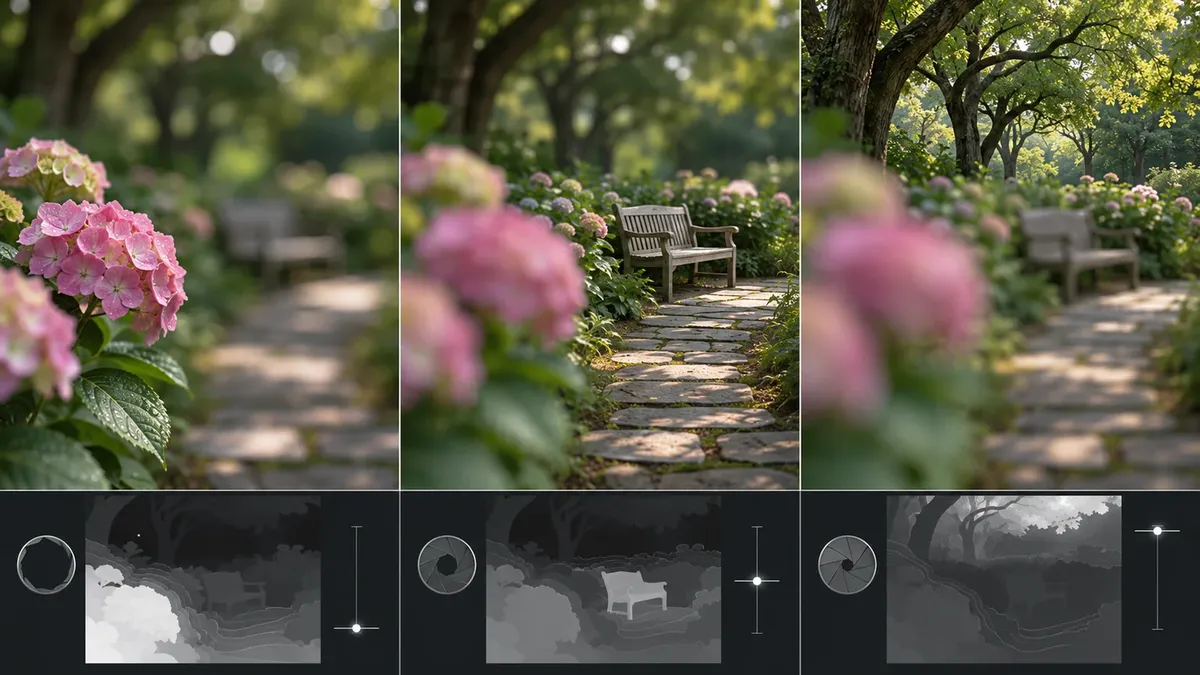
Changing focus after a photo is taken can mean more than choosing what looks sharp: repeated edits should not make the rest of the scene shift. FlashReFocus proposes a two-stage approach that reconstructs the image once, then renders different focus choices with a lightweight network.
A photo’s focus is usually fixed when it is taken. Software can simulate a different focal plane afterward, blurring some regions while keeping others sharp. But interactive refocusing brings a practical challenge: when someone compares several focus settings on the same image, the scene should stay stable. If each edit regenerates the image independently, details may change between versions.
FlashReFocus, a method described in an arXiv preprint, addresses this by separating reconstruction from blur rendering. Its authors argue that recovering detail from a blurred image is the difficult, ambiguous part of the task and can benefit from a generative model. Once the image has been reconstructed, applying a new blur pattern is more directly controlled by scene depth and the chosen focal plane. The method therefore runs diffusion once per photograph rather than for every edit.
One reconstruction, many focus choices
The system first uses a one-step diffusion deblurrer to produce an all-in-focus image, followed by a decoder refiner intended to recover fine detail. A separate, lightweight network then renders blur for each focus choice. It takes an explicit defocus map—a representation of where and how strongly the image should be blurred—so the user can control the effect.
The rendering network also uses what the authors call defocus-bias attention. In broad terms, this encourages information exchange between image tokens, or local representations, with similar blur magnitudes. Because subsequent edits reuse the same reconstructed image, the authors say in-focus content remains consistent across those edits. Editing the defocus map can also produce tilt-shift and two-plane effects, according to the abstract.
What the abstract reports
The authors introduce 3CReal, a benchmark containing 89 image pairs from three camera-lens systems, intended to test generalization to optics not seen during training. They also report zero-shot bokeh-rendering evaluations on EBB! Val176 and 3CReal. On those benchmarks, FlashReFocus leads the evaluated methods in both fidelity and perceptual quality, according to the abstract. The supplied evidence does not give scores, uncertainty estimates, or details about the comparison methods, so the size and robustness of that reported advantage cannot be assessed here.
The abstract reports a complete refocus time of 2.45 seconds for a 1536-by-1536 image on one RTX PRO 6000 GPU. Each later edit takes 0.46 seconds on that hardware. These are reported measurements for a specific image size and GPU, not a guarantee of the same speed on other systems or in other workflows.
What remains uncertain
The proposed design offers a clear rationale for consistency: keep the reconstructed image fixed and change only the blur rendering. But the available source is only the paper’s abstract. It does not provide the full experimental setup, dataset details, evaluation procedures, baselines, or limitations. Nor does it establish how well the method handles varied scenes, difficult depth estimates, or images outside the reported benchmarks. The claim that reconstruction is the especially ill-posed step is the authors’ motivation for their design, not a result independently established by the abstract.
The work is an arXiv preprint, and the supplied material does not establish that it has undergone peer review. Its findings should therefore be read as the authors’ reported results, not as a settled comparison across image-refocusing systems. The abstract suggests a promising engineering tradeoff—expensive reconstruction once, then quicker controlled edits—but fuller evaluation is needed to judge its practical reach.
- computational photography
- image refocusing
- diffusion models
- bokeh
- image editing
- computer vision
Related reading
Automatically matched by shared topic keywords. These links do not imply that the sources agree or establish a consensus.
An image-editing model explores gene and shape signals in kidney cells
Source published
Shared keywords: diffusion models
Teaching AI to Find the Traces of Image Editing
Source published
Shared keywords: computer vision
How separate image generators can make coordinated outputs
Source published
Shared keywords: diffusion models
A robot's-eye view, generated from outside video
Source published
Shared keywords: computer vision, diffusion models
IdealCache plans when image and video AI should reuse its calculations
Source published
Shared keywords: image editing