TRANSMISSION // 2610.21232v2
Can strong Lyα emitters stand in for the first galaxies?
Source published
A JWST study finds that strong Lyα emission alone does not reliably identify the most metal-poor galaxies. Stellar mass adds a potentially useful clue, but the evidence comes from a small, selected sample.
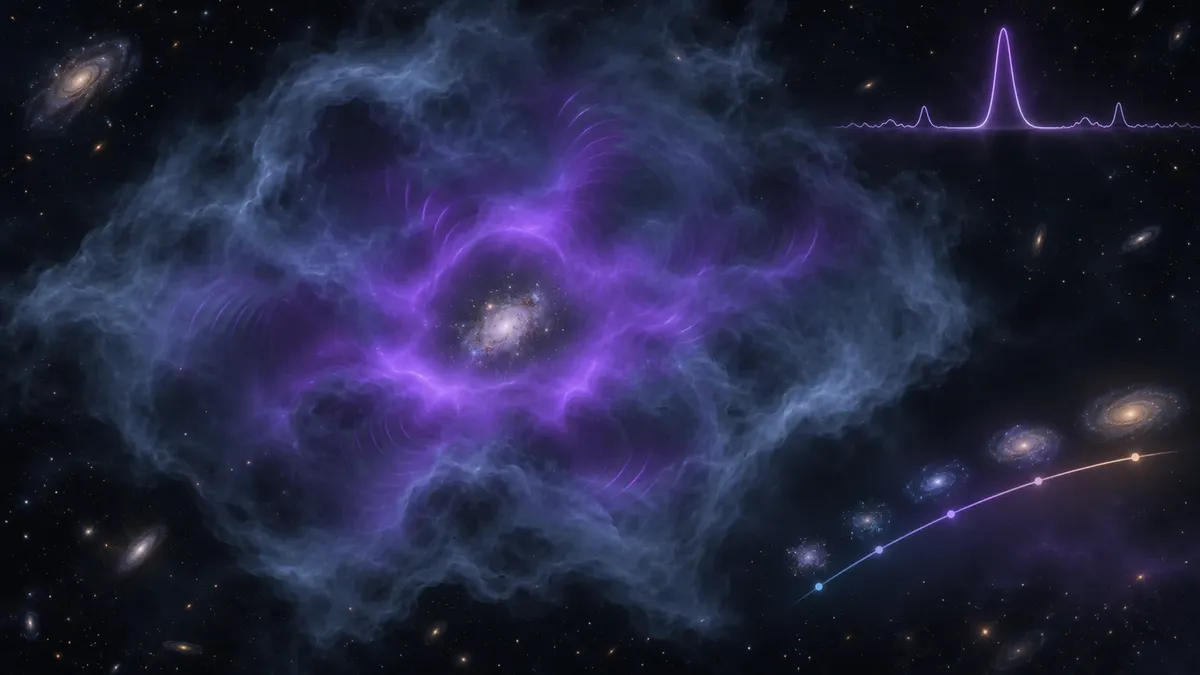
Galaxies with unusually strong Lyman-alpha emission are often studied as accessible clues to the faint, chemically primitive galaxies that may have helped reionize the Universe. A JWST study tests whether the strength of this emission tracks a galaxy’s metal content—and finds a more complicated picture: stellar mass may help reveal a pattern that Lyα strength alone does not.
The first galaxies are difficult to study directly. Many are expected to be faint and low in mass, and their light has travelled for billions of years. Astronomers therefore study galaxies at more accessible distances that share some traits expected in the early Universe. One candidate is the Lyman-alpha emitter, or LAE: a galaxy selected for strong emission in Lyα, a spectral line produced by hydrogen. Some theories predict that especially strong Lyα emission should be associated with little chemical enrichment.
A new study asks whether that expectation holds up. The researchers examined 88 LAEs at redshifts of roughly 2 to 7, identified in observations from the MUSE instrument and followed up with the James Webb Space Telescope’s NIRSpec spectrograph. Redshift measures how much the expansion of the Universe has stretched a galaxy’s light; larger values generally mean we see it farther back in time.
The team combined emission-line measurements with models of stars and ionized gas. They used BPASS stellar-population and Cloudy photoionization models to estimate gas-phase metallicity—the abundance of elements heavier than helium—and other gas properties. Stellar masses came from fitting models to NIRCam imaging. In brief, spectra helped estimate what the gas is made of, while imaging helped estimate how much stellar material the galaxies contain.
The path from the original sample to a usable comparison was narrow. Only 46 of the 88 LAEs had a secure counterpart in the available NIRCam images. The final group with reliable measurements of both stellar mass and metallicity contained 16 galaxies. Some targets were exceptionally faint; in other cases, the spectroscopic slit missed part of the host galaxy, or the observations did not provide enough well-measured emission lines.
The galaxies’ emission-line ratios were generally consistent with highly ionized, low-metallicity star-forming systems. But the study found no compelling evidence that Lyα equivalent width—the line’s strength compared with the underlying light—has a strong, simple relationship with gas metallicity. A commonly used line ratio, called R3, appeared to decline as Lyα equivalent width increased, but the pattern was not statistically convincing in the authors’ tests. When they estimated metallicity by fitting multiple emission lines together, rather than relying on that single ratio, they found no robust linear trend. Galaxies also showed considerable metallicity scatter at similar Lyα strengths.
A different pattern emerged when the researchers considered stellar mass. Galaxies with stronger Lyα emission tended to sit below the average mass–metallicity relation: at a given stellar mass, they appeared less enriched than typical galaxies. This suggests that strong Lyα emitters may be less chemically evolved than other galaxies of comparable mass. It does not mean Lyα strength alone reliably picks out the most chemically primitive systems. Rather, combining Lyα strength with stellar mass may be more informative.
That distinction matters because Lyα light is affected by more than chemical composition. Its photons scatter through neutral hydrogen, so the observed emission can depend on the gas’s distribution, motion and geometry. The researchers also note that gas metallicity is not identical to the metallicity of the stars producing ionizing radiation. These differences could help explain why the link between Lyα strength and gas enrichment is not straightforward.
There are substantial limits to the conclusions. The key mass-and-metallicity comparison rests on only 16 galaxies, and the sample is not a complete census of faint LAEs. The study’s model tests suggest metallicity is better constrained than gas density or ionization strength, which remain difficult to disentangle using optical lines alone. The models also rely on assumptions about the gas, stellar populations and chemical abundances. The authors call for additional ultraviolet emission-line measurements, deeper spectra aimed at galaxy hosts, and larger samples to test the results.
The work is presented as a 2026 preprint, and the supplied paper text contains an unfilled journal acceptance date. Its final publication and peer-review status therefore cannot be confirmed from that text. The findings should be read as evidence from one analysis, not a settled verdict. The measured conclusion is that high-equivalent-width LAEs may be useful but imperfect analogs of early galaxies, and stellar mass may help identify the less-enriched systems among them.
- Lyman-alpha emitters
- JWST
- galaxy metallicity
- cosmic reionization
- early galaxies
- mass–metallicity relation
Related reading
Automatically matched by shared topic keywords. These links do not imply that the sources agree or establish a consensus.
Webb imaging identifies 14 extremely metal-poor galaxy candidates
Source published
Shared keywords: galaxy metallicity
Can a different cosmic expansion ease the JWST–CMB reionization tension?
Source published
Shared keywords: cosmic reionization
JWST probes the chemistry of tiny early galaxies—and a nitrogen puzzle
Source published
Shared keywords: early galaxies
Small, bright galaxies offer a closer look at early star-forming systems
Source published
Shared keywords: cosmic reionization
Could ancient magnetic fields have brought forward cosmic reionization?
Source published
Shared keywords: cosmic reionization, early galaxies