TRANSMISSION // 2610.20772v2
A simpler strategy holds up in searches for gravitational-wave memory
Source published
Tests on simulated pulsar observations and NANOGrav’s 15-year dataset suggest that a simpler noise treatment can identify potential gravitational-wave memory signals. A more demanding approach may still help assess candidates, but neither method finds a detection in the real data.
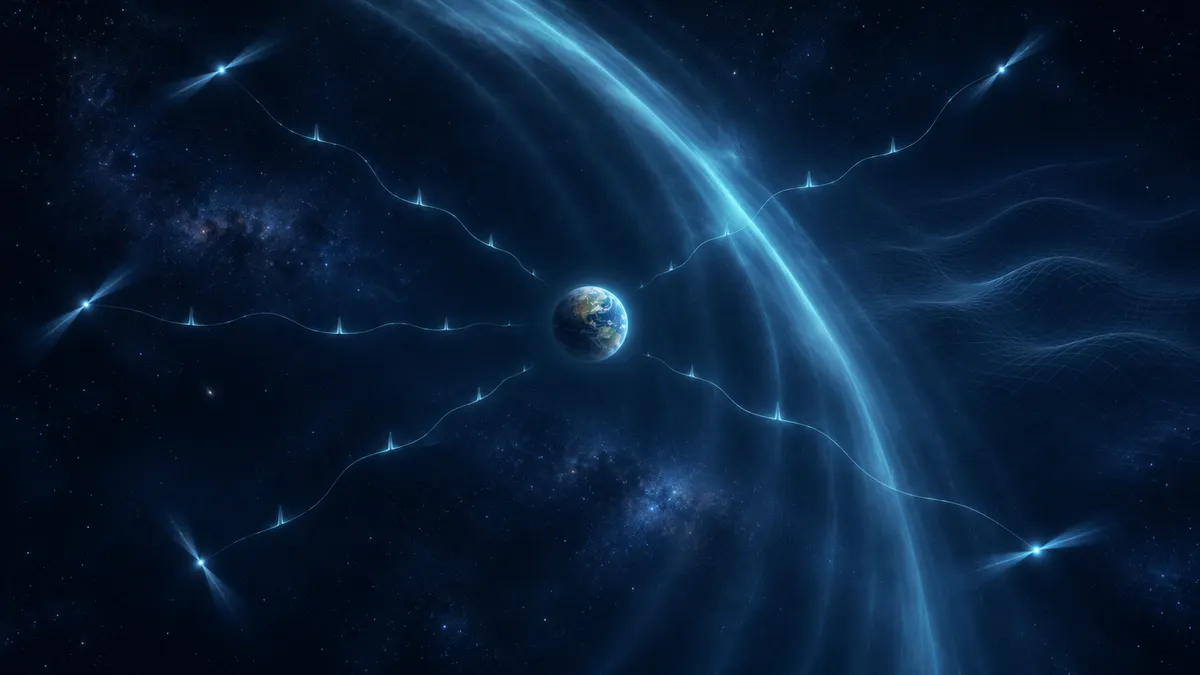
Gravitational waves can leave a lasting change in spacetime, rather than only a passing oscillation. A preprint by Rand Burnette and Xavier Siemens examines how best to search for this gravitational-wave memory using pulsar timing—and finds that a computationally simpler approach performs much like a more elaborate alternative in their tests.
Looking for a lasting change
Pulsar timing arrays search for gravitational waves by measuring the arrival times of radio pulses from rapidly rotating millisecond pulsars. Researchers compare those measurements with predictions from a timing model. The differences, called timing residuals, can contain gravitational-wave signals as well as noise.
Gravitational-wave memory is a lasting shift in spacetime associated with violent gravitational-wave-emitting events, such as mergers of supermassive black holes. When a memory wavefront passes Earth, it changes the observed pulse frequencies. In timing residuals, that produces a ramp: a drift that begins at the wavefront’s arrival.
Burnette and Siemens investigate how uncertainty about noise affects the search for this pattern. Their methods-development preprint was first submitted to arXiv on October 14, 2026, with the examined second version submitted on November 6. It reports a comparison of search techniques, not a discovery of gravitational-wave memory.
Two ways to handle uncertain noise
The researchers integrated an existing frequentist memory statistic into the enterprise pulsar-timing analysis software. Their chosen statistic, called Fi, combines contributions from individual pulsars without enforcing the full sky-dependent response of a coherent memory signal across the array.
Both approaches they compare begin with a Bayesian analysis of red noise: fluctuations with more power at low frequencies. That analysis produces samples describing plausible noise parameters, including parameters for noise intrinsic to individual pulsars and a common, spatially uncorrelated red-noise process.
The simpler approach, which the paper calls maximum-posterior, uses one selected best-fit set of noise parameters to calculate the statistic. The noise-marginalized approach repeatedly draws parameter sets from the Bayesian samples, recalculating the statistic each time. This produces a distribution of results that reflects uncertainty in the noise parameters.
That extra calculation is substantial. The authors report that noise marginalization takes more than an order of magnitude longer, because each draw requires a different noise covariance matrix in the calculation.
To interpret the statistic, they calculate false-alarm probabilities: under the assumed noise model, the probability of obtaining a statistic at least as large from noise alone. These probabilities are not the probability that a candidate is astrophysical.
Simulated signals give similar answers
The simulated arrays contained 20 randomly positioned pulsars, each with 20 years of observations. Their Gaussian white-noise level was 100 nanoseconds. The simulations also included a common uncorrelated red-noise process and an injected memory signal.
The researchers evaluated both methods across 200 possible memory arrival times. They varied the injected signal strength and, in separate tests, the red-noise amplitude.
For a weak memory injection, neither method produced significant evidence for the signal. An intermediate injection produced a peak near the correct arrival time, with false-alarm probabilities around 0.1 percent, which the authors did not regard as sufficient for a detection claim. A stronger injection, with dimensionless strain of 10 to the minus 13, produced a clear peak and false-alarm probabilities around 10 to the minus 13 using either method.
Reducing the red noise also made a fixed injected signal more significant. Across the simulations, however, the choice between the two noise treatments did not change the resulting inference. The simpler results almost completely overlapped the noise-marginalized means and remained within their reported 90 percent credible regions.
Real observations add nuance, not a detection
The team also analyzed NANOGrav’s 15-year dataset. Unlike the idealized simulations, its pulsars have different observing baselines. The number able to contribute to a search therefore changes with the proposed memory arrival time, requiring corresponding changes to the noise-only reference distribution.
Both methods supported a non-detection, consistent with an earlier Bayesian memory search. Their results differed more than in the simulations. Near an epoch favored by that earlier search, a noise-marginalized peak aligned more closely with the Bayesian result than the simpler method’s peak did. This did not establish a signal.
The conclusions apply to the tested incoherent statistic and noise models. The analysis considers the wavefront passing Earth, not individual pulsars, where a memory event is difficult to distinguish from transient noise. The authors did not apply noise marginalization to the coherent statistic because its additional sky-location calculations were prohibitively expensive.
Their practical conclusion is that the simpler method is sufficient for identifying potentially detectable signals in these tests. Noise marginalization may remain useful when examining Bayesian candidates and assigning false-alarm probabilities.
- gravitational-wave memory
- pulsar timing arrays
- noise marginalization
- NANOGrav
- gravitational waves
- statistical methods
Related reading
Automatically matched by shared topic keywords. These links do not imply that the sources agree or establish a consensus.
Why Bigger Telescopes Alone Cannot Perfect Pulsar Timing
Source published
Shared keywords: gravitational waves, pulsar timing arrays
Faster noise modelling could sharpen studies of exoplanet atmospheres
Source published
Shared keywords: statistical methods
Cosmic phase-transition simulations reveal a two-scale gravitational-wave signal
Source published
Shared keywords: gravitational waves
Blazar jets could create a background that complicates high-frequency gravitational-wave searches
Source published
Shared keywords: gravitational waves
Quantum sensing proposal aims to stop gravitational-wave signals cancelling out
Source published
Shared keywords: gravitational waves