TRANSMISSION // 2610.19671v2
How Magnetic Winds May Slow Merged Hot Subdwarfs
Source published
Models suggest magnetic braking could slow some merger-made hot subdwarfs, but the result depends strongly on uncertain stellar winds and other assumptions.
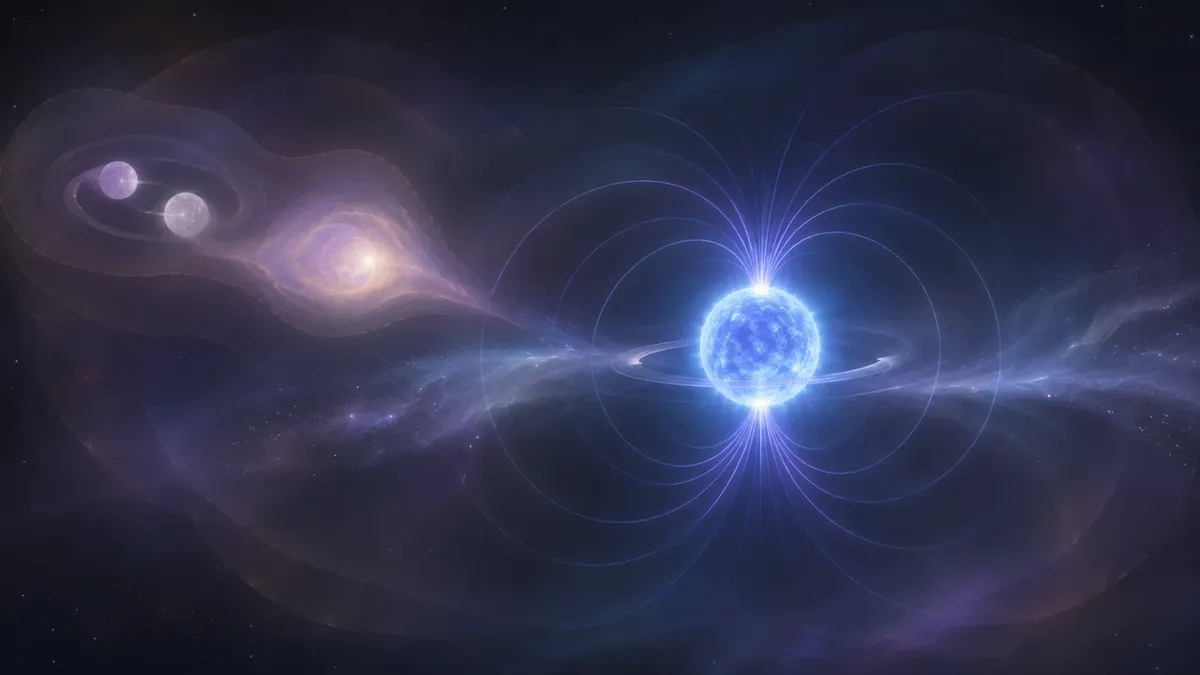
Merging helium-core white dwarfs can leave a star with substantial angular momentum. Some apparently single hot subdwarfs nevertheless rotate slowly—especially helium-poor sdB stars. New stellar-evolution models test whether magnetic fields and stellar winds could help explain that pattern, while showing how uncertain wind strength affects the answer.
A merger of two helium-core white dwarfs can leave a compact, hot star with helium burning in its core. The merger’s orbital motion carries angular momentum, so a remnant might be expected to spin quickly. Yet many apparently single, helium-poor sdB stars are observed to rotate slowly. Could magnetic fields help explain the difference between the spin a merger might supply and the rotation seen later?
Facundo D. Moyano and colleagues explored this possibility with stellar-evolution models. Their proposal is magnetic braking: magnetic fields can exert torques through a star’s wind, allowing the escaping material to carry angular momentum away. The calculations test whether that process, alongside other angular-momentum losses, could leave merger remnants rotating slowly during their hot-subdwarf phase. This is a proposed explanation, not a direct measurement of braking in an individual star.
Following two modeled remnants
The researchers used the MESA stellar-evolution code to evolve two model remnants, with masses of 0.5 and 0.7 times the Sun’s mass. Their initial structures and angular-momentum profiles came from earlier simulations of white-dwarf mergers and their immediate aftermath. The new calculations added magnetic torques that move angular momentum within the star and a prescription for angular momentum lost through magnetized winds.
They tested different magnetic-field strengths and two prescriptions for stellar mass loss, then compared the resulting rotation with spectroscopic measurements and rotation rates inferred from stellar pulsations. The models are one-dimensional approximations of a complex process. In particular, the wind-torque prescription is formally for a dipole field aligned with the rotation axis. The authors also distribute the braking torque through the star using a parameterized approach that they explicitly say has no physical basis.
Results depend on the star and its wind
The models do not predict the same rotation for every hot subdwarf. Helium-rich He-sdO stars and helium-poor sdB stars have different model setups and comparisons. In the adopted Krtička wind models, the paper’s conclusion is that He-sdO remnants can be slowly rotating at surface fields of about 50 kilogauss or more. For the 0.7-solar-mass He-sdO model, the paper reports low surface rotation at roughly 50–100 kilogauss; the 0.5-solar-mass model can reach low rotation with a field as weak as 1 kilogauss under those assumptions. At 500 kilogauss, modeled surface speeds can fall to about 0.1 kilometres per second. These are calculated outcomes, not measured rotation speeds for a sample of stars.
For hydrogen-rich sdB models, the authors find that fields of about 5–10 kilogauss can reproduce low spectroscopic surface rotation. Models with fields of 20–40 kilogauss are compared with measured sdB core and envelope rotation rates from asteroseismology. But those models reach nearly rigid rotation by the hot-subdwarf phase. If substantial core-to-surface differential rotation is confirmed in apparently single sdB stars, that would challenge this part of the scenario.
The wind assumptions are a major source of uncertainty. The two mass-loss prescriptions can differ by as much as four orders of magnitude during core-helium burning. The Vink prescription gives higher mass-loss rates than the Krtička prescription in the comparison discussed by the authors, producing stronger braking and, in some models, allowing slow rotation with weaker fields. Thus, field thresholds cannot be interpreted independently of the chosen wind prescription.
Angular momentum can also be lost through centrifugal mass loss when a model reaches critical rotation. For one illustrated 0.5-solar-mass model with a 100-kilogauss field, the authors report that 99% of its initial angular momentum is lost before helium flashes begin. That figure describes this particular model, not every merger remnant. The assumed hydrogen content also matters, and some envelope compositions in the calculations are inputs rather than established outcomes of mergers.
A testable but unsettled explanation
The paper discusses asteroseismic magnetic-field limits that are lower than fields required by some of its models. It cautions that both the field estimates and the model requirements have uncertainties, including uncertainties in winds and envelope composition. The comparison therefore does not settle whether magnetic fields explain slow sdB rotation.
The broader result is conditional: magnetic braking could contribute to slow rotation if merger remnants retain suitable large-scale fields and their winds remove enough angular momentum. Better measurements of winds, magnetic fields, and internal rotation could test the idea. The source is an arXiv preprint; its text reports acceptance by Monthly Notices of the Royal Astronomical Society, but this account is based on the supplied preprint and does not independently verify publication status. Its conclusions come from models, not an observational demonstration that this mechanism explains the population.
- hot subdwarf stars
- stellar mergers
- magnetic braking
- stellar rotation
- stellar winds
- asteroseismology
Related reading
Automatically matched by shared topic keywords. These links do not imply that the sources agree or establish a consensus.
Listening to stellar pulses puts new limits on hidden magnetism
Source published
Shared keywords: hot subdwarf stars
Did two stars become one? Clues from the heaviest white dwarfs
Source published
Shared keywords: stellar mergers
White dwarf brightness offers clues to AM CVn evolution
Source published
Shared keywords: magnetic braking
Merging stars could give newborn black holes a faster spin
Source published
Shared keywords: stellar mergers
A newborn star’s disc moves gas inward and outward in stacked layers
Source published
Shared keywords: magnetic braking