TRANSMISSION // 2610.19567v2
A better way to read gas flows in barred galaxies
Source published
Simulations show why gas streaming around galactic bars can fool standard velocity models—and introduce a method designed to capture its sharp, shock-shaped motions.
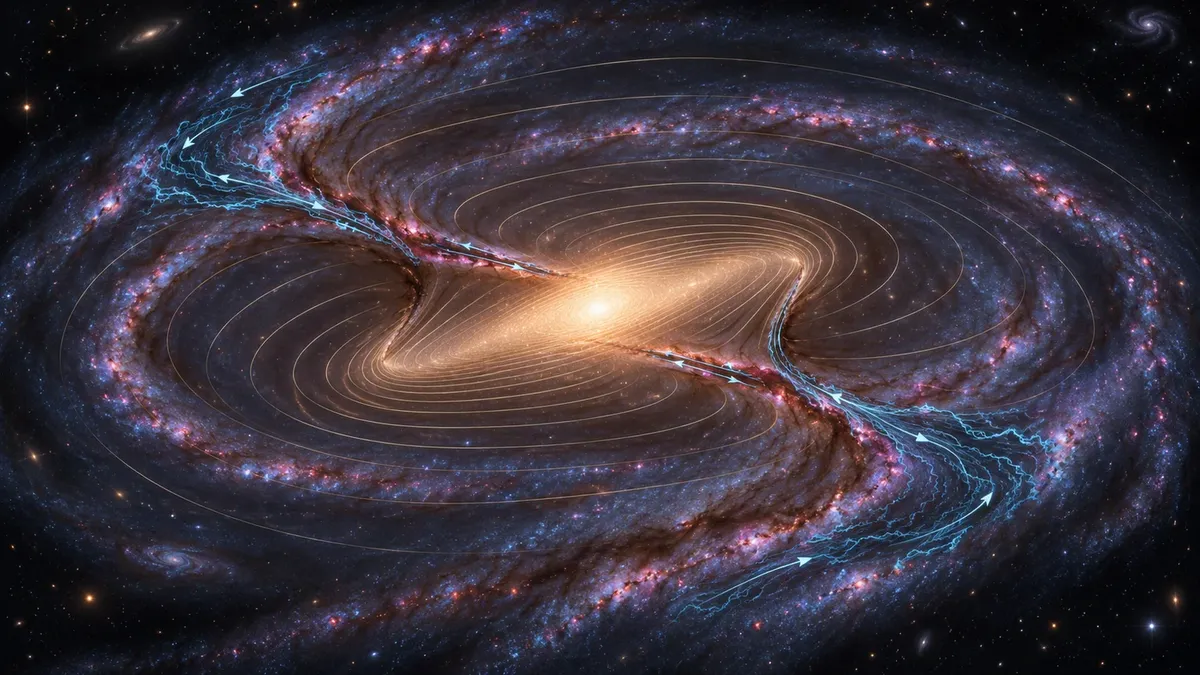
A galaxy’s bar can drive gas inward, but the resulting motions are not always smooth. In simulations of Milky Way-like galaxies, researchers find that cold and warm gas follow sharply changing paths near shocks, unlike the smoother average motion of stars. Their new “barflow” model is designed to account for those differences when interpreting observed velocities.
A stellar bar is an elongated structure that crosses the center of many disk galaxies. Its gravity can redirect gas, sometimes carrying it toward the galactic center. But astronomers do not observe a galaxy’s full motion directly: a telescope measures the part of the motion toward or away from us. Recovering the gas’s actual movement across the disk therefore requires a model—and a model that assumes the wrong kind of motion can misestimate both rotation and inflow.
In Barflow: Modeling Gas Kinematics of Bar-Driven Flows, Seungwon Baek and colleagues investigate how gas moves in barred galaxies and whether a commonly used velocity model can describe it. Their proposed alternative, called barflow, is built to represent gas motions that change sharply around shocks along a bar.
Simulated galaxies, changing gas content
The team ran self-consistent computer simulations of isolated, Milky Way-like galaxies containing stars, dark matter and, in some cases, gas. They varied the initial gas fraction from zero to 20 percent of the disk’s mass, while keeping the total disk mass fixed. The simulations included processes such as gas cooling, star formation and feedback from supernovae.
To examine the model’s performance, the researchers also created a mock observation of gas in one simulated galaxy. They projected its motions onto a line of sight, blurred the map to represent limited image resolution and fitted the result using both barflow and a conventional “bisymmetric” model. That standard approach represents bar-related velocity changes as smooth, repeating waves with a single phase angle. The mock observation had no added random measurement noise, and the fits used the simulation’s known viewing geometry.
Gas changes the bar—and moves differently from stars
In these simulations, adding gas delayed the formation of a stellar bar. The most gas-rich model did not form one during the simulated period. The authors attribute this outcome to a combination of stronger multi-armed spiral patterns and early gas inflow that increased the mass concentrated near the galaxy’s center. In models where bars did form, continued inflow and gravitational interactions between gas and the bar weakened the bar and limited its slowing and growth. The gas-bearing models generally remained in the “fast-bar” category, while the gas-free bar evolved into the “slow-bar” category.
The simulations also reveal why a smooth velocity formula can be a poor fit for gas. Stars and gas respond differently to the same bar. Averaged over many stellar orbits, the stellar velocity field looks relatively smooth and is reasonably described by the conventional bisymmetric pattern. Cold and warm gas, by contrast, follows elongated paths and encounters shocks along the bar’s leading edges. Its radial motion can change abruptly, producing a sawtooth-like pattern; its tangential motion forms a more arch-like pattern. The location of these features shifts with distance from the center as the shock lanes curve.
Hot gas behaves differently again: stellar feedback and thermal pressure largely separate its motion from the ordered flow driven by the bar. Meanwhile, the average tangential speeds of cold and warm gas track the simulated circular speed over much of the disk. That does not mean the gas follows circular paths: strong local motions can coexist with an average rotation speed close to the circular speed.
A more flexible fit, with important limits
Barflow represents the gas’s uneven velocity patterns and allows the phase associated with the shock front to vary with radius. In the controlled mock observation, it recovered the simulated rotation curve, velocity perturbations and inward gas transport more accurately than the bisymmetric model. The standard model left coherent mismatches around the bar and shocks and, in this test, overestimated the magnitude of radial transport.
These results are promising, but they are not yet a demonstration on real galaxies. The main comparison uses one simulated gas component and a deliberately controlled mock observation without measurement noise. Barflow also has more adjustable parameters than the conventional model, and the authors find that recovery depends on viewing angle and image resolution. They caution that the model is not designed to isolate bar-driven motion where tidal disturbances, lopsided gas, outflows or other processes strongly affect the velocity field. In particular, outward and net gas transport can be harder to recover when feedback-driven motions contribute substantially.
The study is available as an arXiv preprint, a manuscript that may not have completed peer review. The authors’ next step is to apply barflow to observations of nearby barred galaxies. Until then, its advantage is established in simulations and mock data—not as a universal correction for every barred galaxy.
- galaxy bars
- gas kinematics
- galaxy simulations
- barflow model
- gas inflow
- astronomy
Reviewed cross-references
These connections were reviewed by a model, not independently fact-checked by a human. Similarity does not imply agreement; consult the original papers and the evidence below.
In Circinus, gas inflow may help power a compact starburst
Supporting evidence: Baek et al. find in isolated-galaxy simulations that bars drive gas inflow; Vollmer et al. model gas feeding toward Circinus’s nucleus and suggest that variations in inflow may relate to its nested spirals. Both connect non-axisymmetric structure with inward gas transport, but the studies address different scales and use different methods, and the Circinus link is suggested rather than established as a barflow result.
Model review: · openai-codex/gpt-6-luna
Evidence and provenance
Selected excerpts, not complete papers. PDF extraction can omit figures or damage equations, tables and reading order; sources may be preprints.
2610.19567v2 — Original paper
Excerpt reference:
static/papers/2610.19567v2.md:12-62
Basis: Paper text
Source SHA-256:4501badf4e91a1b2ebbd662193704c84eea023bab9322fd204d64d1f2db2226e2611.27419v1 — Original paper
Excerpt reference:
static/papers/2611.27419v1.md:18-70
Basis: Paper text
Source SHA-256:9cbb9558fd006f5fa1eede04023f831ca9f1cfcb7ab7225fa39d148cc3e92afb2611.27419v1 — Original paper
Excerpt reference:
static/papers/2611.27419v1.md:128-190
Basis: Paper text
Source SHA-256:9cbb9558fd006f5fa1eede04023f831ca9f1cfcb7ab7225fa39d148cc3e92afb
Related reading
Automatically matched by shared topic keywords. These links do not imply that the sources agree or establish a consensus.
Dwarf-galaxy simulations find supernova energy matters more than failure rates
Source published
Shared keywords: galaxy simulations
Webb maps gas and stars moving differently around faint active black holes
Source published
Shared keywords: gas kinematics
A passing star can make a planet-forming disc look more warped than it is
Source published
Shared keywords: gas kinematics
Three black holes, changing partners: a new model follows mergers inside simulated galaxies
Source published
Shared keywords: galaxy simulations
WISPIT 2’s gas shows clues near known planets
Source published
Shared keywords: gas kinematics