TRANSMISSION // 2610.19517v2
How a robot can learn from its own attempts
Source published
VLRLA lets vision-language-action robots use past actions and rewards to guide later behavior without changing model parameters during deployment. Early tests show promise, with important limits.
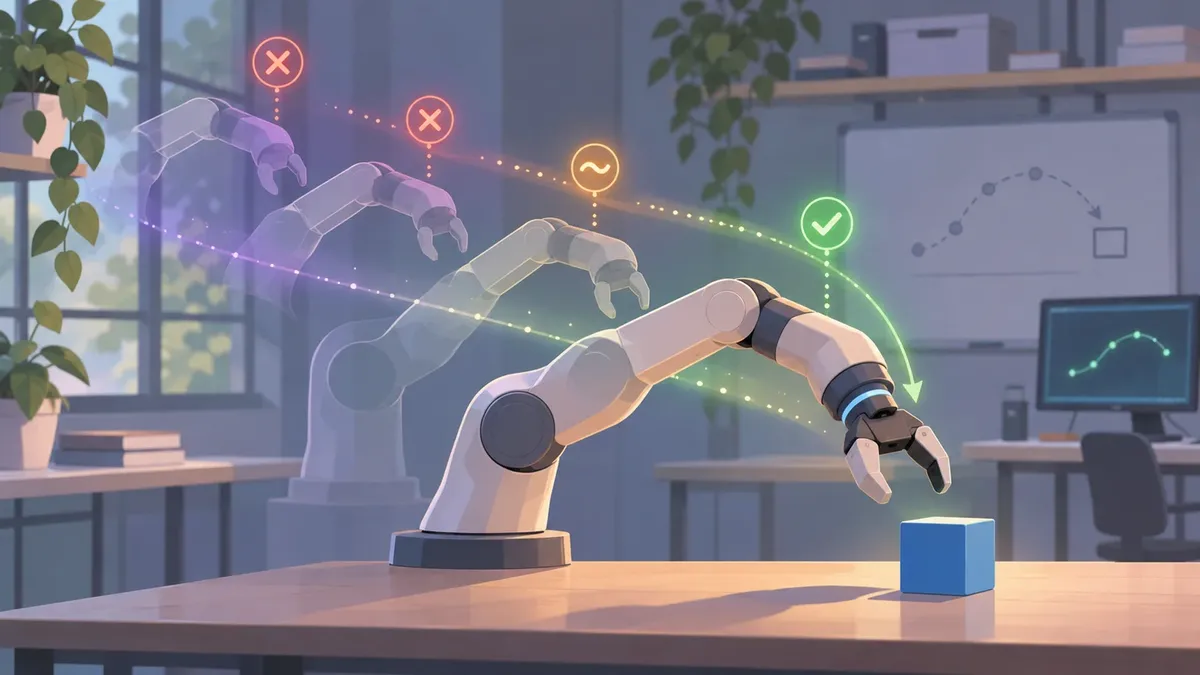
A robot may follow instructions well yet struggle when the camera angle, object or task setup changes. VLRLA aims to help by letting it use feedback from earlier attempts to guide later ones—without updating its model parameters during deployment.
The question: can a robot improve without retraining?
Vision-language-action (VLA) models connect camera observations and natural-language instructions to robot actions. But a policy trained on demonstrations may not know how to adjust when it encounters an unfamiliar setup. Updating a model with new data can take time and computing resources, and may require human involvement.
In an arXiv preprint, Diyuan Shi and colleagues introduce VLRLA, a framework for deployment-time adaptation. Its central idea is to condition a robot’s next action on a record of earlier observations, actions, rewards and episode endings. The model’s parameters stay fixed during deployment; a learned adaptation module uses interaction history to influence behavior.
How the framework works
The authors describe two versions. VLRLA-simp uses a frozen visual-language encoder and a trainable recurrent action module to produce actions. VLRLA-bridge keeps both a pretrained encoder and action expert, adding a trainable module that modifies the expert’s internal representations using past interactions. The bridge version is designed for more complex tasks and real-world deployment.
The system needs examples of how behavior changes as experience accumulates. The paper explores three ways to build these learning histories: ordered reinforcement-learning rollouts in simulation; sequences ordered from unassisted robot attempts through partial human corrections to almost entirely human demonstrations; and relabeled demonstrations for a task with an intentionally underspecified instruction. In that last setup, rewards provide clues to the robot about the intended target across episodes.
At deployment, the policy can use accumulated history across episodes of a task. Here, “learning” means using experience in context—not changing the model’s stored parameters online.
What the tests found
In the RoboTwin simulation benchmark, the paper reports results for six seen and six unseen tasks. Across those tasks, VLRLA-bridge’s overall average success rate was 63.4%, compared with 50.9% for the starting π0.5 policy. The authors report gains over that starting policy on each task in the table. This does not mean VLRLA succeeds on every attempt or leads every comparison: on the six unseen tasks, GRPO’s average was slightly higher. The paper also describes success-rate evaluations across 128 randomized environment instances; its separate adaptation experiments use other protocols.
Other simulation experiments suggest that history matters. In one test, zeroing the history memory left success near zero; repeating the same old history produced an initial improvement but not continued gains. The authors also report that transferring history between rollouts of the same task improved initial performance in two tested tasks. These focused results do not show that arbitrary past experience will transfer to a different task.
The real-robot tests covered fruit placement and a task where reward feedback helped resolve an underspecified instruction. For apples and starfruit, performance increased over successive episodes; grape results fluctuated. In another test, a red pepper and metal pot were not present in the training data. The paper reports that VLRLA outperformed the π0.5 baseline in its evaluation of this setting, which involved 25 runs; the excerpt provides no uncertainty estimate for that comparison. In the feedback task, the robot had to infer which of two plates was the target from rewards across episodes. The paper reports rising success after the first episode.
What remains uncertain
These results come from particular robots, objects, tasks and training procedures. They cannot establish how well the method would work across homes, factories or unexpected failures. Some real-world evaluations are small, and the authors note inconsistent performance for one fruit. Simulation findings also depend on benchmark and implementation choices: the paper identifies a constrained representation interface as a possible contributor to weaker performance with one backbone on one task.
VLRLA requires a trained adaptation module and constructed learning histories. The paper includes a sample-efficiency comparison, rating VLRLA-bridge and RoboTTT as moderate and GRPO as low in that comparison. This does not establish a general efficiency advantage across settings or alternatives. Although VLRLA’s parameters remain fixed during deployment, training is still required beforehand.
This article is based on the authors’ arXiv preprint, not an independent replication or a peer-reviewed assessment. The findings are evidence that history-conditioned adaptation can work in the settings tested—not proof of general-purpose robot self-improvement.
- robotics
- vision-language-action models
- reinforcement learning
- robot adaptation
- in-context learning
- robot manipulation
Reviewed cross-references
These connections were reviewed by a model, not independently fact-checked by a human. Similarity does not imply agreement; consult the original papers and the evidence below.
A critic helps robot policies learn from logged experience
Supporting evidence: Both papers report improved task outcomes using collected robot experience, but by different routes: VLRLA conditions actions on accumulated interaction history with model parameters fixed, while OVOGO trains from a fixed offline dataset and optimizes the action expert. This supports only the bounded observation that experience-based adaptation improved outcomes in these reported evaluations; their methods and evaluation conditions differ.
Model review: · openai-codex/gpt-6-luna
Evidence and provenance
Selected excerpts, not complete papers. PDF extraction can omit figures or damage equations, tables and reading order; sources may be preprints.
2610.19517v2 — Original paper
Excerpt reference:
static/papers/2610.19517v2.md:62-109
Basis: Paper text
Source SHA-256:43123c92b46b50ec8e840300c38623b7a1a0797c88f64bc91cd86a02962b5d172610.19517v2 — Original paper
Excerpt reference:
static/papers/2610.19517v2.md:740-797
Basis: Paper text
Source SHA-256:43123c92b46b50ec8e840300c38623b7a1a0797c88f64bc91cd86a02962b5d172611.30477v1 — Original paper
Excerpt reference:
static/papers/2611.30477v1.md:926-1001
Basis: Paper text
Source SHA-256:61f0cf0bba8f3260dd7364c5d81d69d664227bd11c64de779ab022ae74f535d8
Related reading
Automatically matched by shared topic keywords. These links do not imply that the sources agree or establish a consensus.
How Robot Memory Can Guide the Next Move
Source published
Shared keywords: in context learning, robot manipulation, vision language action models
A robot plan that knows what remains—and when to consult a demonstration
Source published
Shared keywords: in context learning, robot manipulation, vision language action models
When a robot misses a grasp, force feedback can cue a retry
Source published
Shared keywords: reinforcement learning, robot manipulation, vision language action models
Teaching robot actions to stay on track—and gentle
Source published
Shared keywords: reinforcement learning, robot manipulation
Can a Robot Learn a New Task by Watching One Video?
Source published
Shared keywords: in context learning, robot manipulation