TRANSMISSION // 2610.19054v2
A visual map for mixed quantum states
Source published
Generalized BEADS uses spherical functions called beads to depict correlation structures in mixed quantum states, separating contributions such as classical correlations and multipartite entanglement.
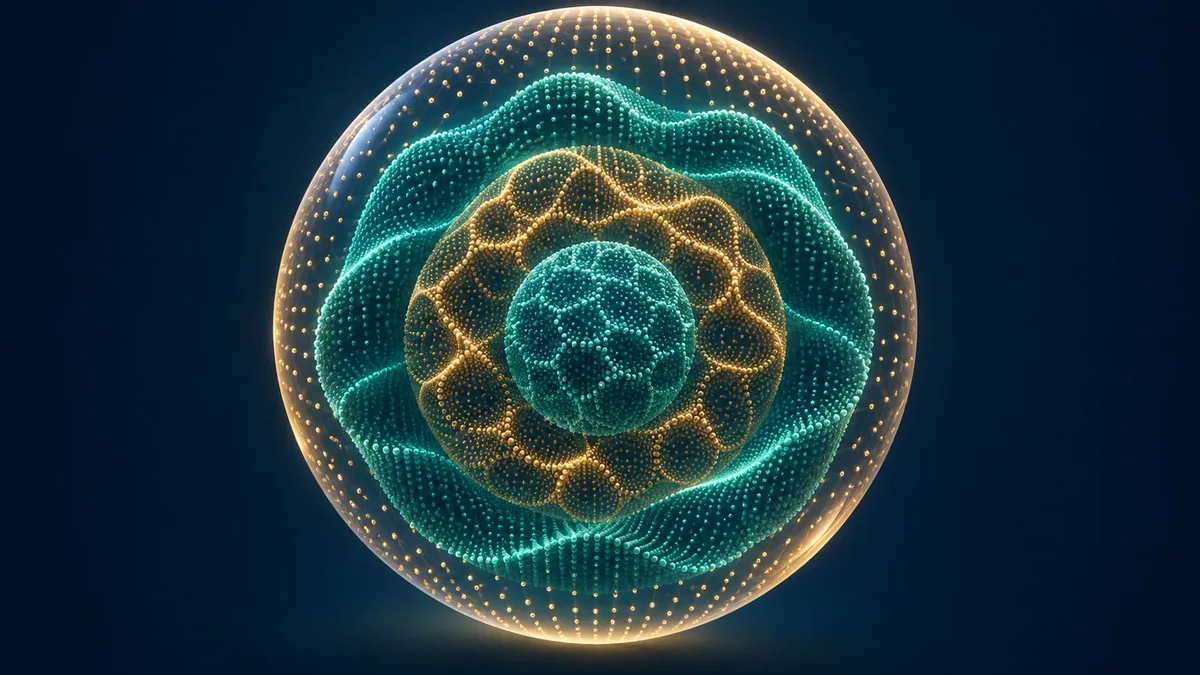
Quantum information theory can describe states and correlations with mathematical formalisms that are difficult to picture. Generalized BEADS extends an earlier visualization for pure states to mixed quantum states, aiming to make different correlation structures visible.
A visual language for correlations
Celina Bräutigam, Steffen J. Glaser and Dennis Huber present the generalized BEADS representation, an extension of an existing approach for visualizing pure quantum states. Their focus is mixed quantum states and the challenge of showing the correlations they contain in an informationally complete way.
The representation uses spherical functions called “beads.” The authors say these encode correlation structures for an N-qubit state. Here, “informationally complete” describes the intended scope of the representation; the abstract does not give enough detail to assess how that property is established or how readily people can interpret the resulting visuals.
Separating kinds of correlation
To construct the representation, the authors use a recursive optimization scheme to obtain minimum-entanglement pure-state decompositions of all subsystems of a given state. The abstract does not provide the mathematical details or explain the optimization procedure further, so its practical demands and behavior cannot be assessed from the available evidence.
The authors also describe decomposing correlation-function components into contributions associated with different kinds of correlation. These include total correlation, genuine multipartite entanglement, nonclassical correlations of the quantum-discord type, and classical correlations. The purpose is to make these categories visually distinguishable rather than treating correlation as a single undifferentiated feature.
A further contribution is a new quantifier for W-type entanglement, intended to identify states in the W class. The abstract does not state the quantifier’s formula or provide results that would allow its performance to be evaluated.
Examples, and what remains uncertain
The paper examines generalized BEADS representations for product, classically correlated, separable but nonclassically correlated, and entangled states. It also presents entanglement distillation and noise channels as example applications. The abstract names these cases but gives no quantitative findings or detailed demonstrations of what the visuals reveal in them.
The proposal is a visualization framework, not evidence by itself that the approach is easier to use or offers a practical advantage. Those questions would require the full mathematical account and assessment of the examples. This article is based on the paper’s abstract alone: equations, figures, quantitative results and detailed limitations were not available in the supplied evidence. The source is an arXiv preprint, and the supplied information does not establish whether it has been peer reviewed. Accordingly, the method’s operation and the proposed W-type quantifier cannot be independently assessed here.
- quantum information
- mixed quantum states
- quantum correlations
- multipartite entanglement
- BEADS representation
Related reading
Automatically matched by shared topic keywords. These links do not imply that the sources agree or establish a consensus.
New tools for studying three-way quantum entanglement
Source published
Shared keywords: multipartite entanglement, quantum information
A unified way to measure quantum entanglement
Source published
Shared keywords: quantum information
How phase and spin–orbit interaction shape qubit correlations
Source published
Shared keywords: quantum correlations, quantum information
How much quantum source is needed to reproduce correlations?
Source published
Shared keywords: quantum correlations, quantum information
Quantum correlations in a Higgs decay
Source published
Shared keywords: quantum correlations